Luxury Brands of Ancient Rome | 10:13
toldinstone | 652K subscribers | 18,829 views | October 10, 2026
Posted on 10/12/2026 5:01:18 PM PDT by SunkenCiv
Luxury Brands of Ancient Rome | 10:13
toldinstone | 652K subscribers | 18,829 views | October 10, 2026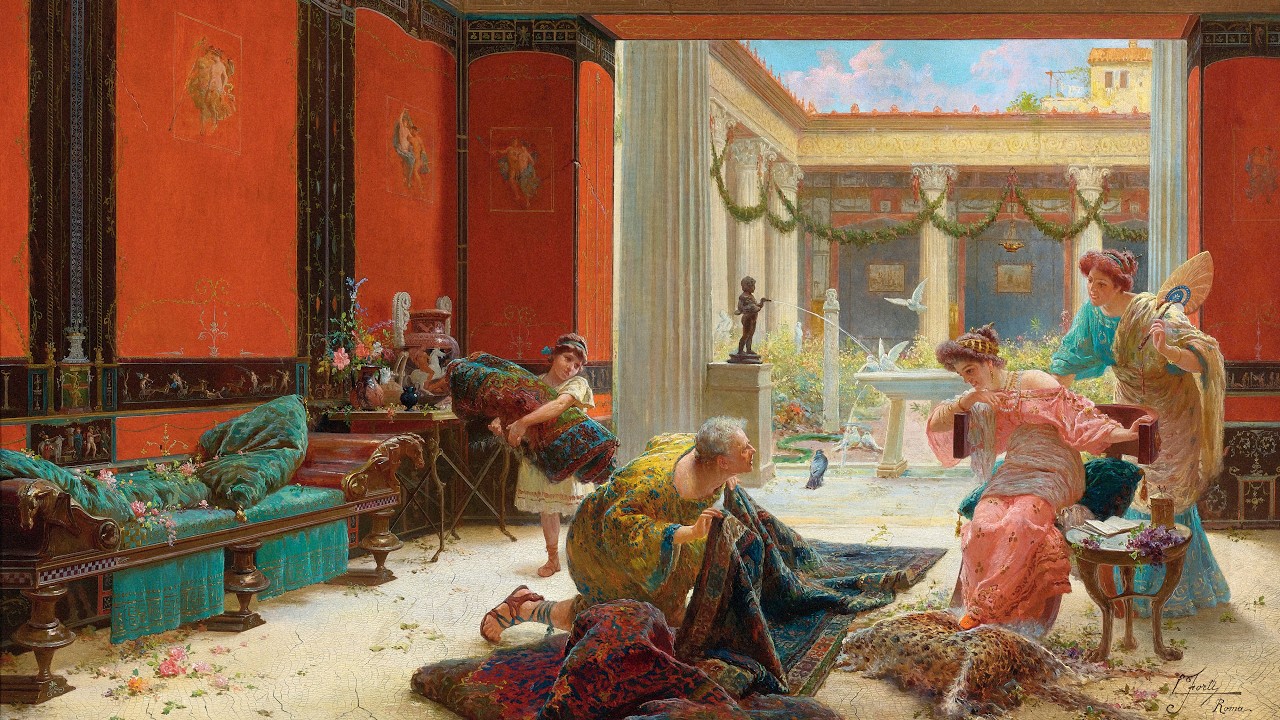
(Excerpt) Read more at youtube.com ...
Dear FRiends,
We need your continuing support to keep FR funded. Your donations are our sole source of funding. No sugar daddies, no advertisers, no paid memberships, no commercial sales, no gimmicks, no tax subsidies. No spam, no pop-ups, no ad trackers.
If you enjoy using FR and agree it's a worthwhile endeavor, please consider making a contribution today:
Click here: to donate by Credit Card
Or here: to donate by PayPal
Or by mail to: Free Republic, LLC - PO Box 9771 - Fresno, CA 93794
Thank you very much and God bless you,
Jim
The transcript -- some fine country craftsmanship, BTW -- will follow.
Transcript
Chapter 1: The scale of Roman production
This nail was forged in the Roman legionary fort at Inchtuthil, just below the Scottish Highlands. Buried in a pit when the fort was abandoned, it was discovered in 1960 with nearly a million other nails — a testament to Roman mass production. Although most Roman craftsmen worked in small workshops, the size of the empire encouraged the large-scale manufacture and distribution of certain goods. The technology involved remained pre-industrial, and few ancient enterprises approached the scale of a modern corporation. But factories, trademarks, and brand competition were all aspects of the Roman economy.
Chapter 2: State-run imperial enterprise
The largest commercial enterprises in the Roman world were associated with the imperial government. In late antiquity, the arms and armor of the legions were produced in 35 state-run factories. Some of these facilities made both shields and weapons; others specialized in breastplates, arrows, horse armor, or ballistae. Though staffed by civilian craftsmen, they were overseen by minor bureaucrats. The emperors also owned a vast network of quarries, some worked by condemned prisoners under military surveillance. Marble and granite columns, cut to standard lengths, were sent by the hundreds to Rome and other major cities. So were sarcophagi and copies of famous statues. To avoid damage in transit, sculptures were usually shipped with their details only roughed out; some sarcophagi have been found with the faces of their occupants still unfinished. Many other imperial enterprises achieved impressive economies of scale.
Chapter 3: Aristocratic economic empires
From the reign of Septimius Severus onward, Rome’s famous grain dole — which fed 200,000 people — was distributed as bread from state-run bakeries. To process the grain, the emperors built a network of mills powered by the aqueducts and overflow from the baths. The wealthiest Roman aristocrats had economic empires of their own, staffed by skilled slaves and freedmen. The late republican mogul Crassus famously organized brigades of enslaved firemen, builders, and artisans. To supply Rome’s boundless appetite for building materials, families with estates near the capital produced bricks and tiles in standard sizes, stamped with the date and place of manufacture. Some clay pits employed several hundred workers, and produced bricks by the tens of thousands. Their products were shipped as far as North Africa.
Chapter 4: Resource processing and trade
In the western provinces, wealthy landowners with properties on the Mediterranean coast established salting facilities to take advantage of seasonal fish migrations. Besides salted fish, they produced garum, the famous fermented fish sauce. A factory at Troia, in what is now Portugal, had no fewer than 19 huge processing tanks, with a total capacity of more than 600 cubic meters — enough to salt tens of thousands of fish at once. In North Africa and southern Spain, aristocrats developed olive plantations to produce oil for export. Worked by a combination of slave and free labor, these estates sometimes featured factory-like structures with batteries of presses and cavernous storerooms. Rome’s Monte Testaccio — discussed in one of my older videos — is made up of more than 50 million oil amphorae from Spain.
Chapter 5: Industrial ceramic pottery
Although elite families dominated the production of raw materials, some of the Roman Empire’s most famous brands were created by craftsmen of humbler origins. During the reign of Augustus, Italian terra sigillata — a red, glossy, mold-made pottery sold from Britain to India — was produced on an industrial scale in and around the Tuscan city of Arezzo. Stamps pressed into the clay before firing allow us to identify several dozen workshops. The largest employed at least 60 craftsmen, all probably highly-trained slaves. A few owners opened branch workshops in Gaul. Over the course of the first century, Gaul became the primary center of terra sigillata production. Excavations at La Graufesenque, in what is now southern France, have revealed kilns in which up to 35,000 vessels could be fired simultaneously — a level of production that would not be equaled until the nineteenth century.
Chapter 6: Glassware and craftsmanship
Glass-blowing, invented somewhere in the eastern Roman provinces during the first century BC, spread rapidly through the empire. Though never on the scale of ceramic production, more glass was made in the early imperial era than at any time before the fifteenth century. A craftsman named Ennion, probably working in the city of Sidon, produced signed pieces of decorated mold-blow glass that circulated throughout the provinces as luxury objects. About fifty of his vessels still exist, found at sites from Spain to Israel. Ennion’s success inspired a series of imitators, who tried to copy the forms and replicate the success of his glassware.
Chapter 7: Sponsorship and history
[ad text redacted]
Chapter 8: Brands and advertising
Returning to our topic. Roman craftsmen understood the importance of trademarks. Glassmakers in Cologne, for example, marked their products with an ornamental line of colored glass — the so-called “Cologne squiggle”. Other Roman brands appear in the archaeological record. Fibulae made by the Aucissa firm, for example, have been found from Gaul to the Black Sea. At Vindolanda, a luxury slipper — made in Gaul by Lucius Aebutius Thales — was discovered in the ruins of the headquarters complex. It was likely worn by the commanding officer’s wife. Roman businessmen advertised as aggressively as their modern counterparts. Aulus Umbricius Scaurus, the garum king of Pompeii, controlled at least half a dozen shops in the city and resided in a mansion splashed with images of his “high-quality mackerel garum.” Several amphorae found in Pompeii were labelled “Vesuvinum” — a portmanteau of the words for Vesuvius and wine.
Chapter 9: Competition and decline
Archaeologically, competition between firms is visible through the growing or receding presence Italy — were sold throughout the western provinces in the first century. Gradually, however, their market share was eclipsed by local knock-offs that sometimes even copied the Fortis trademark. In late antiquity, likewise, the fashionable vases made by the workshop of Navigius gradually displaced those produced by a series of rival potteries across North Africa. The last pots fired in the kilns at La Graufesenque were poorly-made and crudely decorated, apparently because a fall in prices brought about by a crowded market forced the manufacturers to speed up production.
Chapter 10: Legacy of Roman capitalism
The Romans were never close to an Industrial Revolution. Unlike eighteenth-century Britain, the Roman Empire had neither a class of entrepreneurs ready to invest in innovative technologies nor any industry that rewarded such investment. But to a greater degree than any other preindustrial society, the Romans mass-produced inexpensive goods, established luxury brands that were recognized across three continents, and prefigured the trade wars of modern capitalism.
[product plugs redacted]
Next April, you can join me in Tunisia, where we’ll explore Carthage, Dougga, and a host of other sites. In June, I’m going to Romania, to see some of the Roman world’s most spectacular and seldom-visited ruins. Learn more about these and my other upcoming trips by following the links in the description. My new book — Leaky Aqueducts, Battle Pigeons, and Mystery Cults — is now available in both print and audio. You’ll find additional content — including the next episode in my epic review of HBO’s Rome — on the Toldinstone Patreon. Finally, don’t forget my other channels, Toldinstone Footnotes and Scenic Routes to the Past. Thanks for watching!
In the era before clocks, how do you suppose the workmen at the factories and quarries knew when to arise? What roused them from slumber? What was their commute like? Did they have time cards? What was the penalty for chronic tardiness?
I suppose slaves were kept in slave quarters and that took care of all such problems. But were free men working in the factories, too?
Did the bosses commute to work in chariots?
I wonder how all that was structured...all the myriad details of modern life we just take for granted. Of course, the first commercially successful factory time clock to punch workers in and out is only 140 years old.
Sand dial, or perhaps a water clock
Plain evidence that capitalism is not the accumulation of wealth for the sake of a privileged class as the socialists love to preach, but the natural process that enables civilizations to advance while helping all of society.
This generation of youth has been severely short-changed educationally to believe otherwise.
Get ‘em right here in your local Pompeii market. It’s hot and we’re shakin’
Many intricately carved golden (color) sundials! There’s no time like the ‘I’m better than you’ time.
Free grapes card at local market in Herculaneum where you know Vesuvius makes the grapes grow best! Get in on it while it lasts in lovely 78.5 AD!
Wine from Emperor Caligula’s over stock! (pay no attention to those who say it causes stomach aches).
Exotic wood four poster lectus bed featuring carved Roman eagles on top of the posts! Buy Roman!
Beautiful young female slaves from Greece who speak three languages...Latin, Greek and the language of love!
(P.S. Beauty is in the eye of the beholder).
It’s all here in your local Roman luxury marketplace on the widest street in Pompeii...
We live in the era of the greatest abundance of material wealth in all of man’s history, the highest standards of living in all history, more leisure time than ever before. Most people are freed from the 6 days a week of heavy physical toil and labor. All of these are “gifts” from people pursuing their own person goals, aspirations and dreams in life.
But, with all that, they have some mysterious, vague, deep unappreciation of it all. They cannot articulate what they do not lot like other than “unaffordable,” “oligarchs,” and “income inequality.” And “Orange Man Bad,” of course.
If the boss was in Italy, Rome especially, good chance that he walked to work. No matter how far across the city.
There are a number of commentaries that talked about how much Romans of all classes walked.


Seriously though, you are right that we live better than anyone ever has before yet teeter on the brink of ruination because of one generation's perceived inconveniences.
That saying about how we can vote in socialism but we'd have to shoot our way out of it keeps persisting in my mind like a bad song I'd like to forget.
Being an early riser was probably a positive for career advancement. In the finer homes, there was always someone awake, probably more than one, keeping watch, and they would wake their relief.
Very likely just as in ancient times, my neighbor and I awaken to his roosters.
sculptures were usually shipped with their details only roughed out; some sarcophagi have been found with the faces of their occupants still unfinished.
Sorta like IKEA...DIY instant art...
In our own colonial period, the limner painters kept a bunch of ‘portraits’ on hand, which they’d paint when they didn’t any jobs on deck, then would paint in the detailed face of a customer. Great way to simplify production in a low-volume, potentially high-margin biz.
Ages ago a humanities prof showed us a whole series of slides of such works, which are mostly unattributed (unsigned, unknown artists), including one that, in recent years, I found out was one of my ancestors, hilarious.
Did they have Nike and UnderArmour? Luis Vetron? Or Coach?
Disclaimer: Opinions posted on Free Republic are those of the individual posters and do not necessarily represent the opinion of Free Republic or its management. All materials posted herein are protected by copyright law and the exemption for fair use of copyrighted works.
