Skip to comments.
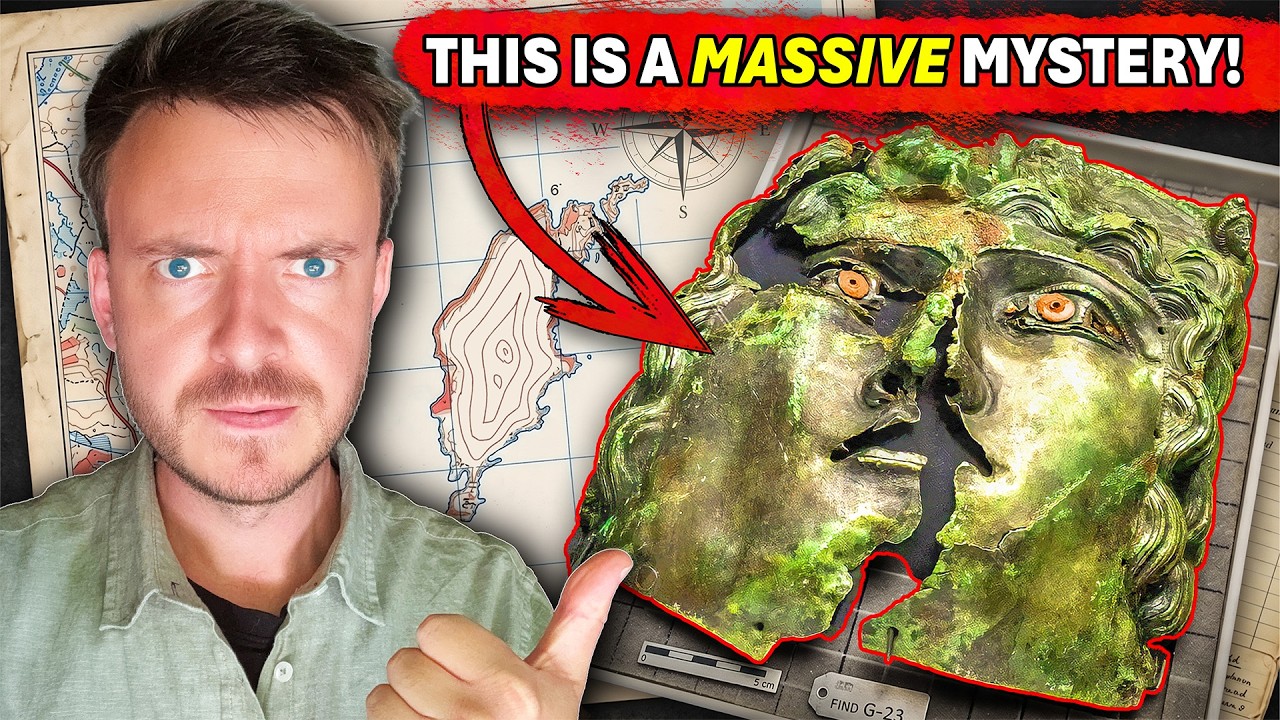
A Roman Mask BURIED on a Remote Viking Island... but why? [6:14]
YouTube ^
| August 13, 2026
| Adam Morgan Ibbotson
Posted on 08/17/2026 11:20:45 AM PDT by SunkenCiv
A Roman cavalry mask. Found on the remote Baltic island of Gotland. Altered centuries later, with its right eye deliberately removed and buried beneath a longhouse -- possibly echoing Odin's sacrifice of his eye for knowledge. But why was a Roman object, made hundreds of miles away, being ritually transformed in Scandinavia? And what does it have to do with Sutton Hoo, Anglo-Saxon England, Viking helmets and the strange movement of Roman culture across Europe? The Hellvi Mask may be one of the missing links between Rome, Scandinavia and the warrior culture of early medieval Britain. A Roman Mask BURIED on a Remote Viking Island... but why? | 6:14
Adam Morgan Ibbotson | 30.8K subscribers | 17,411 views | August 13, 2026
(Excerpt) Read more at youtube.com ...
TOPICS: History; Science; Travel
KEYWORDS: alexanderthegreat; godsgravesglyphs; gotland; middleages; odin; romanempire; vikings
Navigation: use the links below to view more comments.
first 1-20, 21 next last
Pinned by @AdamMorganIbbotson - it's pronounced GOTland. I was trying to match the GOHtland pronunciation of a Swede, but I'm northern English. So I just sound like I'm saying Goat...
YouTube transcript reformatted at textformatter.ai *may* follow.
1
posted on
08/17/2026 11:20:45 AM PDT
by
SunkenCiv
To: SunkenCiv
Well because Rome was there at the time. I remember reading about how Roman soldiers stationed in Scotland would write home (on bark) about the lousy food and weather.
2
posted on
08/17/2026 11:28:15 AM PDT
by
SkyDancer
( ~ Am Yisrael Chai ~)
To: StayAt HomeMother; Ernest_at_the_Beach; 1ofmanyfree; 21twelve; 24Karet; 2ndDivisionVet; 31R1O; ...
Somehow I had started a file about this, must have been in some other video, but hadn't saved it. Just glad that Adam has a new one.

3
posted on
08/17/2026 11:28:15 AM PDT
by
SunkenCiv
(TDS -- it's not just for DNC shills anymore -- oh, wait, yeah it is.)
To: SunkenCiv
But why was a Roman object, made hundreds of miles away, being ritually transformed in Scandinavia?
~~~
Simple explanation.
The Vikings raided many places where the Roman Empire ruled. They took this back as a part of their plunder. Just because there wasn’t a roman city or even encampment left when they were raiding, doesn’t mean there wouldn’t be roman artifacts to take.
4
posted on
08/17/2026 11:32:52 AM PDT
by
z3n
(Kakistocracy)
To: SkyDancer
There was much more Roman activity going on in northern Europe than appears to be generally known. But this was in Gotland, not Scotland. Some sidebars from the FRchives:
5
posted on
08/17/2026 11:34:50 AM PDT
by
SunkenCiv
(TDS -- it's not just for DNC shills anymore -- oh, wait, yeah it is.)
To: SunkenCiv
6
posted on
08/17/2026 11:35:43 AM PDT
by
Red Badger
(Iryna Zarutska, May 22, 2002 Kyiv, Ukraine – August 22, 2025 Charlotte, North Carolina Say her name)
7
posted on
08/17/2026 11:42:44 AM PDT
by
SunkenCiv
(TDS -- it's not just for DNC shills anymore -- oh, wait, yeah it is.)
Transcript
This is the Hellvi Mask, a crushed bronze face found under mysterious circumstances on the Baltic island of Gotland. Although its discovery began with illegal looting, what followed would unravel into one of the strangest and most important stories in the annals of European archaeology, which may be very important to the history of the British Isles and elsewhere.
In the 1980s, a metal detectorist working illegally at the village of Hellvi Norrgårde (nor-gar-de) found a badly corroded bronze object in two pieces. One piece: the left side of a human face; and the other, the right cheek and its temple. Rather than calling up the archaeologists and potentially incriminating themselves, the fragments were instead taken home, where they would remain for decades. Little is known from this point on, but it’s suspected that the finder died sometime around 2009. The bronze pieces then passed on to a family member, who was probably quite alarmed by what they had inherited. So, in the winter of 2010, the pieces were handed to the Gotland County Administrative Board.
Strangely, when handed to archaeologists, they identified the object as a broken Roman cavalry mask, the only example found in Sweden, and only the second known from Scandinavia. The face was likely of Alexander the Great. Within the decorative detailing, Castor and Pollux appeared at the temples; Hercules, carrying his club and the skin of the Nemean lion, on the forehead. Then there were the eyes.
The original mask had open eye sockets for the wearer to, you know, see things. But here, the sockets were filled with separately manufactured metal components made of bronze, silver, and brass. Someone had evidently altered this Roman object after it had reached Gotland. To anyone familiar with Norse mythology, a one-eyed man in Scandinavia should raise eyebrows. But thanks to the tomfoolery of the detectorist, the fragments had no archaeological context. Therefore, there was no way to know where the mask had been kept, what surrounded it, who had owned it, or why the eye had been replaced.
So, in the summer of 2011, several fantastic archaeologists led an excavation at Hellvi. The dig was conducted by a team from the Gotland Museum under the direction of archaeologist Per Viderström, collaborating with Dan Carlsson of ArkeoDok. At the site, they found a large three-aisled longhouse, around thirty metres long, occupied from the Roman era until its destruction in the seventh century, just prior to the Viking Age. Importantly, though, Sweden in the Roman period was not occupied by the Romans. In fact, Gotland was among the most far-flung regions from the Empire.
Near a limestone hearth was a large posthole belonging to one of the building’s roof supports. At its base, embedded in the floor, were several pieces of metal. These fragments proved to be the missing right eye of the mask. The eye had not been lost, after all. Instead, something far stranger had occurred. It had been removed from the mask and, importantly, it had deliberately been deposited beside one of the building’s supports. Nearby, beneath a collapsed wall, excavators found another deposit: the dismantled and folded remains of as many as five Roman drinking horns, together with a Baltic dress pin, silver bracteate, and broken neck ring. This house, on a remote Swedish island, had access to imported and high-status Roman objects.
The mask itself had been made somewhere within the Roman Empire, probably between AD 100 and 250. It was a ceremonial object for the hippika gymnasia, the elaborate mounted displays of Roman cavalry. By the fourth or fifth century, it had reached Gotland. Stylistically, it’s very similar to several examples found in Britain, specifically the Ribchester and Crosby Garrett helmets. This one — the Crosby Garrett Helmet — was also found by a detectorist and was sold into private ownership, if you can believe our absolute joke of a country.
Now here’s the money shot: Neil Price and Paul Mortimer have linked this alteration to the Germanic worship of Odin or Woden, who is said to have sacrificed his right eye at Mímir’s well in exchange for knowledge. Removing the mask’s right eye and burying it beneath the one-eyed face was taken as evidence for this. And that position beside a structural post was considered in relation to the symbolism of the Norse World Tree.
But the most fascinating thing about this out-of-place artefact is not how it came to be. We know for a fact that helmets roughly duplicating Roman cavalry helmets were being produced in Scandinavia. Helmets that, within a few hundred years, would outshine even the most ornate Roman examples. And, in 1939, on the southeastern English coast, a possible ancestor of these masks was found inside a buried longship beside an Anglo-Saxon king. The Saxons, of course, coming over from Scandinavia themselves. Yes, Sutton Hoo and its many famous objects can trace almost directly back to messy happenstance like this. In fact, the dating of the oldest phase of use at Hellvi actually post-dates Sutton Hoo. So, while that ship was being buried, this Roman cavalry helmet was still hanging in a Norse hall!
This has been Adam Morgan Ibbotson. Goodbye.
8
posted on
08/17/2026 11:43:19 AM PDT
by
SunkenCiv
(TDS -- it's not just for DNC shills anymore -- oh, wait, yeah it is.)
To: SunkenCiv
9
posted on
08/17/2026 11:59:06 AM PDT
by
BenLurkin
(The above is not a statement of fact. It is opinion or satire. Or both.)
To: SunkenCiv
Just spitballin’ but the mask might have been a prized possession of the person buried…and they did not want “that bitch” getting it after he died. So he had his buddies bury him with it.
To: z3n
Vikings were also traders and merchants. Vikings also liked gold. Why not a deal with some one.
11
posted on
08/17/2026 12:04:49 PM PDT
by
carcraft
(Pray for our Country)
To: SunkenCiv
Sven probably found it, thought it was cool, and took it home with the rest of the loot.
12
posted on
08/17/2026 12:05:46 PM PDT
by
Sirius Lee
("Never argue with a fool, onlookers may not be able to tell the difference.)
To: carcraft
Vikings were also traders and merchants. They were also raiders and murderers. Let's not over-romanticize the pine savages the way North America's savages have been remade into peaceful folks living at one with Gaia.
13
posted on
08/17/2026 12:08:31 PM PDT
by
Sirius Lee
("Never argue with a fool, onlookers may not be able to tell the difference.)
To: Vermont Lt
Oh, her. Hey, at least you’re not bitter. 😆
14
posted on
08/17/2026 12:11:48 PM PDT
by
SunkenCiv
(TDS -- it's not just for DNC shills anymore -- oh, wait, yeah it is.)
To: Sirius Lee
I wonder sven this burial took place.
15
posted on
08/17/2026 12:17:01 PM PDT
by
SunkenCiv
(TDS -- it's not just for DNC shills anymore -- oh, wait, yeah it is.)
To: Sirius Lee
There is another thread on a Viking trepanning, and I was also wondering if the big dude’s skull was fractured, and this was an attempt to save him. He sounded like a good friend to have in a fight.
Our ancestors were far more pragmatic than modern people seem to think.
To: BenLurkin
Probably a Halloween party gone wrong.
17
posted on
08/17/2026 12:17:45 PM PDT
by
SunkenCiv
(TDS -- it's not just for DNC shills anymore -- oh, wait, yeah it is.)
To: z3n
Agreed. No mystery at all, as far as I am concerned. Of course that’s what happened
18
posted on
08/17/2026 12:20:14 PM PDT
by
j.havenfarm
(25 years on Free Republic, 12/10/25! More than 12,750 replies and still not shutting up!)
To: SunkenCiv
To: SunkenCiv
I was just adding in what and where the Roman empire expanded to.
20
posted on
08/17/2026 3:13:10 PM PDT
by
SkyDancer
( ~ Am Yisrael Chai ~)
Navigation: use the links below to view more comments.
first 1-20, 21 next last
Disclaimer:
Opinions posted on Free Republic are those of the individual
posters and do not necessarily represent the opinion of Free Republic or its
management. All materials posted herein are protected by copyright law and the
exemption for fair use of copyrighted works.
FreeRepublic.com is powered by software copyright 2000-2008 John Robinson