Posted on 07/29/2026 10:01:38 AM PDT by SeekAndFind
One of the most worrying trends in Western societies is the failing institution of marriage.
Not only are divorce rates high, but increasingly young people are opting out altogether. A generation ago, 80 to 90 percent of the population in the United States would have been married by the age of 35; the number is now closer to 60 percent and has been falling over the past 10 years.
That number matters because marriages are less likely to produce children after 35. In virtually all Western countries, the birth rate is now below replacement, which is almost certainly linked to the falling marriage rates.
What is it about this ancient and venerable institution, one that has worked to ensure the survival of our civilization, that is so unappealing to the young?
Theories abound. Social roles have changed. Men fear commitment. Women no longer need to depend on men to provide for them. It is easier now to avoid having children. Young people cannot afford to buy a home, and so on.
More important than an analysis of decline is to search out examples in our culture that have prized this essential institution and look to them for knowledge and inspiration about how this imperiled institution might be revived.
When Jane Austen wrote her masterpiece “Pride and Prejudice,” marriage was placed at the very heart of the culture. Consider the novel’s famous opening lines, “It is a truth universally acknowledged, that a single man in possession of a good fortune, must be in want of a wife.”
We soon discover that it is not only a gentleman with a fortune who thinks about marriage. A woman’s education, her social life, the future care of her children and parents, her father’s connections and fortune, all play into her highest hope that one day she may become married, have children of her own, and cultivate their prospects in kind. Society as a whole turns on married life in Austen’s world.
Austen was a keen observer of the social pressures surrounding marriage. One might go as far as to say that the burden on young people in her time was much greater than in our own. But it is neither a social obligation nor the mere fact of its cultural importance that led Austen to defend marriage.
Perhaps the greatest novelist of all time, Austen prized marriage because of the prospect of happiness it offers to husband and wife. If a man and woman marry for love, this elevates the chances of social goods that naturally flow from a happy marriage for children and the wider society.
For her, if young people do not approach marriage in this way—if they do not marry for love, affection, and friendship—they cannot reasonably expect to be happy in it when the inevitable challenges of children, finances, and the follies and wickedness of self and others are thrown in their way.
For all the differences between society in her day and our own, we still have something important and essential in common with Austen. When young people do marry, they still marry for love, in the hope that they may find happiness by committing their life to another person. Similarly, young people do not marry for the same reason: they do not see how their happiness in this life could or should depend upon another person.
Austen thought marriage is a mixture of romance and friendship. Elizabeth Bennet cannot reconcile herself to marrying Fitzwilliam Darcy—an ideal match from a material and social perspective—before she first learns to respect him, wish for his happiness, and discover how much she wishes his happiness to depend on herself.
The marriage and courtship of Darcy and Elizabeth is filled with sadness and tragedy, as any married life will be, but because they approach married life with discernment and caution alongside a deep sense of romance, they are able to overcome their own shortcomings, their pride and prejudice—the novel is not called “Of Love and Happiness,” note well!
Once they are able to conquer themselves, they are also able to will the good of one another and form meaningful friendships in the wider community that work to contain the evils they find in it. The sense of mutual goodwill that forms the basis of their courtship and marriage puts them in a position to protect the vulnerable, innocent, and those less fortunate than themselves.
If we can begin to encourage young people to embrace the adventure of married life and see the possibility of deep friendship there, in addition to the obvious appeal of romance, we may begin to rebuild our culture, contain and work through the tragedy we find in the world, and offer a nourishing site for the young to grow in knowledge and love.
Young people remain deeply romantic but have little idea of how to channel their romantic instincts. The institution of marriage is a great teacher, and few taught it better than Jane Austen, warts and all. If you are considering married life or know someone who is, encourage them to crack the cover of “Pride and Prejudice.” A slow and sensitive reading will offer the kind of education that will last a lifetime.
This is a confusing sentence. I had to read it a couple of times before I understood the author's meaning.
Because its not a legally binding institution. No fault divorce and in general abandonment of some form of institutional sanctions for the divorced from religious institutions have made marriage a false practice.
Used to be a sin to get a divorce, now we don’t believe in sin. Used to be a legally binding commitment but we don’t regard it binding anymore.
So its not attempted, because its effectively meaningless to this generation.
Theories abound. Social roles have changed. Men fear commitment. Women no longer need to depend on men to provide for them. It is easier now to avoid having children. Young people cannot afford to buy a home, and so on.
The government. If anyone wants to easily ID the root cause of the failure of marriages and families in America; look no further than laws and polices enacted to destroy the American family and of course America itself.
Basically its been held together by people who say for themselves that they are bound together in matrimony.
But the problem is that both men and women are liars. So it doesn’t practically hold together.
I grieve for what has happened to marriage in our time.
But I would never have wanted to live as a woman in Austen’s time.
I am an advanced senior by now, but remember getting married at a young age. I was about 22 as I recall, still in the military, owned a car....that was about it. My military pay was pretty pitiful, even for those days. So, my sweetie & were married with about 6 mos. left in the military. My new in-laws had a large house at the time & we were accepted in. After my discharge, we moved back to my home town,half a nation away. We had very little to move & very little money either. But, somehow, I found jobs (low-paying) right away. Point is, we advanced slowly to bigger & slightly better things & stuck with it all the way; never once ever considering any other way. Now I am retired & widowed. But it was good, all things considered.
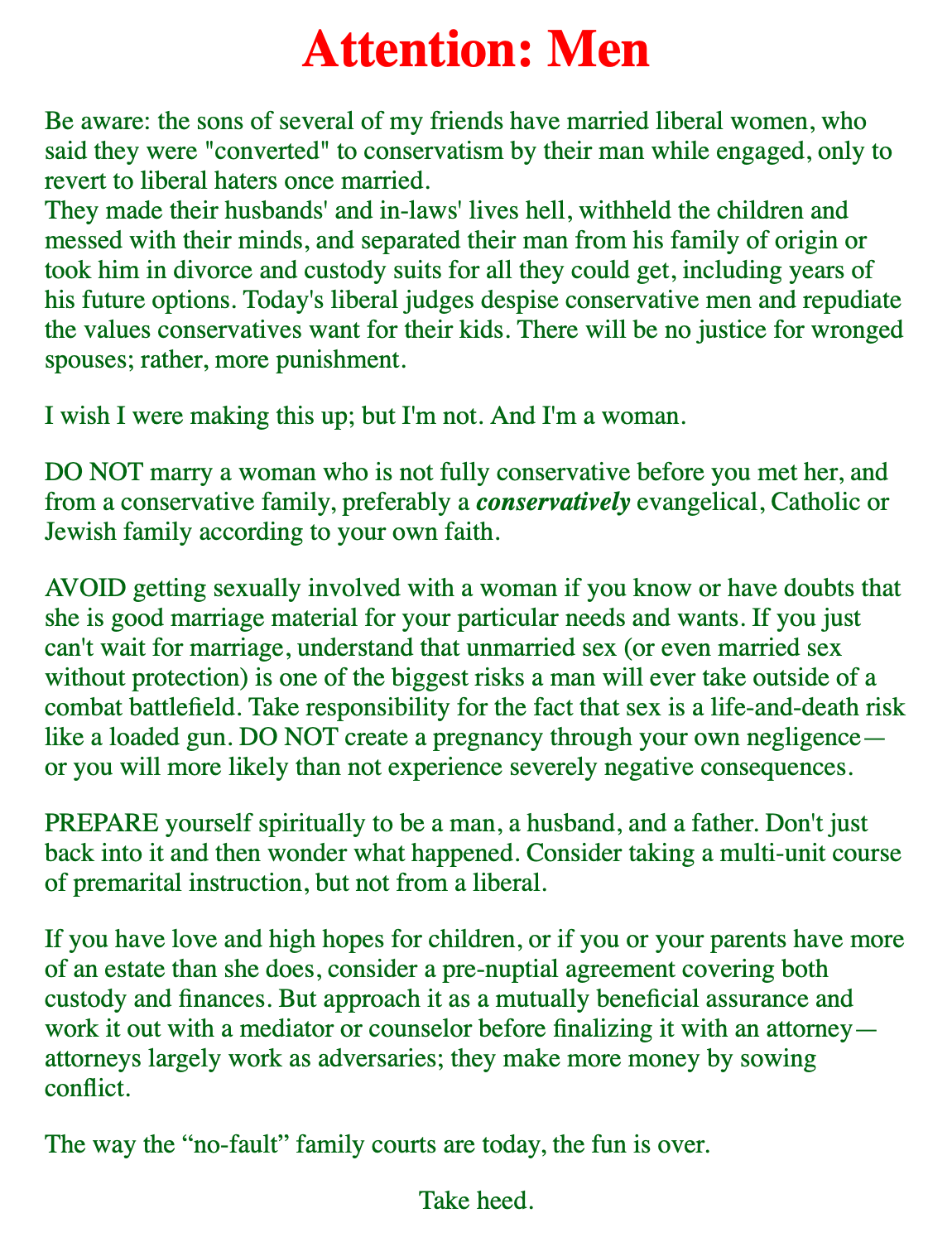
Some young people today are romantic. But some are looking for an ATM. The marriage contract is very one sided and men need to be careful.
The same thing could be said for women. There are plenty of free loading guys out there looking for a woman with a good job.
The laws have gotten out of whack but the laws and valid reasons for the decline of marriage and boys raised by women never mentions something that was always there and which all these changes have fed steroids and brought to the surface in bulk.
Modern males are afraid of females, they are timid in their role as males seeking females, they listen to the podcasts and read the articles telling them all the problems hindering them in relationships and why women are too selective and so on, and they don’t let their passion for female bodies make them take to action in spite of it all, they succumb to the comfort of avoiding risk taking and complain, rather than take the risk of crossing that room to the table where the chicks are, where the odds might be several fails to every success, but that is the way it has always been .
Success with females isn’t about money or status, it is about seducing them in spite of their plans and what their magazines tell them, generalities are fine and one needs to know them to understand what is going on with trends and societal changes, but real life with female company means thinking in terms of one on one, not seeing her as part of an inflexible herd you read about or the podcast that told you about how all modern women are.
I married as somewhat liberal woman even though I was very conservative back then. She joined my Church, had a bunch of kids and is now more conservative on some issues than me.
Jane Austen was never married.
The biggest harm was caused by the so-called Sexual Revolution. There was a time when a woman sleeping around was viewed as shameful. It was assumed that the young lady was ‘saving herself” for her husband.
There have always been people who co-habited without benefit of marriage, but these were exceptions, and those people were regarded as breaking social mores.
Today, nobody seems to bat an eye about unmarried couple living together. It is very sad, and it makes a mockery of marriage. Sadder still, of course, when children are born into such make-shift unions.
When you have so many free range people getting Marriage bad odds others not so much.
You’re not complete until you’re married, and then you’re all done.
I met an old high school friend at a reunion.
His first wife treated him like an ATM. He divorced her to rescue what was left of his retirement savings.
Then he got engaged again, wanted a pre-nup and that quickly ended the relationship.
Communications — so important. Second wife may have been looking for a romantic passion. He may have been looking for a practical companion in life, with love to deepen with experience of one another.
Correct but as a part of the deal, you're marrying Uncle Sam.
Disclaimer: Opinions posted on Free Republic are those of the individual posters and do not necessarily represent the opinion of Free Republic or its management. All materials posted herein are protected by copyright law and the exemption for fair use of copyrighted works.