Posted on 07/05/2026 10:01:39 AM PDT by Red Badger
Before the war was over, five would be captured, 12 would lose their homes, and 17 would lose their fortunes. None renounced the cause of their own free will.
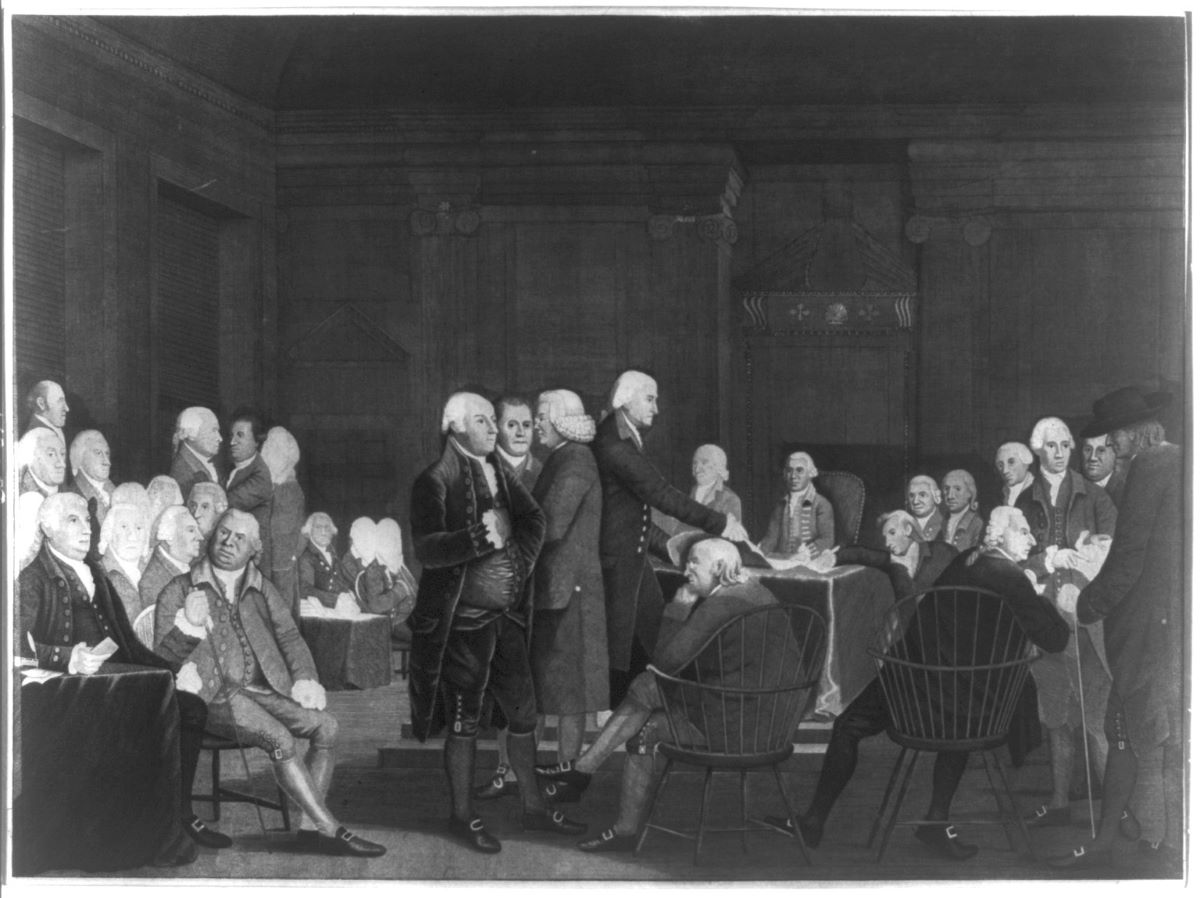
Congress voting on the Declaration of Independence. Library of Congress/Public Domain
===============================================================
Today the United States celebrates the 250th—or semiquincentennial—anniversary of the adoption of the Declaration of Independence.
While July 4 marks the day Thomas Jefferson’s revised draft of the Declaration of Independence was adopted, it would take months for the document to be signed by all 56 men who would eventually affix their names to it.
Several key figures in American history—George Washington, Alexander Hamilton, and James Madison, among others—don’t appear among the signatories of the Declaration of Independence at all, having been serving in military roles or other capacities at the time.
None of the 56 signers died as a result of their signature, but before the war was over, five would be captured, 12 would have their homes destroyed, and 17 would lose their entire fortunes. None of the 56 signatories ever renounced the cause of independence of their own free will.
Here’s what happened to the men who pledged “our Lives, our Fortunes and our sacred Honor” to the cause of American independence, on the basis of “self-evident … Truths” that not even a global empire—or a king—could deny.
‘The Sage of Monticello’: Thomas Jefferson
Easily the most well-known of the Declaration’s signatories—as well as its author—Thomas Jefferson enjoyed several benefits later in life from his role in the document’s drafting.
During the war, Jefferson nearly faced capture by the British during his tenure as governor of Virginia, forcing him to flee from his Monticello estate. That led to accusations of “cowardice” that eventually prompted Virginia legislators to launch a formal inquiry, in which Jefferson was acquitted.
Later, Jefferson served in a series of key posts, first as the U.S. ambassador to France, then as secretary of state under President George Washington and vice president under President John Adams.
After he was elected president—an event dubbed the “Revolution of 1800”—Jefferson’s egalitarian vision expressed in the Declaration of Independence came to be viewed as one of the most critical documents of the American founding.
‘The First American’: Ben Franklin
While Jefferson often gets the lion’s share of the credit for drafting the Declaration, Ben Franklin is credited with one critical edit to the document.
Widely recognized as a multi-disciplinary polymath, Franklin has been dubbed “the First American” by history for his early and long-running calls for American colonial unity.
In the preamble to the Declaration, Jefferson had originally written, “We hold these truths to be sacred and undeniable.”
Franklin—who served on the drafting committee—replaced this with the revision: “We hold these truths to be self-evident.”
Franklin later served as ambassador to France and lead negotiator on the deal to end the war with Great Britain, was the “president”—or governor—of Pennsylvania from 1785 to 1788, and served as a delegate to the Constitutional Convention of 1787.
Shortly before his death in 1790, Franklin made his last political statement with his support of a petition calling on the federal government to abolish slavery.
‘The Atlas of American Independence’: John Adams
John Adams, the future second president, was one of the first delegates to the Continental Congress to call for independence. He was also among the most outspoken in its defense, leading him to be dubbed by some as “the Atlas of American Independence.”
In February 1778, Adams was nearly captured by British warships while leaving on a diplomatic mission for Paris with his son. Adams took up a musket to fight the British vessels, but it took a mix of skillful navigation and a fortuitous storm to shake the pursuers. Had he been captured, Adams likely would have faced imprisonment in the Tower of London and execution for treason.
In one of the most remarkable coincidences in history, Adams and Jefferson both died on July 4, 1826—50 years after the Declaration’s adoption day. Adams’s final words, “Jefferson still lives,” were in fact mistaken: the third president had passed away at Monticello hours earlier.
‘The First Founding Father’: Richard Henry Lee
Less well-known than either Jefferson or Adams, the Virginia delegate Richard Henry Lee was no less instrumental in bringing about independence, authoring the part of the Declaration stating the 13 colonies “are, and of Right ought to be, free and independent States.”
On July 2, 1776, the Second Continental Congress adopted this “Lee Resolution.” Adams famously predicted incorrectly that July 2, rather than July 4, would be celebrated as the American Independence Day, and would be commemorated with, “pomp and parade ... from one end of this continent to the other.”
During the war, Lee faced military attacks on his property, chronic stress that took a toll on his health, and a severe hit to his finances as the war hit international shipping and the tobacco trade he relied on.
He later served as the first Virginia senator alongside William Grayson, joining the anti-Federalists in opposing a national government. Lee died in June 1794 at age 62.
The Midnight Rider: Caesar Rodney
A lesser-known but critical signatory of the Declaration was Caesar Rodney, who rode 80 miles to Philadelphia while suffering from facial cancer to cast a tie-breaking vote for Delaware’s delegation in favor of independence.
Unanimous support from all colonies was required to authorize the Lee Resolution—meaning Rodney’s vote was critical to final adoption.
Rodney later served as “president,” or governor, of Delaware until 1781, and died in 1784 of facial cancer at age 55.
The First Signer: John Hancock
John Hancock’s signature on the Declaration—the first—was so large that his name became an American idiom for one’s signature.
The Massachusetts revolutionary leader had been serving as president of the Second Continental Congress since May 24, 1775.
Hancock, aside from being the first signer, is the only person who actually signed the document on July 4, 1776.
Hancock was at the head of a massive commercial empire, deriving his wealth partially from inheritance and partially from smuggling. Had American independence failed, Hancock—as well as his family—would have lost everything.
Despite close calls, he made it through the Revolution without facing capture. However, several of his properties were destroyed or occupied by the British during the conflict, while Hancock expended nearly half of his personal wealth financing the cause of independence.
He later served as the first governor of independent Massachusetts, and died in 1793 at 56.
The Last Signer: Thomas McKean
Like several other delegates to the Second Continental Congress, Thomas McKean of Delaware left to join the Revolution as soon as he cast his ballot in favor of independence.
This meant that he was ultimately unable to sign the documents until months—or, by some estimates, years—later. While historians are confident that McKean is the final signatory, the exact date is disputed, with estimates ranging from early 1777 all the way to 1781.
McKean took part in key battles during the conflict, assisting in the defense of New York City and Delaware. By 1781, McKean was serving as president of the Continental Congress, making him the civilian authority directing the Battle of Yorktown, which ended the war.
After the Revolution, McKean served as chief justice and governor of Pennsylvania. During the War of 1812, he led a civilian defense group against the British, taking up arms one final time before his death in 1817 at the age of 83.
The One Who Renounced His Signature: Richard Stockton
While none of the 56 signers ever willingly renounced their support for the Declaration, historians think that signer Richard Stockton of New Jersey renounced his signature under coercion and following a long period of captivity by the British.
Imprisoned by the British, Stockton signed a parole agreement in which he reneged on his signature and pledged not to take part in the war. Under the agreement, Stockton resigned his seat in the Continental Congress.
Later, Stockton reaffirmed his loyalty to the United States before his death at age 50 in 1781. The Fighters
Like McKean, several signers went on to take part in the conflict.
These included Rodney, Oliver Wolcott of Connecticut, Thomas Nelson Jr. of Virginia, and William Floyd of New York.
Others who left Philadelphia to join the conflict were taken as prisoners of war during the Revolution.
One of these was George Walton, who was wounded and captured during the Battle of Savannah. Despite spending months in British custody, Walton survived and was eventually freed, going on to serve as a governor, chief justice, and U.S. senator for Georgia.
Three others—Thomas Heyward Jr., Arthur Middleton, and Edward Rutledge—were taken prisoner during the Battle of Charleston. All three survived months of captivity at St. Augustine, Florida, with Heyward becoming the last of the three to die at age 62 in 1809.
Homes Looted, Occupied, or Destroyed
Many other signers faced consequences related to their properties and estates. Some of the most prominent of these included Lee and Hancock.
In New York, meanwhile, signer Francis Lewis had his property destroyed by the British, who captured his wife during the attack. Held in captivity for months without a change of clothes or adequate food, Elizabeth Annesley Lewis was ultimately freed under a prisoner exchange negotiated by Washington, but died shortly thereafter from the stress of the ordeal.
Also in New York, signers William Floyd, Philip Livingston, and Lewis Morris had their vast estates occupied by the British during the war, with the properties being used as barracks or stables.
Signer John Hart of New Jersey was also forced to flee from his home—and his wife’s deathbed—when Hessian troops attacked his farm and mills.
The Longest-Lived Signer: Charles Carroll
In 1832, Charles Carroll of Maryland knew that he was dying.
The only Catholic signer of the Declaration, Carroll had by then been the sole remaining signatory of the document for around six years.
He gained the accolade on July 4, 1826, following the deaths of Adams and Jefferson, who were among the final three living signers. Franklin had passed more than 40 years earlier.
By 1832, Carroll was well-used to the questions he received from young people and reporters, who were set on preserving as much of the early Republic as possible during the twilight years of the 1820s.
Before his death, Carroll played a key role in welcoming the new era of American life, laying the first stone of the B&O railroad, one of the first steps toward the transcontinental railroad that would take decades yet to be completed.
Carroll’s passing was commemorated in the papers and on the streets of the blossoming American republic, whose citizens recognized that with Carroll’s passing, the first generation of the United States was truly over.
Commenting on his status near the end of his life, Carroll wrote, “Grateful to Almighty God for the blessings. ... I do hereby recommend to the present and future generations the principles of that important document ... and pray that the civil and religious liberties they have secured to my country may be perpetuated.”
Wild guess... They all died.
Yes. Some at very young ages.............


And no Indians....oops, I meant Original Peoples.............
Great post!
To which will add— the meanings of the symbols on the US One Dollar bill.
Likely very few Americans of certain younger generations know any of this- or the history of the creation of the phrases and symbology. They only know “clicks” and electric “money” not as originally intended. Thus little appreciation of the actual sacrifice of the Founders-as you have posted. The Latin alone is largely a mystery to the uninformed. Roman numberals, major organizing phrases and concepts. Which notably Al Gore NEVER has gotten correct, and JoeBama jello brain summarized as “you know... the thing!”.... a true tyrant moron.
Here: https://historyfacts.com/us-history/article/symbols-on-the-dollar-bill-meaning/
Here- and there have been condensed email versions of this same information, all worth reading and knowing.

Of the equally distinguished congress of 1776, Mr. Livingston was a member, and had the honor of giving his vote in favor of that declaration, which, while it was destined to perpetuate the memory of the illustrious men who adopted it, was to prove the charter of our national existence. In the following year, he was reelected to congress by the state convention, which, at this time, tendered to him and his colleagues an expression of public thanks, for the long and faithful services which they had rendered to the colony of the state of New-York.
The constitution of the state of New-York was adopted at Kingston, on the twentieth of April, 1777. Under this constitution, Mr. Livingston, in May following, was chosen a senator for the southern district, and in that capacity attended the first meeting of the first legislature of the state of New-York.
In October of the same year, an election took place for members of congress, under the new constitution. Among the number chosen, Mr. Livingston was one. On the 5th of May, 1778, he took his seat in that body. This was an eminently critical and gloomy period in the history of the revolution. The British had taken possession of Philadelphia, compelling congress to retire from that city. They had agreed to hold a session at York.
At this time, the health of Mr. Livingston was exceedingly precarious. And such was the nature of his complaint, which was a dropsy in the chest, that no rational prospect existed of his recovery. Indeed, he was daily liable to be summoned from the active scenes of life, to his final account. Yet, in this dubious and anxious state, his love to his country continued strong and unwavering. For her good he had made many sacrifices; and, now that her interests seemed to require his presence in congress, he hesitated not to relinquish the comforts of home, and those attentions which, in his feeble and declining state, he peculiarly needed from a beloved family.
Previous to his departure, he visited his friends in Albany, whom he now bid a final farewell, as he expected to see them no more. His family, at this time, were at Kingston, whither they had been obliged to flee to escape the British army. To these, also, he bid an affectionate adieu, at the same time expressing his conviction, that he should no more return.
These sad anticipations proved too true. On the fifth of May, he took his seat in congress, from which time his decline was rapid. On the twelfth of June, he ended his valuable life. Although deprived of the consolations of home, he was attended, during the few last days of his illness, by his son, Henry, who was at that time a member of General Washington's family. Hearing of the illness of his father, he hastened to administer such comforts as might be in his power, and to perform the last duties to a dying parent. On the day of his decease, his death was announced in the half of congress, and by that body the following resolutions adopted: "Congress being informed that Mr. P. Livingston, one of the delegates for the state of New-York, died last night, and that circumstances require that his corpse be interred this evening, "Resolved, that congress will in a body attend the funeral this evening, at six o'clock, with a crape round the arm, and will continue in mourning for the space of one month. "Ordered, that Mr. Lewis, Mr. Duer, and Mr. G. Morris, be a committee to superintend the funeral; and that the Rev. Mr.. Duffield, the attending chaplain, be notified to officiate on the occasion."
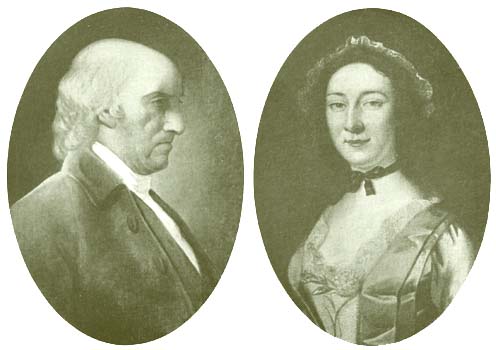
In the spring of 1775, it was no longer doubtful that a resort must be had to arms. Indeed, the battle of Lexington had opened the war; Shortly after which the New York convention of deputies were assembled to appoint delegates to the general congress. Men of a zealous, bold, and independent stamp, appeared now to be required. It was not singular, therefore, that Mr. Morris should have been elected.
On the 15th of May, he took his seat in that body, and eminently contributed, by his indefatigable zeal, to promote the interests of the country. He was placed on a committee of which Washington was the chairman, to devise ways and means to supply the colonies with ammunition and military stores, of which they were nearly destitute. The labors of this committee were exceedingly arduous.
During this session of congress, Mr. Morris was appointed to this delicate and difficult task of detaching the western Indians from a coalition with the British government, and securing their cooperation with the American colonies. Soon after his appointment to this duty, he repaired to Pittsburgh, in which place, and the vicinity, he continued for some time zealously engaged in accomplishing the object of his mission. In the beginning of the year 1776, he resumed his seat in congress, and was a member of several committees, which were appointed to purchase muskets and bayonets, and to encourage the manufacture of salt-peter and gunpowder.
During the winter of 1775 and 1776, the subject of a Declaration of Independence began to occupy the thoughts of many in all parts of the country. Such a declaration seemed manifestly desirable to the leading patriots of the day, but an unwillingness prevailed extensively in the country, to destroy all connection with Great Britain. In none of the colonies was this unwillingness more apparent than in New York.
But, notwithstanding this prevalent aversion to a separation from Great Britain, there were many in the colony who believed that a declaration of independence was not only a point of political expediency, but a matter of paramount duty. Of this latter class, Mr. Morris was one; and, in giving his vote for that declaration, he exhibited a patriotism and disinterestedness which few had it in their power to display. He was at this time in possession of an extensive domain, within a few miles of the city of New York. A British army had already landed from their ships, which lay within cannon shot of the dwelling of his family. A signature to the Declaration of Independence would insure the devastation of the former, and the destruction of the latter. But, upon the ruin of his individual property, he could look with comparative indifference, while he knew that his honor was untarnished, and the interests of his country were safe. He voted, therefore, for a separation from the mother country, in the spirit of a man of honor, and of enlarged benevolence.
It happened as was anticipated. The hostile army soon spread desolation over the beautiful and fertile manor of Morrisania. His tract of woodland of more than a thousand acres in extent, and, from its proximity to the city, of incalculable value, was destroyed; his house was greatly injured; his fences ruined; his stock driven away; and his family obliged to live in a state of exile. Few men during the revolution were called to make greater sacrifices than Mr. Morris; none made them more cheerfully. It made some amends for his losses and sacrifices, that the colony of New York, which had been backward in agreeing to a Declaration of Independence, unanimously concurred in that measure by her convention, when it was learned that congress had taken that step.
“Historian” Jon Meacham on Morning Joe: “There’s a very good case to be made, I think, that we were really founded in 1965. That’s when a multiracial, multiethnic democracy came more fully into being with the Immigration and Nationality Act, with the Voting Rights Act. And so we’re really about 60 years old.”
A-Hole.
CLICK & SHARE THE HISTORICALLY ACCURATE ITEM BELOW AND YOU WILL UNDERSTAND WHY SO MANY “AMERICANS” (I use that term very loosely) ARE TERRIFIED TO STAND UP AND BE COUNTED! Quarter-millennium trivium: The Second Continental Congress approved the Declaration of Independence on July 4, 1776, but the parchment wasn’t signed until four weeks later, on August 2, 1776. Words matter. Of the 56 signatories, before the war was over, five were captured, 12 had their homes destroyed, and 17 lost their entire fortunes. None ever renounced his signature.
Wasn’t 1965 the year of the Immigration and Naturalization Act under the Humphreys, Kennedy et al, in which it was promised that the make-up or demographic of the country would not be altered?
Of course now we know that it was a lie and that the composition of Europeans was diluted.
Sorry I repeated myself re the Act. I only read the first sentence
Thanks Red Badger.
That’s the myth
Untrue
I don’t think any were executed by a number lost everything as a result
A number I think died fighting in the war and their families were punished
The economic loss was high for some too
I’m not sure where this notion came from that most were executed or hanged
I always thought that too till recently
When you ask a question with an obvious answer... Expect an obvious answer.
Disclaimer: Opinions posted on Free Republic are those of the individual posters and do not necessarily represent the opinion of Free Republic or its management. All materials posted herein are protected by copyright law and the exemption for fair use of copyrighted works.
