Posted on 05/25/2026 7:05:20 PM PDT by Red Badger
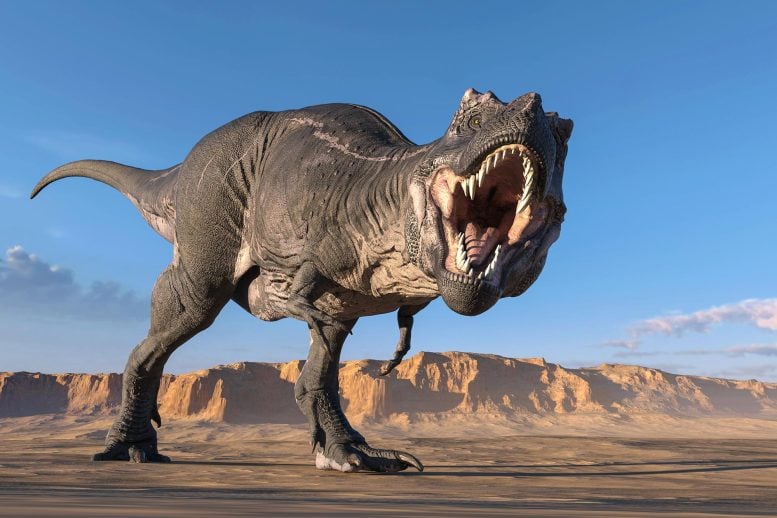
T. rex’s famously tiny arms may have been the result of one terrifying evolutionary upgrade: an enormous skull built for crushing prey. Credit: Shutterstock
A new study suggests T. rex and other giant predators evolved tiny arms because their massive skulls took over as the primary hunting weapon.
As their bites became more powerful, their forelimbs may have gradually faded into evolutionary leftovers.
Why T. Rex and Other Giant Predators Evolved Tiny Arms
The famously tiny arms of Tyrannosaurus rex may have evolved because these giant predators increasingly relied on massive skulls and powerful jaws to attack prey, according to a new study led by researchers from UCL (University College London) and the University of Cambridge.
The research, published in Proceedings of the Royal Society B, analyzed 82 species of theropods, a group of mostly meat-eating, two-legged dinosaurs. The scientists found that reduced forelimbs appeared independently in five major theropod groups, including tyrannosaurids, the family that included T. rex.
Their findings suggest that shrinking arms were tied more closely to the evolution of heavily built skulls and strong bites than to overall body size. In other words, tiny arms were likely not just an accidental side effect of becoming enormous.
Giant Dinosaur Skulls Replaced Claws
The researchers believe the rise of massive prey animals, including giant sauropods (long-necked, long-tailed plant eaters), may have pushed predators toward a different hunting strategy. Instead of grabbing prey with their arms and claws, these dinosaurs may have depended more on powerful jaws and skull strength.
Lead author Charlie Roger Scherer, a PhD student at UCL Earth Sciences, said: “Everyone knows the T. rex had tiny arms, but other giant theropod dinosaurs also evolved relatively small forelimbs. The Carnotaurus had ridiculously tiny arms, smaller than the T. rex.
“We sought to understand what was driving this change and found a strong relationship between short arms and large, powerfully built heads. The head took over from the arms as the method of attack. It’s a case of ‘use it or lose it’ – the arms are no longer useful and reduce in size over time.
“These adaptations often occurred in areas with gigantic prey. Trying to pull and grab at a 100ft-long sauropod with your claws is not ideal. Attacking and holding on with the jaws might have been more effective.”
Scherer added that the evidence points toward skulls becoming stronger before forelimbs began shrinking.
“While our study identifies correlations and so cannot establish cause and effect, it is highly likely that strongly built skulls came before shorter forelimbs. It would not make evolutionary sense for it to occur the other way round, and for these predators to give up their attack mechanism without having a back-up.”
Measuring Skull Strength in Meat Eating Dinosaurs
To better understand the connection between skulls and forelimbs, the researchers created a new method for measuring skull robustness. The system took into account bite force, skull shape, and how firmly the skull bones were connected. Compact skulls were considered stronger than long, narrow ones.
T. rex ranked highest in skull robustness using this method. The second strongest skull belonged to Tyrannotitan, another giant theropod that lived in what is now Argentina during the Early Cretaceous period, more than 30 million years before T. rex.
The team suggested that giant prey animals may have triggered an “evolutionary arms race” in which predators evolved stronger skulls and jaws to handle increasingly massive herbivores. Many of these hunters also evolved gigantic body sizes themselves.
Five Dinosaur Groups Developed Tiny Arms
The scientists compared forelimb length with skull length and identified five dinosaur groups that evolved especially reduced forelimbs. These included tyrannosaurids, abelisaurids, carcharodontosaurids (including Tyrannotitan), megalosaurids, and ceratosaurids.
Their analysis showed that reduced forelimbs had a stronger relationship with skull robustness than with total body size or skull size alone.
The researchers also noted that some dinosaurs with tiny arms were not particularly huge. Majungasaurus, for example, was an apex predator that lived in Madagascar around 70 million years ago. It had a strongly built skull and very small forelimbs despite weighing only about 1.6 tons, roughly one-fifth the weight of T. rex.
Different Evolutionary Paths to Tiny Arms
The study found that dinosaur groups evolved smaller forelimbs in different ways.
Among abelisaurids, the hands and lower portions of the arms beyond the elbow became especially reduced over time. Later species such as Majungasaurus developed extremely tiny hands. Tyrannosaurids followed a different pattern, with all parts of the forelimb shrinking at a more even rate.
The researchers concluded that different dinosaur lineages likely reached the same result through separate developmental and evolutionary pathways.
Reference:
“Drivers and mechanisms of convergent forelimb reduction in non-avian theropod dinosaurs” by Charlie Roger Scherer, Elizabeth Steell and Paul Upchurch, 20 May 2026, Proceedings of the Royal Society B Biological Sciences.
DOI: 10.1098/rspb.2026.0528
The work was carried out by a broader dinosaur evolution research team at UCL, which collaborates closely with the Natural History Museum. The extended group includes research fellows, postdoctoral researchers, and more than 10 PhD students studying dinosaur evolution and other vertebrates such as crocodiles and birds.
I have read that skull construction indicates that T Rex could smell rotting carcasses 20 miles distant. Some modern bears have the same ability. Fast legs would get him there before others found the food. Arms would not be very necessary to eat a stationary meal, and big jaws would scare or bite competing preditors and also allow big bites at a time. In other words his physical traits were more oriented to finding, eating and protecting food, not hunting and killing it.
I do wonder how they played guitar...
The whole world was a buffet. FTM, it still is. 😁
T Rex was a flautist for God’s sake!
Maybe you’re thinkin’ Ian Anderson.
https://en.wikipedia.org/wiki/Marc_Bolan#/media/File:Marc_Bolan_In_Concert_1973.jpg
Oh my.
😆
That’s a faux pas de deux, his Romeo to her Juliet….
/resident muse
Disclaimer: Opinions posted on Free Republic are those of the individual posters and do not necessarily represent the opinion of Free Republic or its management. All materials posted herein are protected by copyright law and the exemption for fair use of copyrighted works.
