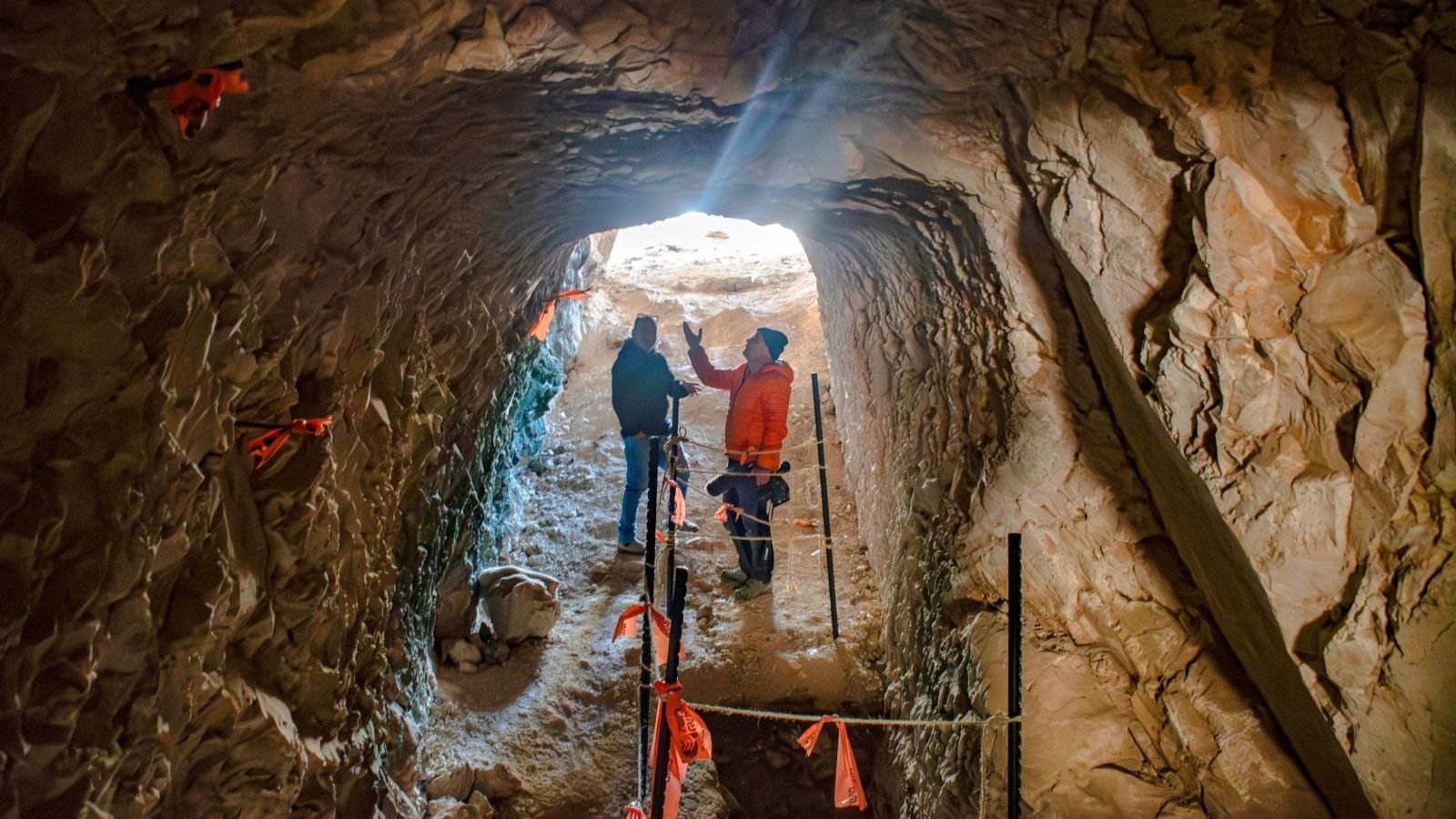
Tunnel, Jerusalem, IsraelYoli Schwartz, Israel Antiquities Authority
Posted on 05/17/2026 9:35:28 PM PDT by SunkenCiv
According to a statement released by the Israel Antiquities Authority (IAA), archaeologists unearthed a mysterious tunnel beneath the streets of Jerusalem. During construction work near Kibbutz Ramat Rachel, workers unexpectedly discovered the entrance to an ancient cavity, measuring 16 feet high and 10 feet wide, that was once accessed via a rock-cut staircase. At first researchers believed the passageway may have been part of an ancient water installation built to access underground springs, but this was subsequently ruled out, since the walls of the tunnel were not covered in plaster as they typically would have been. Geologists also found no evidence of any subterranean water sources in the area. Instead, experts now suggest that the tunnel may have been cut in order to reach chalk layers suitable for quarrying building stones or producing lime. There has been no evidence yet uncovered that might help researchers to date the feature's construction, although it may be related to two nearby Iron Age sites that date to the first millennium b.c. "This discovery joins many others being uncovered every day, hour by hour, throughout the city," said IAA archaeologist Amit Re'em. "Usually we have explanations for the discoveries we uncover, but sometimes, as in this case, we stand astonished and amazed." To read about another discovery from Jerusalem, go to "Bound for Heaven."
(Excerpt) Read more at archaeology.org ...
Tunnel, Jerusalem, IsraelYoli Schwartz, Israel Antiquities Authority
I’m always amazed at how the ancients were able to dig with primitive tools as much as they did.
Knights Templar?
Not just the ancients, either. Building the first transcontinental railroad through the hard granite rock of the Sierras, before plentiful hard steel, before dynamite, before diesel equipment. It was built in six years. During a war. 1,776 miles of track. $4-$5 billion in 2026 dollars.
Maybe, or DUMBs

🤔

They didn’t dig tunnels, they were too busy learning secret handshakes.
16 foot ceilings? Nice, but why?
Not needed to pass unless maybe you had animal drawn wagons.
They didn't have dynamite to blow through the rocks, but they had nitroglycerin. Highly unstable, but just as effective.
nearly a hundred years ago, Richard Halliburton wrote in his Book of Marvels of the tunnels under Jerusalem.
He recounted how at one location the floor elevation was a few inches different. He speculated that the tunnelers started from different ends and one lost the elevation level.
Much more effective. Dynamite is nitroglycerine that has been absorbed into diatomaceous earth.
Diatomaceous earth, also known as diatomite, celite, or kieselgur, is a naturally occurring, soft, siliceous sedimentary rock that can be crumbled into a fine white to off-white powder. It has a particle size ranging from more than 3 mm to less than 1 μm, but typically 10 to 200 μm. Depending on the granularity, this powder can have an abrasive feel, similar to pumice powder, and has a low density as a result of its high porosity.
--Wikipedia--
Dynamite is 50% nitroglycerin at its strongest.
1. Black Powder (Gunpowder)
This was the standard explosive used throughout most of the construction. Workers drilled holes for the explosives using a long chisel held by one man while others took turns pounding it. Then black powder or nitroglycerin were put in the hole, fuses were lit, and the shift's work ended with a bang.
The 15 tunnels along the Central Pacific line required massive amounts of explosives. Crews used as many as 500 kegs of black powder a day during the construction phase through the Sierra Nevada. Black powder was expensive. In a single week, Central Pacific burned more powder than was ignited at the 1862 Battle of Antietam during the Civil War.
2. Nitroglycerin
When black powder proved too slow against the hardest granite, engineers turned to a powerful new explosive. After more than a year of twenty-four-hour days using black powder on the Summit Tunnel, Central Pacific Director Charles Crocker ordered his foreman to begin using nitroglycerin — a clear, odorless, volatile oil thirteen times more powerful than gunpowder, and the active ingredient in dynamite. When black powder was replaced with nitroglycerin, the pace of excavation increased from 1.18 to 1.82 feet per day.
Because transporting the unstable liquid was extremely dangerous, Central Pacific officials employed chemist James Howden to manufacture the material on-site. He set up his nitroglycerin shop at Donner Pass and manufactured the chemical as needed.
Nitroglycerin was used on the Summit Tunnel but proved too dangerous to use elsewhere. Howden dismantled the nitroglycerin factory upon completion of Tunnels 6 and 8, and nitroglycerin was not used again — partly because Charles Crocker was not in favor of it, and partly because black powder could be purchased without paying royalties to Nobel or his U.S. representatives.
Its interesting that they label the tunnel as “mysterious.” If there ever was a city with undiscovered ancient tunnels under it, its Jerusalem. The fact that they just discovered this one should not be surprising unless there is something really unique about it.
Its called slavery...
“During a war. 1,776 miles of track. $4-$5 billion in 2026 dollars.”
During a war, perhaps they were pressed to get rapid transport of all that western gold and silver moving east as fast as possible to finance it. The Railroad industrial complex was a growing business power. Had the Military Industrial Complex established its power by that time?
I am amazed at the boulders in my area of New Hampshire. Left by the retreating glacier 12m years ago.
Meaning the rock walls that were moved with horse, oxen and levers. Clearing a field full of rocks to grow corn/crops.
I have boulders on my property that a 30m# excavator had trouble moving. Yet, there is a wall on the northern border of my property where some Pilgrim piled up rocks for a hundred of more years from plowing a field. Before they wisely moved to Ohio/Indiana/Iowa where the ground has less rocks.
The "nice" thing about the boulder crop is it gets replenished every year. It's a never-ending program to clear them.
When the Missoula Floods happened in our Idaho area, they swept boulders the size of HOUSES. Here's one such boulder in the "Scablands" of western Washington state.
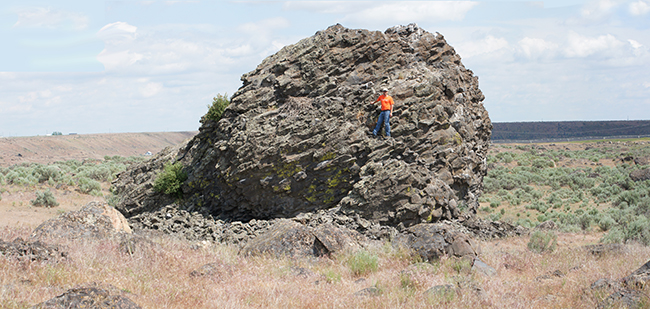
Don’t you mean eastern WA state?
Disclaimer: Opinions posted on Free Republic are those of the individual posters and do not necessarily represent the opinion of Free Republic or its management. All materials posted herein are protected by copyright law and the exemption for fair use of copyrighted works.
