Posted on 05/16/2026 7:05:58 AM PDT by Red Badger
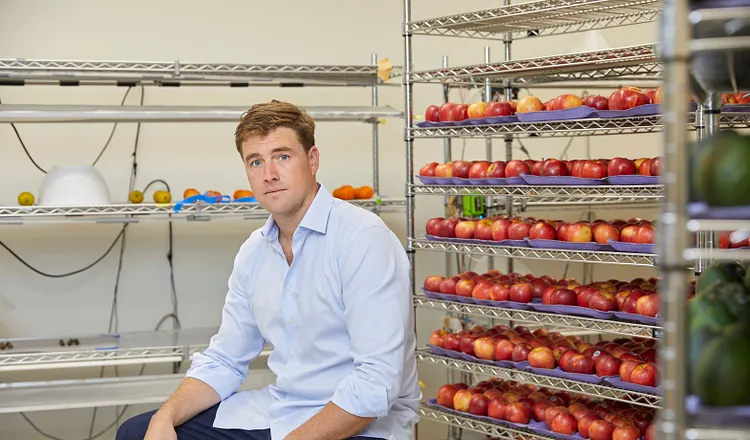
James Rogers, the former CEO of Apeel Sciences, is seen at its headquarters in Santa Barbara, California. (Yuri Hasegawa/Redux)
All it took was two Facebook posts to turn an online mob against Apeel Sciences and its booming business of keeping food fresh longer.
============================================================
The eureka moment for James Rogers arrived while driving past some California farmland in 2011. He was a doctoral student at the University of California, Santa Barbara, focusing on world hunger, and the drive got him thinking about a huge problem with fresh produce. Growing it wasn’t the problem. Keeping it fresh was.
Working out of his garage, Rogers devised a fix. He used materials found in the skins, peels, and seeds of fruits and vegetables—especially grapes—to create a protective covering that slowed down the water loss and oxidation that cause fresh produce to spoil after being harvested. The early results won him a $100,000 grant in 2012 from the Bill and Melinda Gates Foundation. Rogers soon hired two classmates as employees and launched a company called Apeel Sciences.
What happened over the next decade was an only-in-America triumph of entrepreneurial ingenuity and hard-earned recognition among consumers and celebrities alike. Time hailed Apeel as one of its “Genius Companies” in 2018 for keeping fruits and vegetables fresh “two to three times longer.” Apeel-coated apples, avocados, lemons, limes, mangoes, and oranges were sold in thousands of supermarkets across the United States, from Kroger to Costco to Trader Joe’s. Germany’s largest supermarket chain, Edeka, found that spoilage of imported avocados from Chile and Peru fell 50 percent—and sales jumped 20 percent. Apeel raised over $640 million from huge investment firms. Celebrities like Oprah Winfrey and Katy Perry also invested in the company.
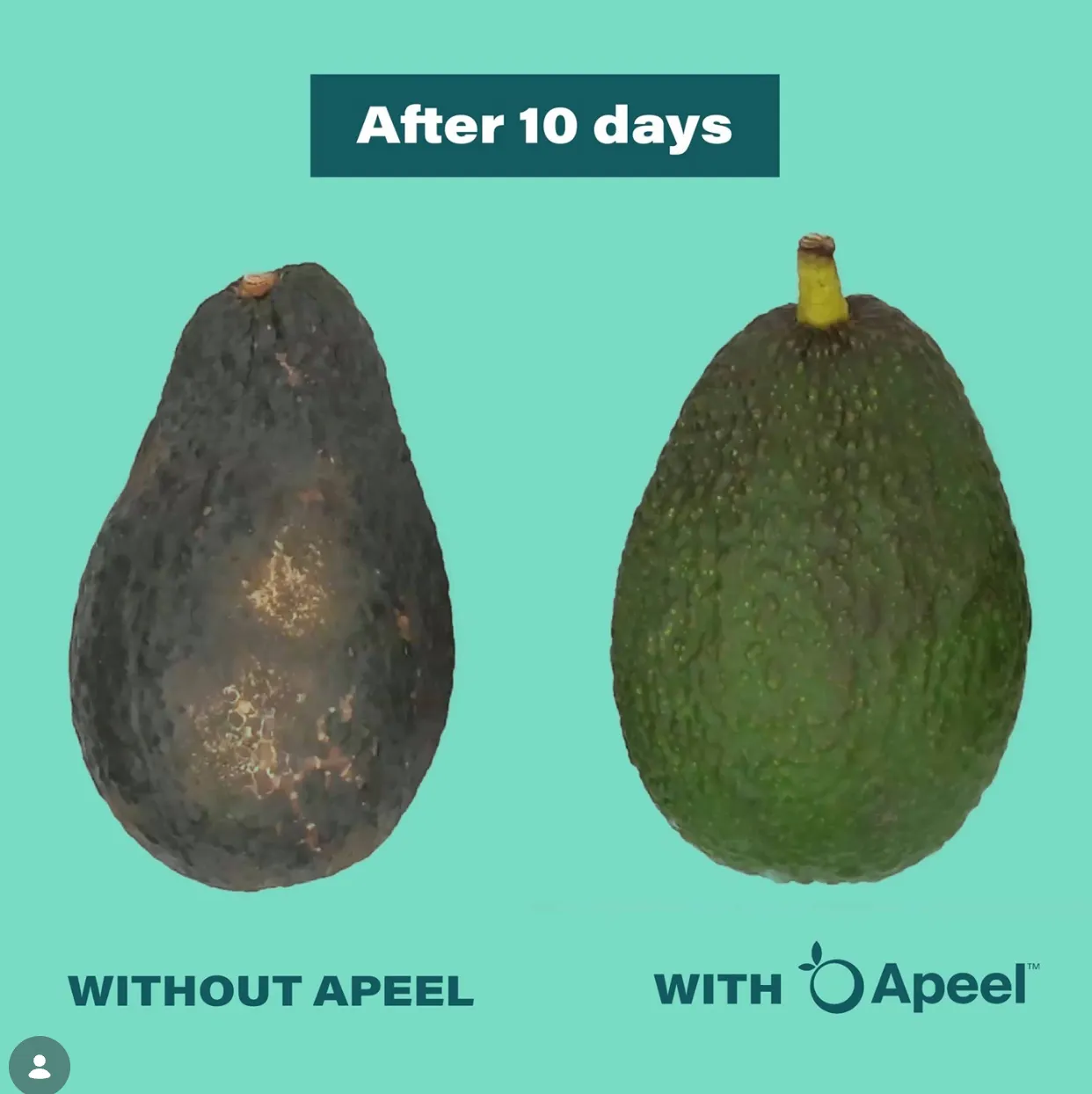
An avocado is shown with and without Apeel after 10 days. (Apeel Sciences)
“We got through seven years of demonstrating its value to retailers,” Rogers told me. Apeel-coated cucumbers were about to become the next big thing. Walmart had begun selling some that no longer had to be cocooned in plastic shrink-wrap to stay fresh.
And then came April 10, 2023.
On that day, at exactly 10:21 a.m. ET, two Facebook posts falsely claimed that Apeel’s product “can’t be washed off” and warned viewers not to “eat anything with the Apeel sticker on it.” The posts linked to the ingredients of a floor cleaner also called Apeel but made by a UK company. Within hours, the posts ricocheted across Facebook, Instagram, TikTok, YouTube, Telegram, Rumble, and Reddit.
The posts ignored the fact that the Food and Drug Administration and the European Food Safety Authority had separately evaluated Apeel, and found no safety concerns. Or that most of the produce sold in stores is coated with a thin layer of wax. This was an online mob, wielding disinformation and threats. And no one could stop it.
Soon after those first two Facebook posts, which came from Canada, similarly baseless claims were repeated by Make America Healthy Again (MAHA) influencers, including some who saw the worst in Apeel’s connection to Bill Gates. For many in the MAHA movement, Gates is a bogeyman, often accused of using his wealth to unduly influence global health policies, favoring pharmaceutical interests over public well-being, and even controlling the food supply.
Typical of the online attacks was a 1,000-word post by Krysten Dornik, who runs a Substack newsletter called Krysten’s Kitchen, with the headline: “The Dangerous Chemical Bill Gates Is Coating Your Organic Produce With.” Bots helped the posts mushroom.
“It caught us totally off guard,” said Harold S. Edwards, the CEO of Limoneira, one of the largest avocado and lemon producers in the U.S. The 130-year-old company had just signed a licensing agreement with Apeel, which Edwards hoped would help his business. “I’m lucky if 30 percent of what we sell doesn’t rot,” he told me. Instead, he became a target, too.
His email and cellphone number were published online. A voicemail from a male caller warned: “If you are going to poison us with Apeel, you better watch yourself.” Edwards also started getting messages from Limoneira’s retail customers, who said they were being hounded by followers of influencers who had published their names and phone numbers and were urging consumers to boycott their stores. Costco and other food retailers told Limoneira they would no longer buy its produce unless the company could guarantee there was no Apeel on it.
“It doesn’t take a lot,” said one purchaser at a large grocery chain in the U.S. “No one wants the risk of losing sales. It’s easier to abandon Apeel than it is to defend them.”
After Costco, Albertsons, Kroger, and other supermarket chains buckled under the pressure, Limoneira decided to back out of its agreement with Apeel before using it on a single avocado or lemon.
This was an online mob, wielding disinformation and threats. And no one could stop it.
By the fall of 2023, retailers stopped asking Calavo Growers, a large producer of avocados and tomatoes, to use Apeel’s coating, said Mike Browne, a former executive vice president of sales and operations at Calavo. He told me that he never questioned the “wholesomeness” of Apeel but realized that its obvious benefits were nothing compared with the power of people “saying really nasty things.” His conclusion: “Social media killed Apeel.”
It isn’t surprising anymore that influencers can ruin companies with TikTok posts, podcasts, and blog posts based largely or even entirely on conspiracy theories, conjecture, vibes, and feelings. But no one I spoke to could recall another example where the destruction was so swift or complete.
At Apeel’s peak, 60 percent of the avocados sold in American grocery stores were coated with Apeel. The number is now zero. Almost all of Apeel’s revenue in the U.S. has disappeared, and the company was forced to lay off most of its employees. Rogers was replaced as CEO in 2024.
“I love the product. It’s a pity it’s not out there,” said Debora Langston, a consultant who spent months testing Apeel for Limoneira, comparing it with the wax coating used for decades. Friends in the food industry warned that Apeel was dangerous and could cause cancer. She expected poor results but reached the opposite conclusion. Her customers in Europe still use Apeel.
There was nothing Apeel could do to restore the confidence of consumers who fell for the lies and spin—or win back skittish supermarkets. What it could do was try to track down those responsible for bringing Apeel down—and make them pay.
Robyn Openshaw, a wellness influencer who markets herself as GreenSmoothieGirl, published over 60 anti-Apeel posts on social media and her own website from July 2023 to May 2025. She wrote that Apeel’s coating was made with heavy metals and solvents, including chemicals found in gasoline, and encouraged her “Green Smoothie Girl Army” to protest by phone and email and in person.
In June 2024, Openshaw called Edwards, the Limoneira CEO, on his personal cellphone, asking him if the company was selling Apeel-coated products. He replied by text: “Hi Robyn, We tested Apeel but never sold any products (avocados or lemons) with Apeel on them. We stopped when the market told us it doesn’t want Apeel.” She published a blog post with the headline: “GreenSmoothieGirl Gets Apeel Shut Down at Billion-Dollar Produce Company.” A video on YouTube boasted that she got Limoneira to “quit using Apeel products.”
Openshaw also reached out to executives at Costco. Produce suppliers to Costco told me that its instructions to stop using Apeel came after Openshaw and her followers inundated Costco with messages and phone calls. When I asked Openshaw about this, she said Costco told her that the company stopped using Apeel because it was too expensive.
The anti-Apeel posts drove traffic to Openshaw’s website, where she sells nutrition supplements and food products. She also found a way to profit directly from her opposition to the company: a “genius guide” listing stores that did and didn’t carry Apeel-coated produce, selling for as much as $19.97.
In July 2025, the actress Michelle Pfeiffer joined the chorus of influencers posting about Apeel. “Organic produce is no longer safe,” she wrote. “Bill Gates’s Apeel just got approved for USDA-certified organic.” The approval, she said, was “very concerning.” Pfeiffer’s post credited My Health Forward, another frequent Apeel critic.
Later that month, Marlin Stutzman, a Republican congressman from Indiana, proposed the “Apeel Reveal Act of 2025” to require disclosure of certain product coatings used on fruit and vegetables. “The red flags went up for me when I saw that the Bill and Melinda Gates Foundation was behind the development of this product,” Stutzman, a MAHA-friendly farmer, said in a Facebook post. He added in a post on X: “If there is a chemical on our foods in American grocery stores and Bill Gates is associated—COUNT ME OUT.” The congressman said Apeel was using a “mystery coating.”
Almost all of Apeel’s revenue in the U.S. has disappeared, and the company was forced to lay off most of its employees.
But there was no mystery at all about the product, known as Edipeel. It is made from monoglycerides and diglycerides, which are extracted from grape seed, its only active ingredient. Edipeel is distributed as a powder, mixed with water, and applied to foods before packaging. The manufacturing process uses no solvents.
The only heavy metals found in Apeel-coated fruits and vegetables are trace amounts that occur naturally and are common in all crops due to absorption from surrounding soil. Apeel uses heat and vacuum to purify the plant oils, reducing the levels of those naturally occurring heavy metals.
Apeel decided to contact Pfeiffer. Twenty days after her anti-Apeel post on Instagram, she apologized in a new post. “Ugh! For any of you who reposted or shared my story about Apeel, it turns out that I unintentionally posted inaccurate and outdated information, and I’m very sorry for that,” she wrote. She acknowledged that Apeel’s organic-certified product was first approved in 2017 and never sold commercially. She also said that Gates had nothing to do with Apeel after the Gates Foundation made a second grant to the company in 2015.
Apeel’s business in Europe was still thriving because the kind of attacks allowed against the company in the U.S. by Facebook, Instagram, X, and other social media platforms are strictly prohibited in Europe. There, social media companies risk steep fines if they fail to remove illegal posts once they are notified.
Edeka, the German supermarket chain, sells avocados, lemons, mandarins, and oranges that are coated with Apeel. Apeel’s European customers also include the British giant Tesco and stores in Denmark, the Netherlands, and Norway. The European Union has confirmed the safety of Apeel, but it isn’t permitted on products with edible skins. An Edeka spokeswoman said it is trying to change that, which would cause “the potential impact of reducing food waste” to be “many times greater.”
Last August, Apeel sued Openshaw, who became a wellness influencer after appearing in the reality television series Wife Swap. In addition to accusing Openshaw and her company of defamation, a legal long shot, Apeel alleged violations of the Lanham Act, a 1946 law that prohibits false advertising. Companies can use the law to challenge the veracity of ad claims made in the media.
Apeel blamed Openshaw’s statements and direct outreach to retailers and produce suppliers for causing the loss of deals worth at least $28.1 million that Apeel hoped to finalize with Costco, berry supplier Driscoll’s, and Limoneira. Apeel claimed that over $60 million in expected revenue vanished after she mobilized the “Green Smoothie Girl Army” to “be the resistance” and show up at stores.
The firm that Apeel hired, Clare Locke, is one of those that represented Dominion Voting Systems in its lawsuit against Fox Corp. Dominion accused Fox News of knowingly broadcasting false claims that Dominion’s voting machines were involved in a conspiracy to rig the 2020 presidential election. Fox settled the case for $787.5 million in 2023.
Alexandra Roberts, a professor of law and media at Northeastern University, said there are few examples of the Lanham Act being used to hold influencers accountable for what they post and say online. Roberts thinks that they should be legally responsible, especially if they make money from their content.
“Advertising laws should apply to influencers,” she said. “Otherwise, they don’t feel obliged to make truthful representations. And people trust what influencers say as fact, especially in health and wellness marketing.”
Openshaw could have said that Apeel “ruins the taste of my fruit,” which likely would have averted any legal peril, Roberts said. Instead, “she made claims like it’s ‘toxic’ or ‘poisonous,’ and that becomes a representation of fact.” It was even more legally dangerous to encourage followers to buy her “genius guide,” which brought in money from “provably false claims.”
Fearing similar lawsuits, other Apeel critics admitted they were wrong or pulled their content down. Alison Steinberg, a former One America News Network host who now works for LindellTV, posted an apology for describing Apeel on air as “literal poison.” In June 2024, she said it was made with “hazardous chemicals . . . known to seriously damage internal organs.”
Openshaw’s lawyers have argued in court filings that her statements were “opinions and commentary “that consist of “loose, figurative, or hyperbolic language that no reader would believe presented facts.”
When I spoke to her last month, she put it differently. “Apeel needed someone to blame,” she said. Several other influencers who railed against Apeel had far more followers than she did, she added, but they had taken down their inflammatory posts by the time she was sued.
But what about all the things she said? In early April, Openshaw told me that she still believes Apeel contains “synthetic preservatives” and is made with toxic chemicals. “I will not make a hostage video admitting I was wrong,” she said defiantly. “I am just a pawn and a scapegoat on which to blame all their failings.”
But two weeks ago, Openshaw posted a 53-second clip that in fact looked a lot like a hostage video. Reading from a prepared statement, she said this about the trashing of Apeel: “Quite a bit of it is not true.” Without referring directly to her own anti-Apeel posts, she added: “Influencers and others appear to be holding Apeel responsible for all the ills of the food world, and that is not fair.”
Luiz Beling, Apeel’s CEO, told me that the suit was settled, with the agreement calling for Openshaw to apologize in videos on Instagram, X, and YouTube, and pay an undisclosed amount. Her company’s insurer recommended and paid for the law firm that represented her in the lawsuit.
Beling believes the settlement might give Apeel another chance in the U.S. Since he arrived, he has overseen new formulations that can be shipped globally and sprayed onto fruits and vegetables. The product’s cost has declined sharply and is in line with food-grade wax. Instead of supermarkets, Apeel is trying to sell to growers, and it managed to persuade most of its former retail customers to lift their restrictions prohibiting Apeel. The legislation targeting Apeel has gone nowhere. Still, retailers said they doubt Apeel will ever make it back into American grocery stores.
Apeel still doesn’t know who was behind those first two Facebook posts that sank the company. Some people in the industry speculate that makers of food-grade wax and other traditional food coatings are to blame. “They charge the packing houses millions a year and are extremely protective of their business,” said Langston, the consultant who tested Apeel for Limoneira. Openshaw said that she and other influencers she knows “were never paid” for their posts, and “none of us coordinated with each other.”
Beling said Apeel has gotten smarter about using artificial intelligence to follow everything about the company that pops up online. The attacks haven’t ended. “We are trying to figure it out,” he told me. “There is still someone out there trying to get us.”
AI Overview
The “Make America Healthy Again” (MAHA) movement initially took shape as a grassroots political slogan and concept during Robert F. Kennedy Jr.’s 2024 presidential campaign in July 2024.The movement transitioned from a campaign slogan into a formalized federal policy and institutional initiative in early 2025. Key milestones in its official establishment include:
February 13, 2025: President Donald Trump signed an Executive Order formally establishing the MAHA Commission, chaired by Department of Health and Human Services (HHS) Secretary Robert F. Kennedy Jr..
May 2025: The HHS released the government’s official MAHA Assessment on childhood chronic diseases, cementing the movement’s focus on food safety, environmental toxins, and prevention-first public health.
Apeel never disclosed the exact ingredients in the product, leaving out (IIRC) 97% or more of the ingredient list.
That Gates was at all involved is the kiss of death.
I think the claim that it cannot be washed off is true, but don’t me.
I feel almost bad for the inventor, getting kicked out of his own invention. Should have been more honest.
That Apeel is both used in Europe and people face charges for speaking against it is unsettling.
Naming it Apeel while someone else is selling a floor cleaner with the same name is kind of stupid. Even though it’s a great idea and I think understand the concept and how it works, having Bill Gates, Oprah Winfrey and Katie Perry putting their names on it scares the living hell out of me.
Anything that Gates gets control of is immediately evil.
Good. I am glad they destroyed this company.
The problems started in 2023 (before MAHA), and sound like it was the result of the name similarity with the UK floor cleaning company. That has nothing to do with RFK Jr.. You may as well ascribe the demise of Ayds Candy to the Family Values movement in the 1980s.
I’m not sure who is the villain here, the company, the ‘influencers’ or the article’s author............
I think that’s it. Possibly a smear campaign that would knock the ball out of the inventor’s hands so someone else could pick it up and run with it.
Industrial espionage and sabotage. Someone needs their as*ses sued.
Re-name it and rebrand it. Be sure all marketing literature includes the words “all natural” and “plant based” and “contains no additives.”
There’s a demand for it, and if it is what this article says it is (I still don’t trust any MSM article that tries to drag Trump into it), there should be good demand.
In America schizophrenics, tormented people with no ability to discern reality, have run wild.
It used to be that the kooks were only local nuisances. Now that they have the internet as a platform they are worldwide...............
Y’all got backstabbed, but not by MAHA — quit trying to blame DJTrump.
BTWay, taking money from Gates for anything is kinda like doing business with a pedo. Well, actually, not “kinda like”; actually spot on.
As to getting done in by WWW arseholes, you must not have been as successful as you told everyone. I like your idea but you sound too fragile.
Apeel should disclose exactly what is in it - and whether or not it can be washed off.
The idea that anything connected to Gates is automatically bad is very low IQ. In this case it was actually the Bill and Melinda Gates Foundation. I guess the low IQers think he’s trying to poison people.
I didn’t think this mini-novel would ever end....so from what I gathered from the article (I read all of it,not recommended) this guy derived a sealant from grape seed and coated fresh produce so as to inhibit the natural decomposition. Some broad types in all sorts of accusations that its oil based/Bill Gates is the funding source and other detrimental statements (she eventually settled after being sued) This product is still used in Europe and elsewhere but the American market was lost to Apeel. The article is too long .
> The idea that anything connected to Gates is automatically bad is very low IQ. <
Then there’s this. I’m a retired city high school teacher. One day we got a letter from the Gates Foundation. They were looking to give out scholarships to high school seniors who were interested in science.
Any student was free to apply.
Except white students.
So, yeah. Maybe anything connected to Gates is automatically bad.
Cheap shot trying to say MAHA had anything to do with this company’s problems.
Maybe he should Apeel to a higher Power..........
Disclaimer: Opinions posted on Free Republic are those of the individual posters and do not necessarily represent the opinion of Free Republic or its management. All materials posted herein are protected by copyright law and the exemption for fair use of copyrighted works.