
Posted on 05/14/2026 5:11:16 PM PDT by Red Badger
A remote desert in Peru has revealed new secrets after an AI-assisted investigation uncovered hidden geoglyphs and traces of an ancient civilization buried in plain sight for centuries.
© After Decades of Failed Research, Artificial Intelligence Just Discovered 303 Hidden Geoglyphs in Peru in Just Six Months. Credit: Shutterstock
=============================================================
Artificial intelligence has helped archaeologists uncover 303 previously unknown Nazca geoglyphs in southern Peru. The discovery nearly doubles the number of known relief-style figures scattered across the desert and gives researchers fresh clues about how the ancient Nazca people used the landscape around them.
The breakthrough came from a joint project between Yamagata University and IBM Research, which used AI to scan high-resolution aerial images of the Nazca Pampa. According to the study published in Proceedings of the National Academy of Sciences, the system detected hundreds of possible geoglyphs in just six months.
For decades, the Nazca Lines have fascinated scientists and travelers alike. Huge birds, monkeys, geometric patterns, and human-like figures stretch across Peru’s dry desert plateau, carved into the soil nearly 2,000 years ago by removing dark stones to expose lighter ground underneath. Some drawings are enormous and easy to spot from the sky. Others are much smaller and almost disappear into the dusty terrain.
Researchers have spent years searching for hidden figures using planes, satellite images, and long walks across the desert. Even then, many faint shapes remained unnoticed. The project using artificial intelligence suddenly changed the pace of discovery.
AI Spotted What Researchers Kept Missing
The research team led by archaeologist Masato Sakai trained the AI system using already known geoglyphs before letting it analyze aerial photographs covering the entire plateau. According to PNAS, the model didn’t simply search for complete drawings. Instead, the system analyzedhigh-resolution aerial photographs by dividing the landscape into thousands of small image tiles and checked each one for patterns linked topossible geoglyphs.

Survey map showing candidate detection zones and newly discovered Nazca geoglyphs identified through machine learning analysis. Credit: PNAS
Researchers also expanded the training dataset by breaking known figures into smaller sections, improving the algorithm’s ability to detect faint or incomplete shapes. The results were significant. The AI identified 303 new surface-type geoglyphs between September 2022 and February 2023. The confirmed total now stands at 430 figures, including 318 recorded by the university since 2004.
Many of the newly found images are relatively small, around 20 yards long on average. Some show human heads with exaggerated eyes or mouths. Others depict animals such as camelids and felines, creatures tied closely to everyday life in ancient Peru.
The Desert Pathways May Hold The Real Clue
One detail caught researchers’ attention almost immediately: many of the newly discovered geoglyphs sit very close to ancient walking paths. As mentioned in the paper, several were located within about 141 feet of old routes crossing the plateau.

Fifteen of the 303 newly identified relief-type geoglyphs uncovered during the AI-assisted survey in Peru. Credit: PNAS
That positioning may explain part of their purpose. Researchers think travelers moving through the desert could have used the figures during rituals or as visual reminders tied to beliefs, myths, or social roles.
“The human heads depict human sacrifices to the gods,” Sakai also noted that Nazca society had no written language. “People learned about the roles of humans and animals by looking at pictures and used them as places for rituals.”
The smaller relief-style figures seem very different from the giant line-type geoglyphs famous around the world. Those larger designs are often connected to broader ceremonial routes where groups may have gathered for collective rituals or processions.
AI Could Change Archaeology Far Beyond Peru
The Nazca Pampa covers more than 190 square miles, and searching it manually takes enormous amounts of time. AI allows teams to narrow down likely locations in days instead of years, making fieldwork far more efficient. Archaeologists can then focus on confirming discoveries and protecting vulnerable areas. Modern roads, mining activity, and tourism continue to threaten parts of the fragile desert surface where the geoglyphs survive.
VIDEO AT LINK: The Nazca Lines: Peru’s Timeless Mystery from the Sky | Machu Travel Peru
The new digital maps created during the project could help authorities identify areas needing stronger preservation measures. And for archaeologists, the discoveries offer a clearer look into a civilization that left no written records but covered an entire desert with images still visible thousands of years later.
“By accelerating the research process,” the authors wrote, “our method contributes to archeology by establishing a new paradigm that combines field surveys and AI, leading to more efficient and effective investigations.”
Nazca PinGGG!.................
Something I drew in second grade. How much would Hunter want? I could be rich.
They could sell t-shirts with those graphics.

I wish AI could help find the Egyptian items that were looted over thousands of years. Nothing gets me angrier than watching archeologists finding mummies or tombs, and then declaring anything of value has been taken by tomb raiders.
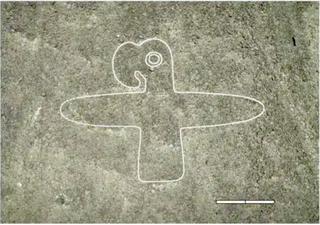
Thunderbird Motel next exit.
Pool, TV, Air Con , Fine Dining
Free WiFi.................
Acually, I stayed there , Jackson , Indiana, c.1961 ( n0 I 70 then ). Travelling with my parents, it wasn’t quite ready to open, as I recall, but the kind owner acquiesced to my father’s late night plea with his wife and five little kids in the car. The things that useta be. No fine dining though . either Spam or Vienna Sausage with a key to peel the top off.
AI knows the script, aliens write the code.
AI knows the script, aliens write the code.
The annual geoglyph festival was always the highlight of the year. Brought in people from all over.
"The breakthrough came from a joint..."
When Google earth first came out, I spent hours everyday at work checking out Peru. It made me think that at one time it was as populated as modern Los Angeles, until something wiped it off the face of the earth. (Like the Great Flood or an ancient thermonuclear war.
LOL!
Yeah, ‘cause the entire $500 billion was invested just to find these.
Should have been a Jimmy Buffet album cover.
Disclaimer: Opinions posted on Free Republic are those of the individual posters and do not necessarily represent the opinion of Free Republic or its management. All materials posted herein are protected by copyright law and the exemption for fair use of copyrighted works.
