Posted on 04/27/2026 6:34:06 AM PDT by MtnClimber
Here in New York, we continue to wait for the announcement of the annual budget that was due on April 1. Negotiations among the Governor and legislative leaders continue, with one big open issue being the potential extension of the “net zero” deadlines of the Climate Act.
While many issues may remain open, one thing on which there appears to be agreement is what they are calling the “pied-à-terre” tax — a real estate tax surcharge on New York City apartments valued at $5 million and up that are owned by people who are not permanent residents of New York. We know that that tax is an agreed part of the budget package because Mayor Mamdani bragged about it in his cringey video of April 15, which I covered (and linked) in my April 17 post. Both Mamdani and Governor Hochul have asserted that the new tax will raise approximately $500 million per year in new revenue for the City. However, neither Mamdani’s video nor anything else has disclosed the details of how this new tax will be implemented.
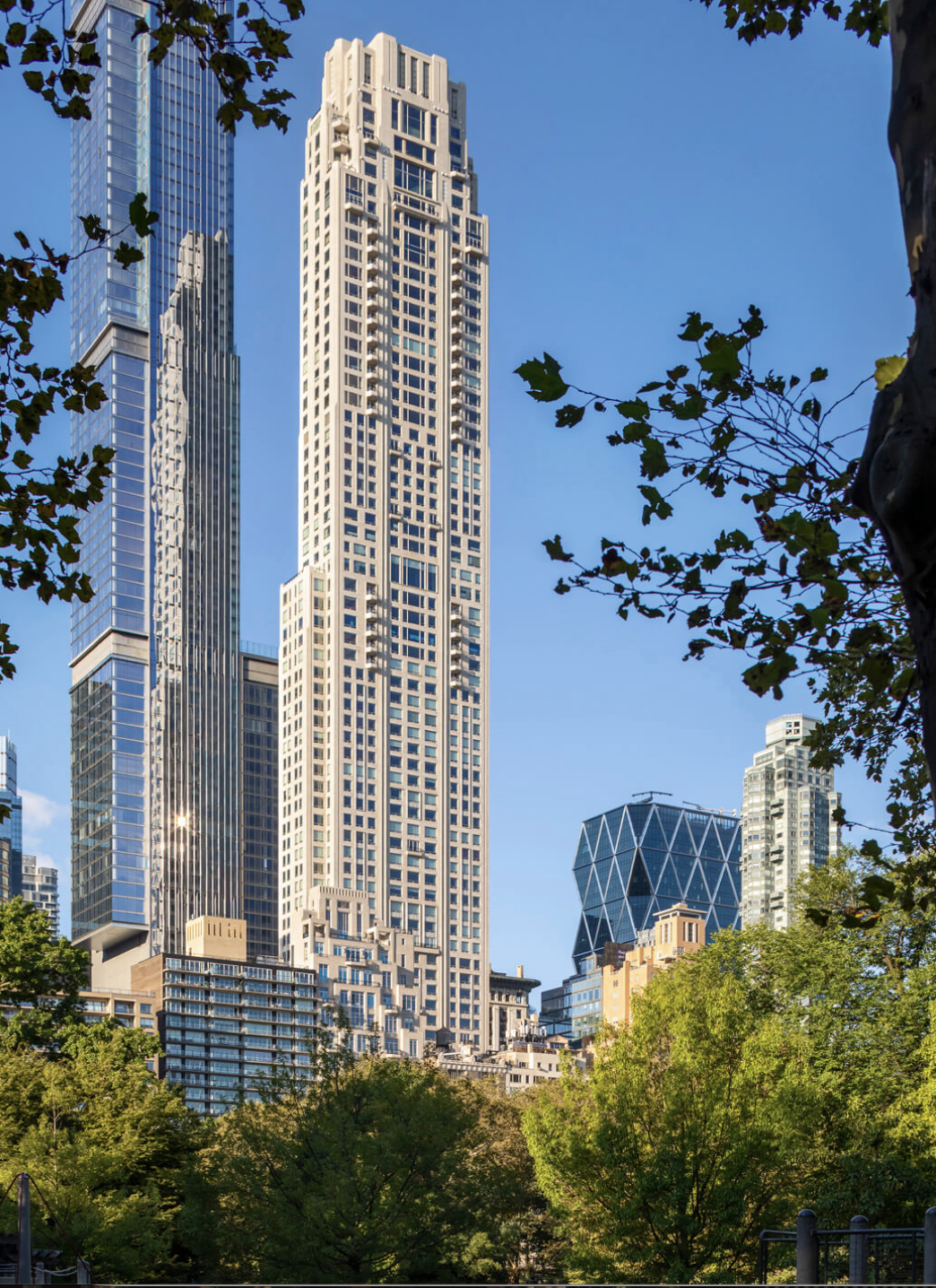
At first glance, implementation might seem easy. For instance, in his video, Mamdani specifically singled out a famous four-floor penthouse apartment at 220 Central Park South, purchased by hedge fund billionaire Ken Griffin in 2019 for $268 million. Here is a picture of that building:
The $268 million price of Griffin’s apartment is $263 million in excess of $5 million, right there. Impose a 1% surcharge on the value in excess of $5 million, and you will get new revenue of $2.38 million per year. Or will you?
The New York Post has several articles in today’s edition discussing the pied-à-terre tax and its impact on Griffin specifically. The most interesting among them is the one that appears on the Business page, written by Taylor Herzlich, headline “COURTING CHAOS: ‘Pied’ Piper Zo’s tax will fuel legal woes: pros.” This article discusses some of the arcana of how the New York City real estate tax actually works. Excerpt:
[A]s experts noted, there is a huge difference between NYC’s property assessment values and market values, and the pols have yet to clarify which figure will be used for the new levies. . . . Nathan Goldman, a member of the American Accounting Association and a professor at North Carolina State University, told The Post [that] [t]here are going to be a whole lot extra layers of legal battles that ensue as a result of this because this isn’t like the stock market. . . . This is a subjective number.”
As I have previously written many times, while New York City is a very high tax jurisdiction, and has unreasonably high taxes in multiple categories, its real estate taxes are relatively reasonable. The current taxation of Griffin’s penthouse illustrates the point in dramatic fashion.
According to Herzlich’s article, the current “market value” of Griffin’s apartment, as determined by the City’s assessors, is — $15.5 million. That’s less than 6% of the $268 million price he paid for it seven years ago. A statutory formula sets the “assessed value” for taxation purposes at 45% of the assessor-determined “market value.” That makes the “assessed value” just under $7 million. The current tax rate (set annually by New York City) is 12.340%. This rate is applied to the taxable assessed value of about $7 million. That means that Griffin’s current real estate taxes on the apartment are about $860,000. Now $860,000 is a lot of annual real estate tax to pay on an apartment. However, it is less than one third of one percent of the $268 million that Griffin paid for the place.
I suspect that the large majority of you provincials out there in the hinterlands of America pay well in excess of 0.3% of market value for annual real estate taxes. A common benchmark for annual real estate taxes is 1% of market value. In cities with deeply depressed market values, where houses sell for almost nothing (example: Detroit) annual real estate taxes can be 3% or more of market value.
So how is it possible that New York City’s assessors have put the “market value” of Griffin’s apartment at only about 6% of what he paid on an open market? Are they idiots? In fact they are not. They are constrained by a statute. What is actually occurring is that New York’s rent regulation regime drastically undermines the amounts that the City could otherwise potentially collect in real estate taxes.
Real estate taxation in New York City is governed by a State code called the Real Property Tax Law, or RPTL. For understanding this particular mess, the key provision of the code is RPTL § 581. Here is the relevant text:
“Real property owned or leased by a cooperative corporation or on a condominium basis shall be assessed . . . at a sum not exceeding the assessment which would be placed upon such parcel were the parcel not owned or leased by a cooperative corporation or on a condominium basis.”
If that way of speaking seems somewhat convoluted, the City’s Comptroller helpfully explained what it means in a June 2024 “Fiscal Note”:
In practice this means that cooperatives and condominiums in New York City are assessed as if they were rental buildings, hypothetically.
And how do they value the rental buildings? Those get valued on the basis of what is called their “real income and expenses,” otherwise known as their actual financial statements. This is a perfectly reasonable way to value rental buildings, since when they get sold on the market, they tend to trade at some multiple of the cash flow.
But the co-ops and condos don’t have equivalent financial statements. So the assessors look to what they call “comparables,” that is, rental apartment buildings of nearby location and with apartments of similar size and age. In New York City, many (and perhaps most) of those “comparables” are going to be buildings with rent-regulated apartments, where the income has been drastically suppressed by the rent regulation regime.
And by the way, the assessors don’t get the last say on what are the applicable “comparables.” Each condo owner or co-op building gets to challenge the assessment every year. For various reasons as to how the system works, it turns out that every single apartment building challenges its assessment every year. You can take the case to court if you want. There is a specialized bar of lawyers that handles these cases. They know every building and its assessment, and they know how to come up with the most favorable “comparables” to get your assessment down to a level you can live with. In practice, almost every one of these cases challenging the assessments gets settled.
In the instance of Ken Griffin’s apartment specifically, I do not know how anybody came up with “comparables” to get the determined market value of the apartment down to $15.5 million. However, I have no doubt that there are numerous building even in that very expensive neighborhood, filled with rent-regulated apartments, that got factored into the valuation.
Is the valuation, and the taxation, of the Griffin apartment “fair”? I have no way to evaluate that. In practice, the taxation of the Griffin apartment is a collateral consequence of other efforts to achieve perfect justice and fairness, most notably the rent regulation regime. All the efforts to use government manipulation to achieve perfect fairness inevitably make the situation worse.
Meanwhile, there is a case very slowly working its way through the courts that might change the methodology of tax valuation of co-ops and condos. That case is called Tax Equity Now NY LLC v. City of New York. The link goes to a decision from the New York Court of Appeals from 2024. The case involves a collection of challenges to New York’s real estate tax system, based on the idea that in many cases more highly valued properties pay a higher percentage of value in real estate taxes than less valuable properties. (If you think about it for a while, you will realize that that result is the inevitable consequence of the rent regulation regime.). The case had begun in 2017, and had been fully dismissed in the lower courts. However, the Court of Appeals (New York’s highest court) partially reversed the case and sent it back to the trial court to consider at least a few of the challenges. And there the case has sat for another couple of years. I think that the real estate markets are betting that the case will not cause any fundamental transformation of the tax system. And the legislature has basically been unwilling to touch the real estate tax system for many decades, because there are too many interests vested in the current regime.
But to get back to the question we began with: How will a pied-à-terre tax actually get implemented? If Ken Griffin’s apartment is valued, for purposes of the pied-à-terre tax, at the $268 million he paid for it, then there could be several million dollars of revenue to tap from that one apartment alone. And so it is possible to see how a $500 million total yield from the tax could happen. But suppose the “market value” of the Griffin apartment is only the $15.5 million determined by the current system? And similarly, under the current system where “market values” for real estate tax purposes are substantially determined by rent-regulated comparables, almost none of the apartments that Mamdani hopes to gouge will have “market values” of over $5 million. The whole gambit could disappear in a cloud of dust.
Marxists are almost never good at math.
Manhattan Contrarian ping
Oliver got Lisa out of NYC just in time!
Green Acres Lyrics by Vic Mizzy
Green Acres is the place to be.
Farm livin’ is the life for me.
Land spreadin’ out so far and wide
Keep Manhattan, just give me that countryside.
New York is where I’d rather stay.
I get allergic smelling hay.
I just adore a penthouse view.
Dah-ling I love you but give me Park Avenue.
...The chores.
...The stores.
...Fresh air.
...Times Square.
You are my wife.
Good bye, city life.
Green Acres we are there.
New Yorkers are like some women in relationships with abusive men. They are kinda stupid and they like the relationship that way. He’s a libtard... this government is what he wants and supports. I got bigger things to warry about than Ken Griffin’s tax bill...
Gonefs. F New York.
Somebody needs to take the Hans Gruber boy up Sockittomi tower (pictured) and throw his ass off.
The question is not whether these rick folks can afford the pied-à-terre tax. Of course they can.
The question is how bad they want to avoid paying it.
What if it comes out a lot less expensive to stay in a fancy hotel when occasionally in NYC (after selling the pied-à-terre)?
This is an example of how Marxist can be good at math. These increased tax revenues fall on those who aren’t voters. See how that works.
Worrying about money but wasting billions on the Insane Net Zero
Hot pants Hochul thinks that she is clever allowing Ma’amdami to crow about taxing the rich while penalizing a handful of people who don’t vote in NY. It would be fun if the rich generously contribute to whoever runs against her.
In 1982 one could buy a NYC apartment for around $40,000.
The maintenance fee was as much as the rent of a suburban apartment was.
Mamdani needs money so the DMV can babysit your kids.
Arnold can do pretty much anything a human can. He can write his name and change channels on the television. He watches the CBS Evening News with Walter Cronkite to keep up with the issues.[5] He signs checks and can adjust the TV antenna, and he is the smartest student at the local grade school.[6] He carries his lunchbox in his mouth, and often plays practical jokes on the other students.[7] Arnold is also artistically talented: he is working on a novel, he plays the piano, and he is an accomplished abstract painter, dubbed "Porky Picasso", whose piece titled "Nude at a Filling Station" wins first prize out of two thousand entries in a student art contest.[8][5] He even works as a "paper pig" delivering newspapers, although he has a bad habit of throwing copies so hard and so badly aimed that he sometimes breaks windows. Arnold is very lucky. He wins a trip to Hawaii in one episode, and a trip to Hollywood in another. After a Hollywood screen test, he is cast in a role originally intended for a horse, but after the horse, implied to be Mr. Ed, explains to Arnold that he needs the job to send his son to Stanford, Arnold's deliberate bad behavior leads to him being fired and the horse getting his job back. He also wins a prize at the Pixley Bijou movie theater for having the most original costume... the theater manager says that Arnold has the best looking pig costume he has ever seen.
For $268 million, you could build a small city with brownstone shells for your set to fill in.
Who needs New Yorkers when they can go country and trade New Yorkers for New Porkers like Arnold Ziffel?
The rich would be better off buying in The Five Towns near JFK.
The Republican legislature of New Hampshire is seriously considering doubling the property tax on properties that are not the owner’s principal residence.
Average rental value per square foot in the area, times number of square feet, times say 20 for 5% cap rate.
The problem isn’t undervaluing that unit, it is artificial rent control on the comps.
New Hampshire is a very beautiful part of the country. It seems many who work in the Boston area live in NH for the lower taxes.
Disclaimer: Opinions posted on Free Republic are those of the individual posters and do not necessarily represent the opinion of Free Republic or its management. All materials posted herein are protected by copyright law and the exemption for fair use of copyrighted works.