The Messinian Salinity Crisis / Zanclean Flood.Scientists Found Evidence Of The Biggest Event In Earth's History | 17:28
Thoughty2 | 25.68M subscribers | 971,176 views | November 17, 2025
Posted on 04/18/2026 10:56:45 AM PDT by SunkenCiv
The Messinian Salinity Crisis / Zanclean Flood.
Scientists Found Evidence Of The Biggest Event In Earth's History | 17:28
Thoughty2 | 25.68M subscribers | 971,176 views | November 17, 2025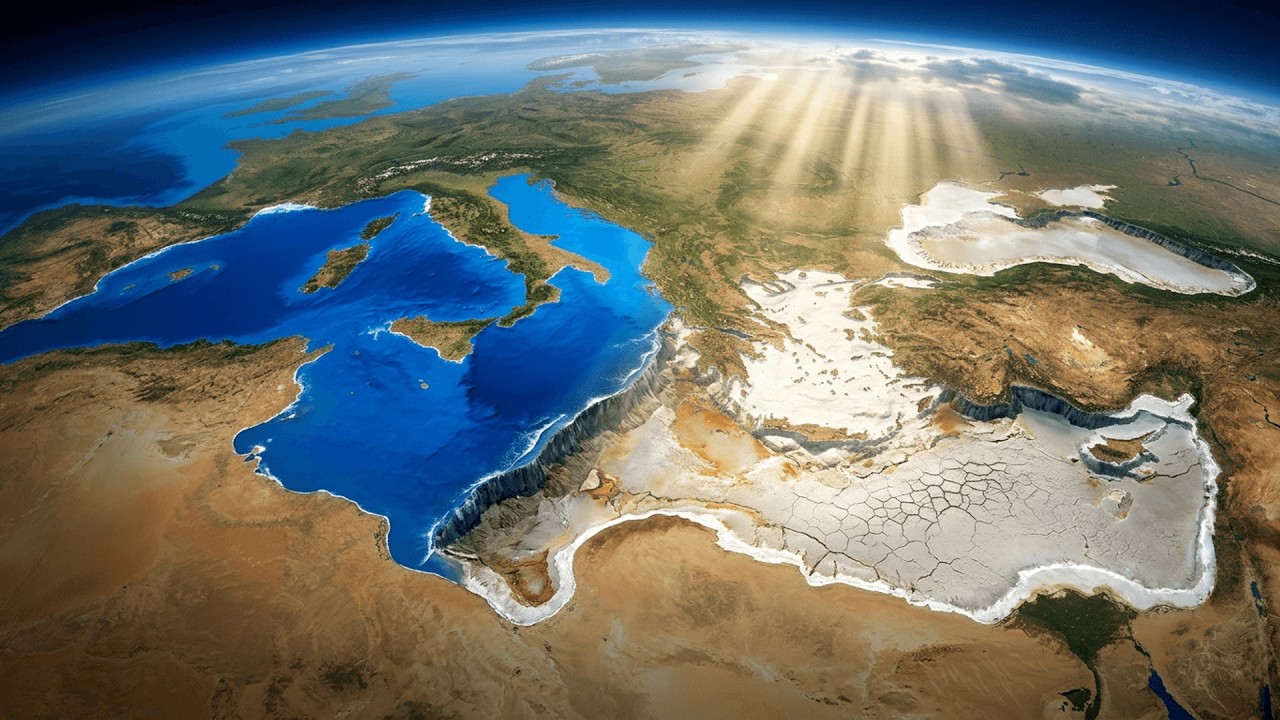
(Excerpt) Read more at youtube.com ...
YouTube transcript reformatted at textformatter.ai follows.
Based on Garcia-Castellanos et al., 2020, Earth Science, Reviews and references therein.Full Mediterranean desiccation-and-reflooding video | 2:09
Daniel García-Castellanos | 5.32K subscribers | 288,419 views | Jan 28, 2023
Transcript
Hey, 42 here. Deep beneath the waters of the Mediterranean is a very strange geological feature: the Mediterranean salt giant. Layers upon layers of rock salt in some areas are up to 2 m deep. It wasn't until the 1970s when scientists first began to understand the true scale of the salt giant. It's not just a geological curiosity. People have been mining this salt for a long time. This is the Rial Monte salt mine in southern Sicily. There are 80 miles of tunnels across six levels snaking deep into the salt giant, about 500 m below ground. The walls are banded with dark and light stripes, which are caused by the season in which the salt settled here millions of years ago. This place is so enormous that miners took it upon themselves to carve a cathedral made of the very salt itself. Dedicated to the patron saint of miners, St. Barbara, an 800-strong mass is held here every year on the 4th of December in Barbara's honor. Of course, you don't end up with layers and layers of salt 3 km deep unless some truly spectacular geological event happened, and that got scientists pondering: what was such an event?
Along with the Rial Monte Salt Mine, we found a few other clues dotted around the Mediterranean. [music] Namely, a deep-sea drilling project in the 70s found huge salt deposits in the seabed, and subsequent seismic surveys discovered that this salt wasn't localized to just a few areas, but in fact, these salt deposits form one continuous sheet of halite spanning the entire Mediterranean basin. Yeah, this thing is truly mind-bogglingly enormous. After some deliberation, it was quite clear what had happened here. There is only one explanation for such a huge deep basin of salt beneath the sea floor: at some point, the Mediterranean Sea itself must have evaporated.
Like all of it. Now, I know that sounds crazy, impossible even. 900,000 cubic miles of water doesn't just disappear into thin air. Except it did, 5 million years ago. Because at that point in our planet's history, the Mediterranean Sea did not exist. Where today you'd find your waters lapping the silken beaches of Greek islands, 5 million years ago, you'd find a vast sun-bleached wasteland. Just a few miles out from the beautiful Amalfi Coast, you wouldn't find Italian fishing boats, but prehistoric elephants and hippos searching rocky plains for scraps of food. Back then, the River Nile didn't end in an expansive delta, but instead plummeted off a cliff edge hundreds of meters into what looked remarkably like the Grand Canyon.
When we think of our planet, it's difficult to imagine it any other way. Even though logically we know that Earth's oceans and land masses have gone through innumerable changes during its 4 and a half billion year history. But we are so used to viewing our world in its current configuration [music] that the idea of, say, the Mediterranean Sea not existing seems completely alien. Yet it really did happen, and only 5 million years ago too, which on the scale of Earth's history is basically yesterday. For context, the supercontinent of Pangaea existed about 300 million years ago. And to understand exactly how you make one of the largest bodies of water on the planet disappear in the blink of an [music] eye, we first need to understand the importance of these eight miles [music] right here.
This is the Strait of Gibraltar. Nestled between, surprise, surprise, the British territory of Gibraltar and Morocco, it has long been one of the most strategic points on our planet, important to navies, global trade, and, as it turns out, the very existence of the Mediterranean Sea itself. Because other than a few rivers and rainfall, this is the only way that the Mediterranean gets topped up with water, at least any significant amount. As the close to half a billion yearly tourists who flood to the Med each year will tell you, it gets pretty warm around these parts. And that means evaporation. Lots of it. In fact, the sea level of the Med drops by a meter every year due to evaporation. At least it would if it weren't topped up. The Med loses far more water to the sky than rivers could ever replace. So the Gibraltar Strait acts as its de facto tap, quietly topping it up with fresh Atlantic Ocean water every [music] day until one day something strange happened that threatened to turn that tap off.
60 million years ago, Africa began pushing up into southern Europe, creating the Alps, Pyrenees, and other mountain ranges. This process began to steadily close off the many waterways that then fed into what would become the Mediterranean Sea, such as Tibetan and Rifian corridors. These were sealed up around 7 million years ago. Finally, only the Gibraltar corridor remained. That is until 6 million years ago when the relentless tectonic pressure from Africa pushed the seabed up across the narrow strait, putting the squeeze on the only real tap that was still feeding the Med. This happens to coincide with the rapid growth of the Antarctic ice sheet, which dropped global sea levels by about 50 m. Hence, 5.96 million years ago, the Med's tap was finally turned off completely, and evaporative demand began to rapidly outstrip supply, which now consisted of just a few rivers and rainfall.
At first, it began slowly. The shallow waters along the shoreline returned to the fo of the land, forming vast salt pans snaking around the entire perimeter of the Mediterranean. No longer shielded from the extremes by the embrace of water, these coastlines began to undergo a slow process of deposits. During dry spells, gypsum would accumulate along the coast, and during wetter seasons, muddy clay would form a top layer. This cyclical process and seasonal changes over hundreds of thousands of years is exactly what caused the banding that we now see in the Rial Monte mines. After 400,000 years of this, the water began to finally draw down enough to cause the main body of water in the middle of the Med to break up into smaller lakes. But eventually, these stubborn holdouts also acquiesced their claims to this great land. And over the next couple of hundred thousand years, this patchwork of lakes dried up to form one immense salt basin. And what remained was a landscape the likes of which no human has ever witnessed. It was a world stripped to its bones. What were once underwater plateaus now pockmarked the landscape. Their tops covered in layers of salt and gypsum. Their sheer cliff edges gave way to descents over a mile high into the bottom of the basin, which was now a yawning expanse of salt flats [music] resembling Salar de Uyuni in Bolivia but about 250 times larger.
The Great Nile and Ran rivers and many others continued their ceaseless emptying into the Mediterranean basin. But where there were once mighty deltas, now stood epic waterfalls over a mile and a half tall. The vast expanse that was once the Mediterranean Sea had now turned into a true death valley. Nothing could survive here other than the most extremophile bacteria. The floor was now so salty and anoxic that most species wouldn't last more than a few hours. The only place you'd have found any meaningful life would be on the larger islands and around the grassy coastline. There you'd see free-toed horses called hipparion, giraffids, which were like giraffes but stumpier, and relatives of the elephant such as gomphotheres. But all of these creatures were towered over by a megafauna, the deinotherium, a true leviathan of the late Miocene. Standing over 4 m tall with two monstrous hooks for tusks, they would have skirted the scrublands on the fringes of the dried-up Mediterranean basin. But even these mammoths didn't dare to meander their way down to the basin floor, where only salt and death awaited. And so this was the scene that would have spanned before your gaze if you had visited the Mediterranean 5.5 million years ago.
So what happened? Something must have happened because today the Med is one of the most idyllic places on Earth, chiefly because the azure waters returned. But how they returned is probably one of the most dramatic moments in the entire history of planet Earth. We don't know for exactly how long the Med stayed in this truly dried-out state, but it was at least a few thousand years until about 5.33 million years ago. The world shifted yet again. The ice sheets began to retreat, raising global sea levels. This put increasing pressure on the rocky dam that had formed across the Strait of Gibraltar. And if you've ever built a moat and filled it with water on the beach, then you probably already know what's coming next. Just picture this: the entire Atlantic Ocean was being held back by a dam only a few miles across made of rock, salt, and sand. And the drop from the top of this tectonic feature to the floor of what would become the Alboran Sea, the westernmost part of the Med, was just over a mile tall. In places like the Ionian and Levantine regions, the difference in altitude between the Atlantic and the bottom of the basin was over two vertical miles.
So, as the waters of the Atlantic began to steadily tick up over the millennia, so too did [music] the pressure building on this very precarious pinch point. Sure, the dam was mostly made of solid rock, but it turns out solid rock ain't so solid when an entire ocean comes knocking. It began with little more than a trickle; literal drips of water were finding their way through the small fissures and over the top of the dam. But every time they did, they would take a tiny bit of rock with them, eroding the dam ever so slowly. The thing is that every time a tiny speck of rock came clean from the dam, it just made it that slight bit easier for more water to push its way through. And as that happened, bigger pieces of rock began to falter. And then even larger volumes of water managed to push their way through, and so on and so forth. I bet you can see where this is going. We have [music] an exponential erosion process on our hands. Before long, and I'm literally talking days here, the entire Gibraltar Dam gave way in an event so spectacular, it was probably the most amazing thing that any human could have ever witnessed in [music] the recent history of our planet. Of course, this all happened 5 million years ago, and there wasn't exactly a guy with a time-lapse camera [music] to capture the action. Neither cameras nor Homo sapiens existed yet. Nonetheless, we have a pretty good idea of how the entire thing went down, thanks in part to this experiment of a simulated dam break. As you can see, a tiny fault is made at the top of the dam, and what appears to be a slow incursion of water very quickly becomes an almighty breach, and the entire thing is practically destroyed within a few seconds. Now, just imagine this happening on an enormous geological scale 5 million years ago in the Mediterranean.
The result was what we now call the Zanclean megaflood. Once the dam across the Gibraltar Strait had erupted, it's estimated that 90% of the Mediterranean's water volume was refilled in just a few months, which is absolutely bonkers when you think about it, considering it took about 630,000 years for the sea to dry up in the first place. So, for the Earth to change again so drastically in just a few months would have been quite a thing to witness. The Zanclean flood rose the sea level in the Med by about 10 m per day. It's estimated that the actual source of the flooding at the Gibraltar Strait had a drop of more than 3,300 ft, discharging about 3.5 billion cubic feet of water per second. It would have made Niagara Falls look like little more than a pissing otter. When the Mediterranean originally dried up, it's estimated that 89% [music] of the endemic species went extinct. After it was refilled by the flood, marine life once again returned. Most of the new species, however, were borrowed from the Atlantic. Before all of this, there were countless species that once existed only in the Mediterranean that were now sadly lost forever.
Sitting on any of the idyllic beaches that line the Mediterranean today, you'd see little to no evidence that one of the strangest series of geological events our planet has ever known occurred here. But dig a little deeper, and the remnants of the desiccation and the great Zanclean flood still remain, hidden at the depths of the deep blue. Because when the mighty floodwaters hit the southeastern toe of Sicily, they encountered [music] something called the Malta Escarpment. A 2.5 m underwater [music] cliff, easily visible from space today. An unfathomable volume of water thundered over this natural formation with tremendous force, about 3.5 billion cubic feet per second. And mixed in with that water was salt, sand, and granite. [music] As this torrent hit the bottom of the cliff, it excavated a huge canyon in the floor, literally ripping apart the earth. Today, we know this as the Noto Canyon. It's a 4-mile wide gash in the seafloor, created entirely by one of the biggest and most violent waterfalls in our planet's history.
Back in 1920, a German architect and certified nut job called Herman Zorgal proposed a plan to repeat the almost complete evaporation of the Mediterranean Sea that occurred 5 million years ago by building an enormous hydroelectric dam across the Strait of Gibraltar and the Bosporus. Whilst not completely drying out the Med, it would have lowered the sea level by 200 m. The hypothetical project was called Atlantropa, and the purpose was to reclaim land around the fertile Mediterranean for people to settle. It would have created hundreds of square miles of new land, and it was taken very seriously by quite a few people. But the vast majority of them were hubristic German architects and urban planners, which is a bit odd considering Germany isn't even on the Mediterranean.
The people of the countries that actually viewed it for what it was, bonkers. It would have cost billions, cut off major ports and fisheries, and driven up the salinity levels in the sea that remained, killing off the vast majority of marine life. So yeah, that boys and girls is why the adage "every idea is a good idea" is utter bollocks.
Thanks for watching.
"Urban Planners"
No suburbs, just a few mechanized farms growing the "approved rationed foods." Everyone else jammed together in the lovely urban plan.
Interesting
Owwwwwwww. Fifteen minute cities. Awesome right? 🤔😵
Last Pleistocene Ice Age, MIS4, possibly Toba-induced, total homo sapien population less than 50K, possibly as low as 1-10K. We were very nearly snuffed out by Planet Snowball.
Biggest event ever? The release of Led Zeppelin IV?



The collision that (most likely) formed the Earth-Moon system was a tad bigger...
Luckily the moon didn’t hit Uranus.
Ok, qualify it as “natural event”. But, then also see my post just above.
I remember the story “Gibraltar Falls”, part of Poul Anderson’s Time Patrol work.
Well, damn. I know I am getting older, but not THAT old.
Gotta admit, that’s pretty big. Glad I wasn’t around to witness that one. I might have been injured.
“Scientists Found Evidence Of The Biggest Event In Earth’s History”
-
Watched the video and found it very interesting, but
what was the “evidence” found by scientists?
Disclaimer: Opinions posted on Free Republic are those of the individual posters and do not necessarily represent the opinion of Free Republic or its management. All materials posted herein are protected by copyright law and the exemption for fair use of copyrighted works.

