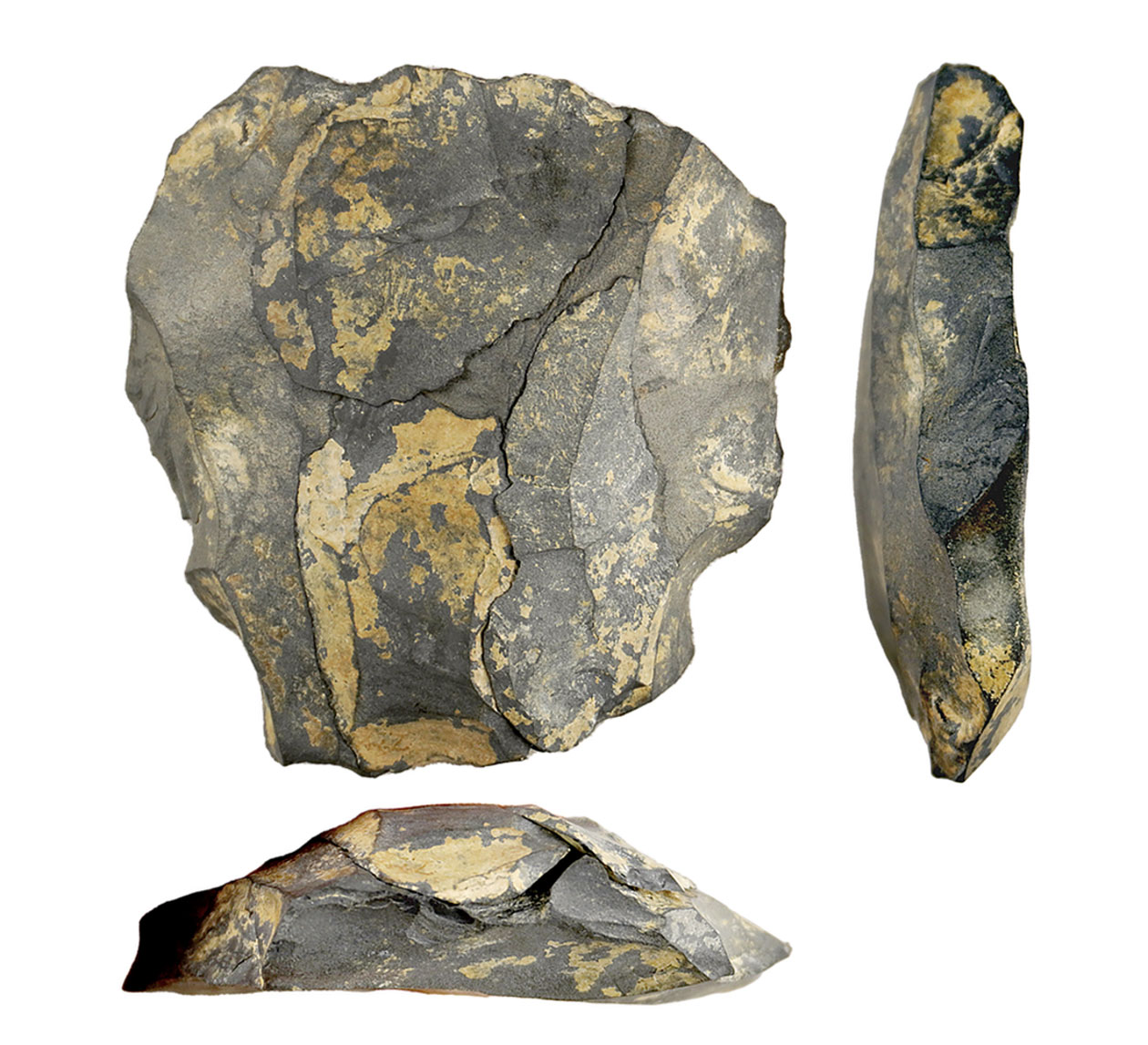
A reassembled stone artifact known as a refit found at the Jojosi site. The last three strikes made by a human knapper are visible in this 3D refit, which consists of four conjoining fragments.University of Tübingen/Gunther H. D. Möller
Posted on 04/14/2026 6:51:35 AM PDT by SunkenCiv
According to a statement released by the University of Tübingen, evidence of quarrying some 220,000 years ago has been discovered at the Jojosi site in eastern South Africa by a team of researchers led by Manuel Will of the University of Tübingen. It had been previously thought that early modern humans found stones for making tools incidentally as they looked for food. Team member Gunther Möller reassembled more than 350 rock fragments recovered from the site into "refits," or stones that had been broken apart by knapping. "With these 3D puzzles, we were able to see precisely where and how material was chipped off and in what order," Möller said. "Several of these puzzles together then allow us to draw conclusions about the form of the actual end product, before it was taken to another place," he explained. The lack of tools or traces of other activities conducted at the site suggests that people traveled to Jojosi only to obtain the desired rocks. This practice continued for about 100,000 years, based on luminescence dating of the finds. Read the original scholarly article about this research in Nature Communications. To read about hunter-gatherers in southern Africa who traveled long distances some 40,000 years ago to obtain special stones for toolmaking, go to "Source Material."
(Excerpt) Read more at archaeology.org ...
A reassembled stone artifact known as a refit found at the Jojosi site. The last three strikes made by a human knapper are visible in this 3D refit, which consists of four conjoining fragments.University of Tübingen/Gunther H. D. Möller

Not my first thought…but it should have been! Lol
Figuring this was done some 220000 years ago, I am presuming a lot of guesswork is involved since no one was there to verify any of this.
“Honey, for vacation this year, we’re going to Jojosi to collect rocks.”
“Oh, no! Not again! Our family has been doing that for 100,000 years!”
later
Went camping..Friend carried my napsack...What do you have in here...rocks?? Exactly I said.
If you run a population growth calculation using 2.2 children per household and 220,000 years, the population today would be trillions or more. I know, there were diseases and wars, but most agrarian families had 10 or more children. Don’t take my word for it, run the numbers, yourself.
🙂😊😁😀😃😆😅😂🤣
“If you run a population growth calculation using 2.2 children per household and 220,000 years, the population today would be trillions or more. I know, there were diseases and wars, but most agrarian families had 10 or more children. Don’t take my word for it, run the numbers, yourself.”
Obviously, YOU didn’t run the numbers ...
what answer did you get? (By the way, I’m also a Texas Gator)
Then there is predation by animals which would be especially severe in those times, all of which would drastically limit numbers of survivors that got to have kids - most of whom would not survive their early years.
An agrarian family is not the same as a hunter gatherer family which, in turn, is different from a loose tribal group just trying to survive in a human-hostile environment.
So you cannot use your calculations.
OK, so when does the population growth curve apply? If not 220,000,years ago, then perhaps 150,000 years ago or 100,000. At some point in human history, population began following a growth curve. Starting when?
South Africa 220,000 years ago:
Around 220,000 years ago, during a glacial phase, the southern tip of Africa was vastly different, featuring a massive exposed coastal plain known as the Paleo-Agulhas Plain. This area, stretching 75 km beyond the modern coastline, was characterized by extensive grasslands, limestone fynbos shrubs, and savanna-like vegetation, supporting megafauna.
Key Features of the Landscape:
The Paleo-Agulhas Plain: Sea levels were lower, revealing a landmass roughly the size of Ireland attached to the southern coast.
Vegetation: The landscape was a mix of grazing-friendly grasslands, rich shrubland (limestone fynbos), and savannah.
Climate: The area was high and dry during the glacial phases, creating a unique ecological niche for early human ancestors.
Coastal Location: Places now on the coast, such as the area near Knysna, were inland, overlooking this vast grassy plain instead of the ocean.
This, now-drowned, landscape played a crucial role in the evolution of early modern humans, offering a rich ecosystem to thrive in during periods of global cooling.
Agrarian = agricultural.
Since agriculture is 210,000 years younger, you might want to recalculate.
At some point in human history, population began following a growth curve. Starting when?
—
probably around the late 16th century AD
Disclaimer: Opinions posted on Free Republic are those of the individual posters and do not necessarily represent the opinion of Free Republic or its management. All materials posted herein are protected by copyright law and the exemption for fair use of copyrighted works.