Posted on 03/25/2026 12:46:49 PM PDT by MtnClimber
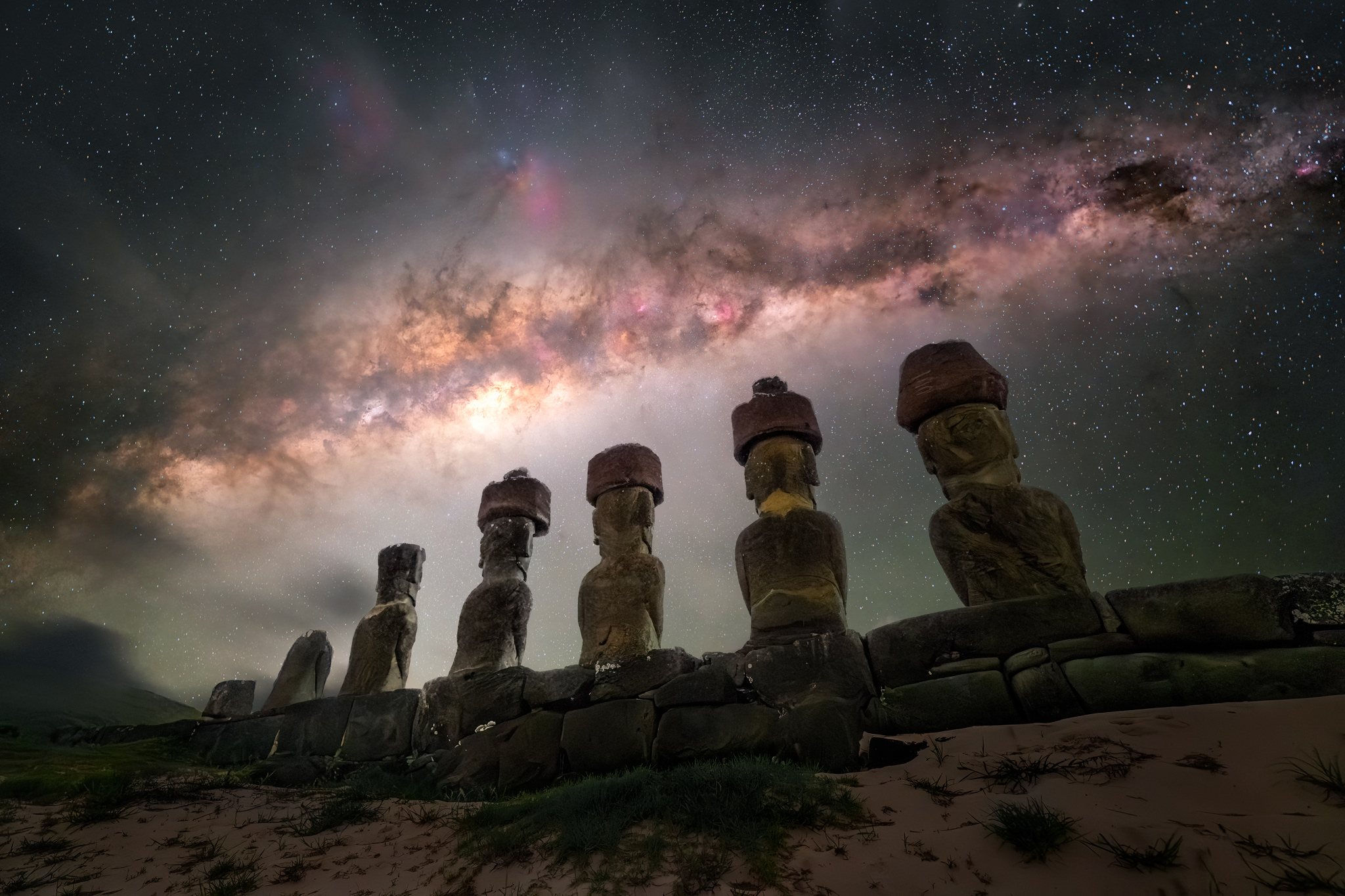
Explanation: In the words of today's astrophotographer, Rositsa Dimitrova, "What have these silent sentinels watched pass across the sky?" The volcanic mo'ai (meaning statue) of Ahu Tongariki stand guard over Rapa Nui (Isla de Pascua, Easter Island), a Polynesian island (annexed by Chile in 1888) located thousands of kilometers off the coast of South America in the Pacific Ocean. Due to the island's remoteness, the mo'ai, with their backs to the dark ocean, are able to gaze upon a clear and vibrant night sky. Pictured, these larger-than-life statues stare at the bright band of the Milky Way, partly obscured by interstellar dust and blurred by Earth's clouds. Under such clear night skies, the Rapa Nui created observatories and used astronomical observations for navigation, calendar calibration, celebrations, and more. Images like this one remind us of the importance of dark skies, protecting the land underneath them, and preserving the culture that they inspire.
For more detail go to the link and click on the image for a high definition image. You can then move the magnifying glass cursor then click to zoom in and click again to zoom out. When zoomed in you can scan by moving the side bars on the bottom and right side of the image.
🪐 🌟 🌌 🍔
That’s a good pic.
Wow.
Quite.
I’m glad you post these photos.
Totally cool! Have they been able to figure out how those statues got there and/or how they were built? I’ve heard a few theories, but nothing definitive.
Are there shots of our Milky Way from every angle? And how can we SEE the Milky Way when we’re IN the Milky Way?
Annoying Minds Want To Know! ;)
I have not heard how they did it either. It looks like it would have been hard.
That is an awesome picture 😀
Are you familiar with the concept of perspective, in art?
Here’s something to try next time you’re looking up at a dark sky, sitting in a recliner is good: the brightest stars are the closest to us. As the distance away from us increases, the stars get dimmer and closer together, eventually becoming so far away from us that they merge into the glow we know as the Milky Way. Try imagining that in 3D.🙂
My brain hurts, LOL!
Think of how you move a refrigerator across the kitchen floor — tip left, tip right, inch forward. Rapa Nui oral tradition literally says “the statues walked,” and the wear patterns on the bases match that. No cranes, no lost technology, no aliens — just brilliant engineering and a lot of teamwork.
As for the Milky Way: We can see it from inside the galaxy for the same reason you can see a forest while standing inside the trees. The closest stars look like individual points. The farther ones blend together into that glowing band. We’re looking along the disk of the galaxy, through thousands of light‑years of stars.
We don’t have photos of the Milky Way from the outside — we’re not that good at space travel yet — but we do have all‑sky surveys, radio maps, and reconstructions that let us map the structure pretty well.
The moʻai have been staring at that same band of light for centuries. We’re just catching up.
FYI: I'm no expert on this topic. I merely asked AI...
“As for the Milky Way: We can see it from inside the galaxy for the same reason you can see a forest while standing inside the trees.”
Now, THAT makes perfect sense to me. Thanks. ;)
That's how I move doors when they're off the hinges. Old doors don't weigh much, but neither do I. Workmen will always leave them lying on floors or otherwise in the way, so I often have to waltz them around. Way easier than pushing, dragging, etc. Same with big ladders.
Disclaimer: Opinions posted on Free Republic are those of the individual posters and do not necessarily represent the opinion of Free Republic or its management. All materials posted herein are protected by copyright law and the exemption for fair use of copyrighted works.