Posted on 03/02/2026 12:12:11 PM PST by MtnClimber
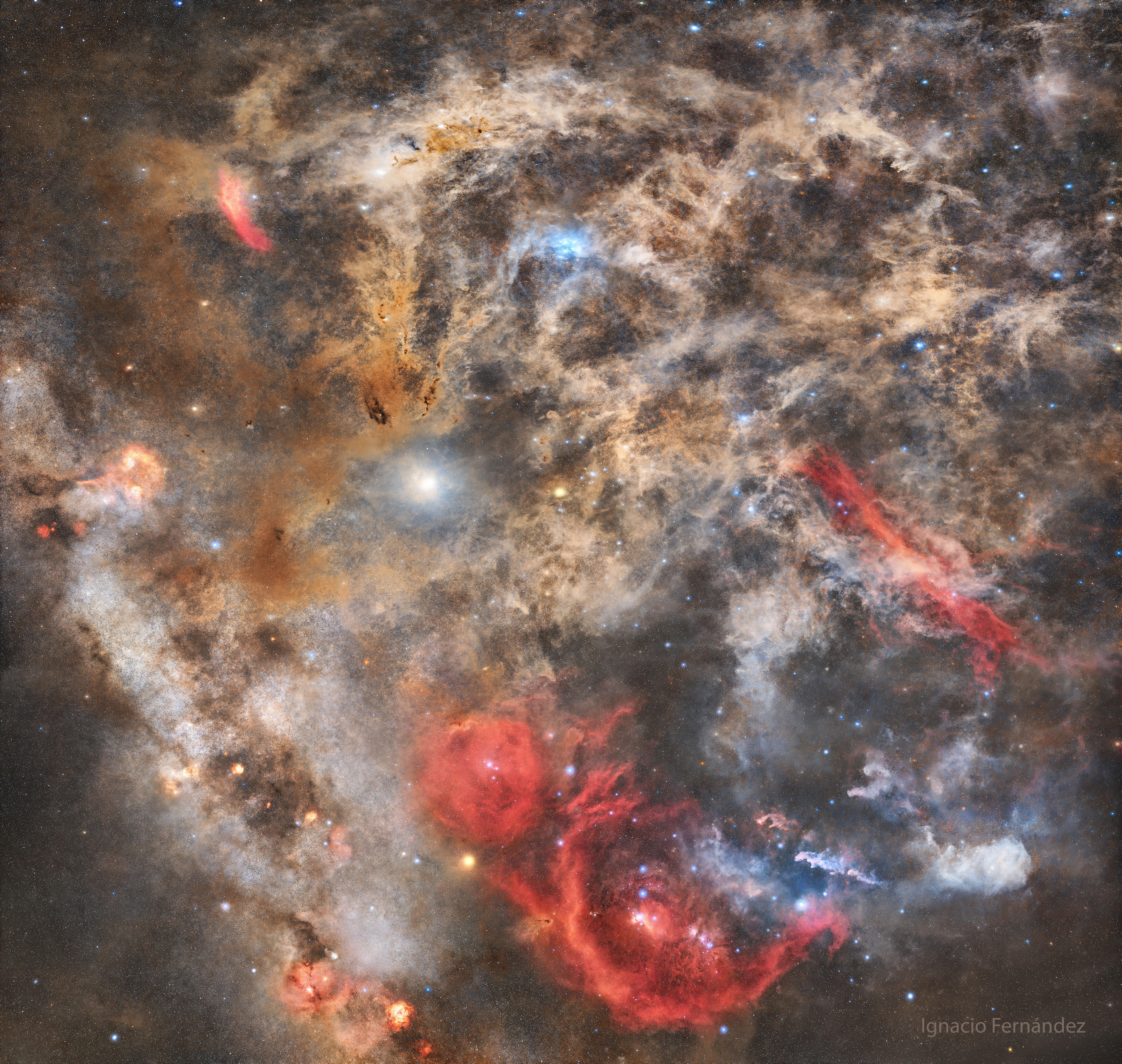
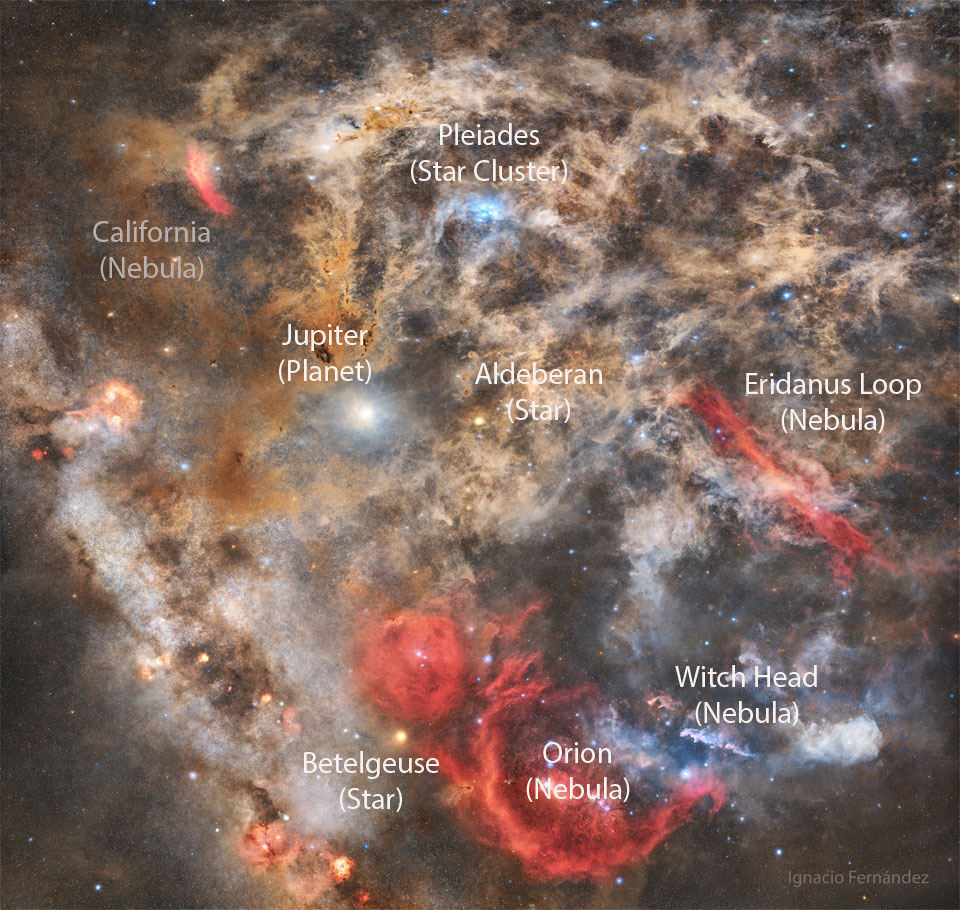
Explanation: How well do you know the night sky? OK, but how well can you identify famous sky objects in a very deep image? Either way, here is a test: see if you can find some well-known night-sky icons in a deep image filled with filaments of normally faint dust and gas. This image contains the Pleiades star cluster, Barnard's Loop, Orion Nebula, Aldebaran, Betelgeuse, Witch Head Nebula, Eridanus Loop, and the California Nebula. To find their real locations, here is an annotated image version. The reason this task might be difficult is similar to the reason it is initially hard to identify familiar constellations in a very dark sky: the tapestry of our night sky has an extremely deep hidden complexity. The featured composite reveals some of this complexity in a 16 hours of sky exposure in dark skies over Granada, Spain.
For more detail go to the link and click on the image for a high definition image. You can then move the magnifying glass cursor then click to zoom in and click again to zoom out. When zoomed in you can scan by moving the side bars on the bottom and right side of the image.
🪐 🌟 🌌 🍔
Wow.
Awesome.
Pretty! :)
16 hours of exposure.
I have trouble holding still for that long.
It amazes me how they can track a target with such precision for so long.
I don’t really understand this picture. Why is the background like that?
It is a long time exposure so it shows illumination of gasses that the human eye can't see.
The only ones I successfully picked out were the California Nebula and the Orion Nebula. Under the actual night sky I could easily find more. Under a truly dark sky I have a hard time finding the constellations. Under our local skies, away from the brightest lights, quite a few are visible. I was totally lost with that image, lol.
Yah, its for astronomers. That picture has a lot of visual clutter that makes it hard to pick through the main objects.
It does show a lot of structures that we couldn’t normally see. I guess that’s a good thing as far as studying astrophysics goes. And astrophotographers can show off what they can do. And that’s cool, we wouldn’t see this stuff otherwise.
Disclaimer: Opinions posted on Free Republic are those of the individual posters and do not necessarily represent the opinion of Free Republic or its management. All materials posted herein are protected by copyright law and the exemption for fair use of copyrighted works.