Posted on 02/19/2026 11:50:16 AM PST by MtnClimber
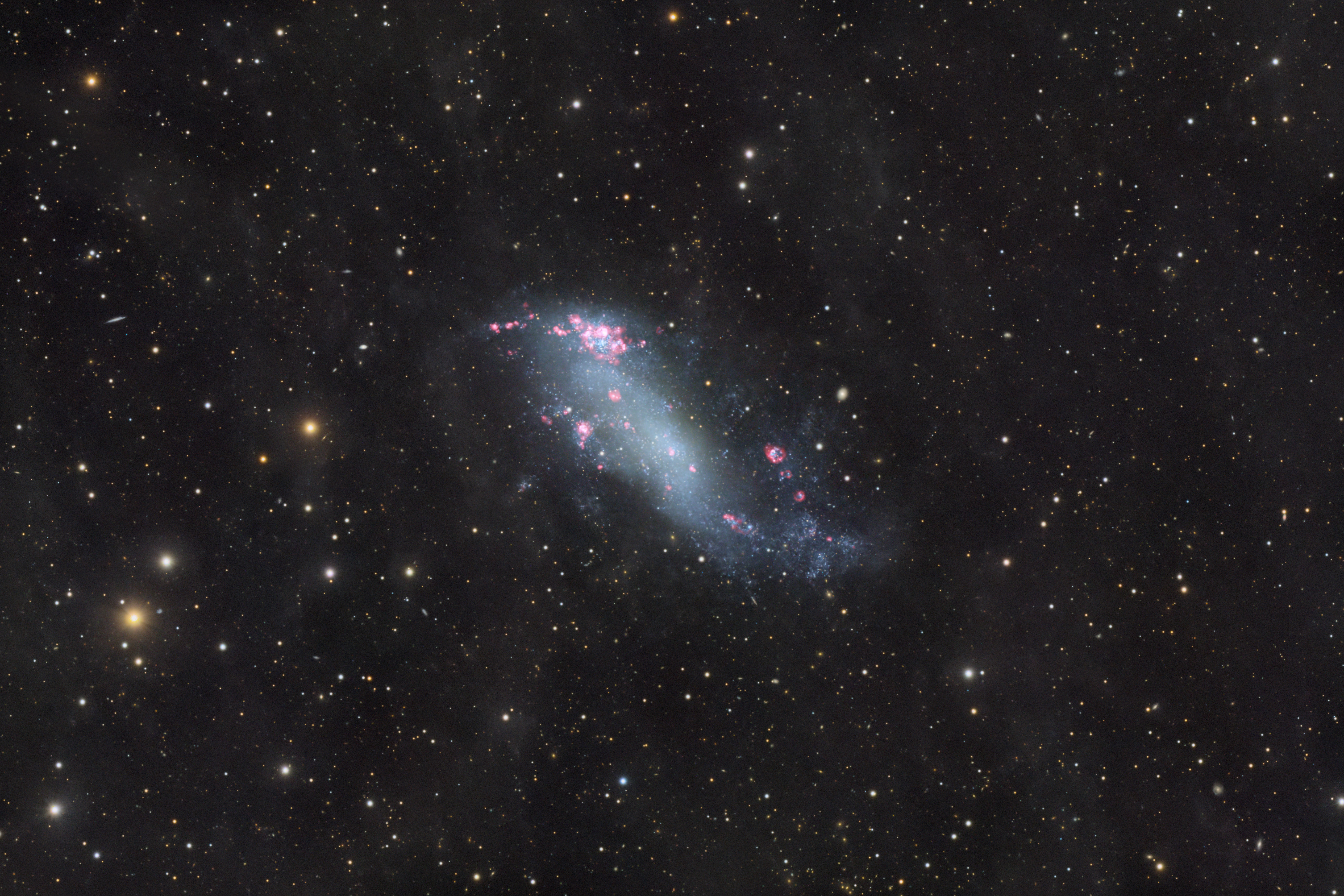
Explanation: Grand spiral galaxies often seem to get all the glory, flaunting their young, bright, blue star clusters in beautiful, symmetric spiral arms. But small, irregular galaxies form stars too. In fact, dwarf galaxy IC 2574 shows clear evidence of intense star forming activity in its telltale reddish regions of glowing hydrogen gas. Just as in spiral galaxies, the turbulent star-forming regions in IC 2574 are churned by stellar winds and supernova explosions spewing material into the galaxy's interstellar medium and triggering further star formation. A mere 12 million light-years distant, IC 2574 is part of the M81 group of galaxies, seen toward the northern constellation Ursa Major. Also known as Coddington's Nebula, the faint but intriguing island universe is about 50,000 light-years across, discovered by American astronomer Edwin Coddington in 1898.
For more detail go to the link and click on the image for a high definition image. You can then move the magnifying glass cursor then click to zoom in and click again to zoom out. When zoomed in you can scan by moving the side bars on the bottom and right side of the image.
🪐 🌟 🌌 🍔
That star formation is…intense!
Oh and, Ping!
“Small, irregular galaxies”
Don’t you listen to them!
You are just as good as any of those other galaxies!
Miralax can fix that irregularity. Heh. :-)

Disclaimer: Opinions posted on Free Republic are those of the individual posters and do not necessarily represent the opinion of Free Republic or its management. All materials posted herein are protected by copyright law and the exemption for fair use of copyrighted works.