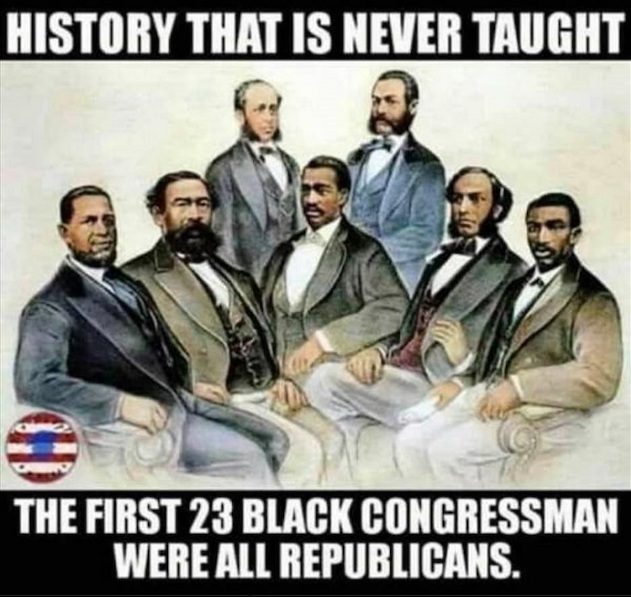

Posted on 01/30/2026 10:05:14 AM PST by MtnClimber
February is Black History Month, which liberals bend toward messages of unceasing oppression while shunning the many black historical figures who improved the nation and proved the American dream works for everyone.
The 1860 Census found 488,000 black Americans—11% of the nation’s black populace—were free before the Civil War broke out.
Let us look at the black American dreamers who did something more than being the first black fill-in-the-blank. It is not that breaking race barriers was unimportant. It is black people did a lot of other things that had little to do with the color of their skin.
I will start with Norbert Rillieux, who was born on March 17, 1806, in New Orleans to a plantation owner and a free mulatto woman. He would grow up to revolutionize the chemical industry with his U.S. Patent No. 4,879 in 1846.
His father also was an engineer. He sent his son to France to study, who became an instructor of applied mechanics at age 24. The son experimented for years before inventing the multiple-effect evaporator under vacuum, which led to his patent to improve sugar refining. His method required less heat, fewer workers and improved safety for those workers—thus saving slaves from harm in refining sugar.
Rillieux’s invention is still used in desalination, making condensed milk, processing other foods, making paper, and wastewater management as well as other chemical processes. He is commemorated as a National Historic Chemical Landmark by the American Chemical Society for revolutionizing sugar processing.
Being a pioneer in the chemical industry whose work still stands nearly two centuries later surpasses by far anything dancer Alvin Ailey, spelling bee winner Zaila Avant-garde or Marley Dias, 21, have done. They each get a day devoted to them on the Black History Month calendar. Rillieux does not.
Another overlooked inventor is Frederick McKinley Jones, who was born on May 17, 1893, in Cincinnati. Orphaned at 12, he fended for himself and became self-educated in engineering and mechanics—eventually holding more than 60 patents.
40 were on refrigeration but one of his other inventions improved cinema sound. He sold that patent to RCA. What good is a patent if you don’t make money from it? His other patents involved portable X-ray machines, radio transmission and race car parts.
But refrigerated transportation was his specialty. Along with businessman Joseph Numero, he founded Thermo King. His refrigeration systems were important in getting food to American troops in World War II.
Thomas L. Jennings is another black inventor who is brushed aside by black history advocates.
Born free in New York City sometime in 1791, he became a tailor. Things went sew-sew for him. Customers complained about stains that ruined clothing with fabrics that could not be cleaned with soap and water.
Jennings experimented and came up a solution. He received his patent for “dry scouring clothes” on March 3, 1821. His was the first patent awarded a black man. The patent made him rich. He took up the abolitionist cause, but died in 1859 before the 13th Amendment was written and ratified in 1865. He helped finance the Underground Railroad.
He did live to see his daughter, Elizabeth Jennings Graham, make history. She tried to board a streetcar, which was against the law in New York City for a black person. She hired a lawyer and won.
Brooklyn Circuit Court Judge William Rockwell declared, “Colored persons if sober, well-behaved and free from disease, had the same rights as others and could neither be excluded by any rules of the company, nor by force or violence.”
Her lawyer was Chester Arthur, who later became the 21st president. His fee was $22.50.
Rosa Parks rightly is honored for refusing to give her bus seat to a white man on December 1, 1955. But let us also recognize the lady who a century earlier made it possible for Parks to be on the bus.
Another heroine was Claudette Colvin (nee Austin). Nine months before Parks kept her seat, Colvin, then 15, refused to give up her bus seat to a white woman also in Montgomery, Alabama. She was one of four plaintiffs in a lawsuit that led to the Supreme Court striking down bus segregation and ending Montgomery’s bus boycott, which lasted more than a year and kicked off Martin Luther King Jr.’s career.
Could the reason she was not highly honored be that Colvin was a pregnant unwed mother when she testified in court? As they say on the Internet, prolly.
She died this January 13 at age 86—five years after the courts officially expunged her arrest record. Her death finally got her some notice in the media.
Black historians have honored black men have fought in many a war. Recently historians have discovered the nearly all black 6888th Central Postal Directory Battalion of the Women’s Army Corps who were sent to Europe to clean up the backlog of mail to servicemen during World War II.
Now it seems rather unimportant in an age of e-mail, but the letters from home boosted morale 80 years ago. The 6888th eliminated a backlog of 17 million pieces of undelivered mail in three months. Tyler Perry directed a movie about them in 2024.
Maybe Perry should look into the heroics of Jack Sisson, a slave who fought in the Revolutionary War. He is best known for being one of 40 men under the command of Major William Barton who pulled a Maduro on British Brigadier General Richard Prescott, arresting him in his home on July 10, 1777.
When the men found Prescott was locked in his bedroom, Sisson smashed through it with a head butt and Major Barton stuck his hand through the hole and opened the latch. They marched the general out in his nightshirt—barefoot. The story made Barton and Sisson legends among the continental soldiers.
While black historians praise Dr. Joycelyn Elders as the first black U.S. Surgeon General and Dr. Patrice Harris as the first black woman president of the American Medical Association, black historians tend to ignore Dr. Ben Carson.
Born into poverty in Detroit on September 18, 1951, he rose to become the Director of Pediatric Neurosurgery at Johns Hopkins Hospital at age 33. He worked on pediatric epilepsy. On September 6, 1987, he headed a 70 member team that in the first successful separation of occipital craniopagus twins—conjoined at the back of the head. It took 22 hours to separate Patrick and Benjamin Binder at age 7 months.
His post-medical political career is why he gets scant attention from those who write Black History. In their eyes, Republicans need not apply. Pinhead Ketanji Brown Jackson is honored. Clarence Thomas is not.
Black History Month is light on black capitalists. Consider Mary Ellen Pleasant, a cook who became the first black millionaire in America.
Born in 1814, she buried two husbands before joining the California Gold Rush, not as a prospector or talk show host but as a cook. Arriving in San Francisco in 1852, there was a bidding war to hire her as a cook. The winner gave her $15,000 in gold coins—money she wisely invested in boarding houses, laundries and restaurants.
But Pleasant continued to work as a domestic. Her big break came when she teamed up with Thomas Bell, a director of the Bank of California. They amassed a fortune of $30 million through investments in mining, real estate and banks.
Black historians ignore her. She made money and lived the American dream, which communists like our 44th president dismiss as white culture.
Another early black millionaire was Madam C.J. Walker. She rose up from poverty by making and selling beauty products to black women door-to-door. She trained and hired other women to use and sell her products. Hair straighteners are no longer acceptable among elitists, such as Jasmine Crockett, who wears a horse hair wig instead.
But the first black woman in what is now the USA to become rich was Marie Thérèse Coincoin. Born a slave in Natchitoches, Louisiana, in 1742, she was leased to French trader Claude Thomas Pierre Metoyer as a servant in 1767. They had 10 children. She bore their first 5 children as a slave.
Her manumission came after their relationship caused a scandal in the Catholic church. Fearing ex-communication, her lover freed her and their children. Metoyer gave her an annual allowance and 68 acres of land. She used the land to grow tobacco and to raise livestock. She owned 16 slaves. She hunted bears and sold bearskins and bear grease.
Her son Louis Metoyer built a plantation himself of 911 acres. By 1830, her family owned 200 slaves.
Well, it is obvious why she is not honored in February. The truth does not fit the narrative of unceasing oppression and anti-capitalism, but now you know some of the rest of the story.
Successful black people do not fit the narrative needed by communist revolutionaries (black = victim, white = victimizer).
How about just re-labeling it “Anti-Whitey History”?
Black history usually fails to mention blacks started black slavery in the New World.
Black history usually fails to mention that it was muslims that ran the slave trade in North Africa or that muslims also raided white countries to capture slaves (white slaves).
Black History Month actually begins with MLK Day now. Ever since that Monday, I’ve been seeing a lot of media programs about Blacks and it’s not February yet.
So, I guess it Black History 3 Fortnights now.
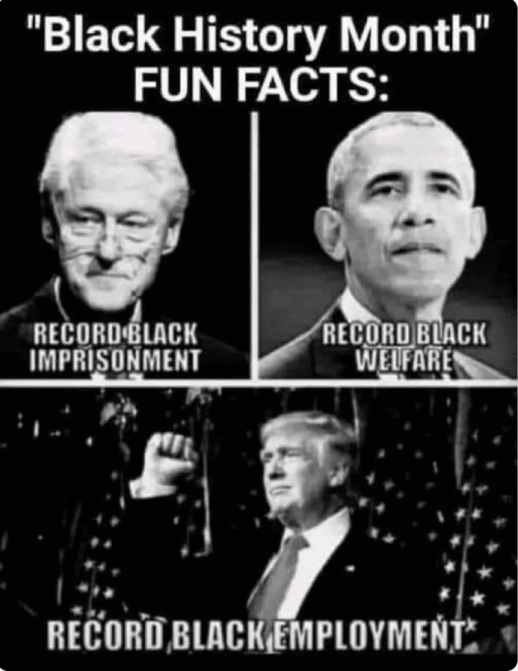
The second graphic is the legacy of the Democrat Party’s welfare state - their apparent solution to the end of slavery/Jim Crow/etc. to keep control of Blacks.
They had intact families and worked hard - they would probably be the wealthiest and most stable, model citizens among us by this point but for that systemic destruction at the hands of Democrat policies.
History that is not taught, indeed.
Indeed - Dr. Thomas Sowell writes a lot on this subject and audio segments are on YouTube with people “reacting” to them.
Re: Black History
There is no cure for inequality
This is the type of history that needs to be held up for all. There is the reality that blacks were brought into this country as slaves. That needs to be examined, as well as the history of the slave trade in Africa feeding the new world with slaves —South and North American both...How Muslims worked with tribes in the interior to “harvest” slaves for the trade.
Its a dirty ugly history that needs to be fairly examined.
And racism—it exists and has existed between all races toward each other. Its a tribal thing between all the various tribes of color, white, brown, red, yellow and black. It will never be stamped out until we all learn to love one another as wel love ourselves and walk in the path of Jesus.
But MLK’s saying that we need to judge a Man by his character and not by the color of his skin is a lesson was true then and true today...
But at what point do we not condemn the sons for the sins of the father?
But BHM is meant to divide, a political calculation on the left to absolve themselves of their sins of their fathers. One would think that democrats of the south actually freed to slaves and the Northern Republicans were the slavers...
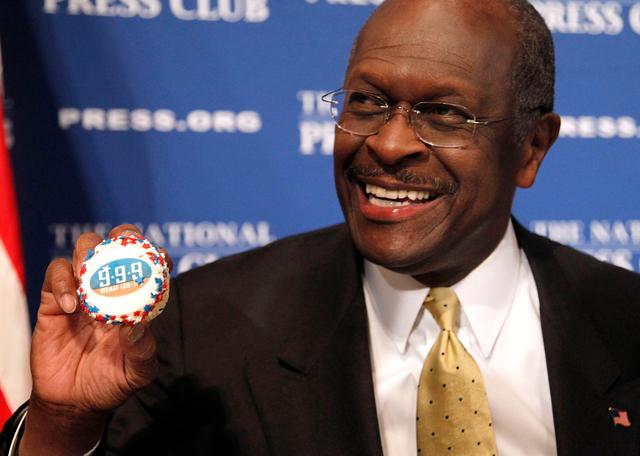
Herman Cain and his 999 plan.
2012 would have been fun with him as president.
The black history not told
Black slave owners believed in capitalism and made large amounts of money doing it.
Blacks do not know their history, only liberal nonsense.
Yeats ago I lived in a large city, and would ride my bike on one of the main downtown streets that passed through an old-time black neighborhood to get to university. There was a church on every other corner. Even as a young woman, I was not afraid and was never threatened. Sometimes I would stop to buy from a produce truck, and put the stuff in my bike basket.
My, how times have changed. Ever since LBJ said what he said and did what he did, destroying the black family.
It drives my liberal friends nuts that I voted for a black person for President before they did.
FREDRICK DOUGLAS
That’s hilarious! Here in Kali by the time the primary hit I think Cain had already withdrawn. Too bad.
1) What? A black ex-slave owning slaves?!?!?! Unpossible!!!! Hush!!!! Quite telling the truth!!! It will ruin The Narriative.
2) 99.9% of Americans do not know how to pronounce "Natchitoches" ...
Thanks for posting!
Disclaimer: Opinions posted on Free Republic are those of the individual posters and do not necessarily represent the opinion of Free Republic or its management. All materials posted herein are protected by copyright law and the exemption for fair use of copyrighted works.