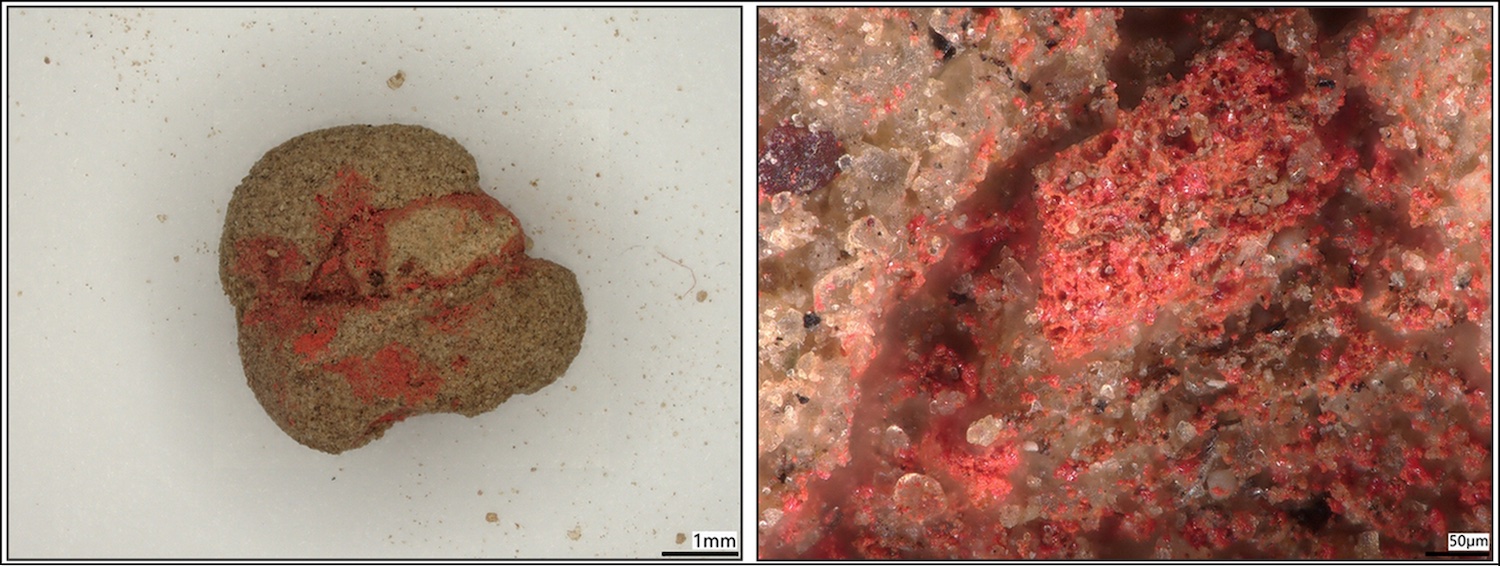
Cinnabar sampleA. Kurzawska/© Antiquity Publications Ltd.
Posted on 01/20/2026 2:35:13 AM PST by SunkenCiv
Science in Poland reports that cinnabar has been recovered from graves in a Scythian cemetery in southern Ukraine. Known as the Chervony Mayak cemetery, the site was in use from the second century B.C. to the mid-third century A.D. More than 175 graves in the cemetery have been excavated to date. Lumps of cinnabar, a toxic mercury sulphide with an intense red color, were found in three of these burials by a team of researchers led by Oleksandr Symonenko of the National Academy of Sciences of Ukraine. The lumps have now been analyzed by Beata Polit of Maria Curie-Skłodowska University and her colleagues. "Pigments of various shades of red have been discovered in graves attributed to the Late Scythian culture, but they are rarely subjected to archaeometric analysis using specialized equipment,” she said. A 2,000-year-old burial chamber contained the remains of two women, one aged about 18, the other between 35 and 45 at the time of death. Three lumps of cinnabar were found near the head and upper chest of the older woman. She is thought to have been buried first, and her remains moved to the back of the chamber when the second body was added a short time later. "It is possible that, in the context of graves to which more bodies were added, the pigment could have been used to neutralize bacteria or slow down the decomposition of the body,” Polit said. Pigments found in containers and shells, however, may have been used as cosmetics or paint ingredients, she added. Read the original scholarly article about this research in Antiquity. To read more about the rituals of this nomadic people, go to "Rites of the Scythians."
(Excerpt) Read more at archaeology.org ...
Cinnabar sampleA. Kurzawska/© Antiquity Publications Ltd.
Cinnabar is important because it was used to prove the existence of Oxygen as an element . It is for curious that an element that surrounds us everyday and was so vital to our existence took so long to actually discover .
Interesting.
Today I learned what cinnabar is.
But I totally read that as Cinnabon.
Cinnabar, sulfite of mercury (HgS), is an important ore of mercury.
Despite being toxic, it has been often used in the past as paint or even cosmetic, because its beautiful red color.
That was probably, why they found it in these graves.
Some bars do have cinnabons in them.
Aluminum and Mercury
NileRed
https://www.youtube.com/watch?v=IrdYueB9pY4
Silver mining at Potosi Bolivia began in precolumbian times AFAIK, but the Spanish really kicked it into gear. I’ve seen figures of 30-40 percent of ALL the silver ever mined in the world having come from Potosi, which helps explain how the Spanish empire because so rich.
Mercury Production and Use in Colonial Andean Silver Production: Emissions and Health Implications
https://pmc.ncbi.nlm.nih.gov/articles/PMC3346781/
Aluminum. It use to be so rare in its elemental state that it was more rare than Gold. The plates Nepolean had for state dinners of the elite used Gold only for lower royalty. The real top elites ate off of Aluminum plates! Just like purple use to be rare and reserved only for Kings science found a way to extract Aluminum. A process that uses a whole lot of electricity to preform!
On the Periodic table Sulfur is right under Oxygen which means the two are similar in their chemistry. That is why Cinnabar when heated produces Mercury Oxide and Mercury .
😀
bttt
Disclaimer: Opinions posted on Free Republic are those of the individual posters and do not necessarily represent the opinion of Free Republic or its management. All materials posted herein are protected by copyright law and the exemption for fair use of copyrighted works.