Skip to comments.
The Grim Reaper [16:44]
YouTube ^
| October 31, 2025
| The History Guy: History Deserves to Be Remembered
Posted on 01/08/2026 9:05:24 PM PST by SunkenCiv
The robed harbinger of human demise was once seen much differently, as was death itself. The history of how we personify death is a record of what we face in life. The Grim Reaper | 16:44
The History Guy: History Deserves to Be Remembered | 1.61M subscribers | 97,710 views | October 31, 2025

(Excerpt) Read more at youtube.com ...
TOPICS: History; Science; Travel
KEYWORDS: faithandphilosophy; godsgravesglyphs; thehistoryguy; thg
Navigation: use the links below to view more comments.
first 1-20, 21 next last
1
posted on
01/08/2026 9:05:24 PM PST
by
SunkenCiv
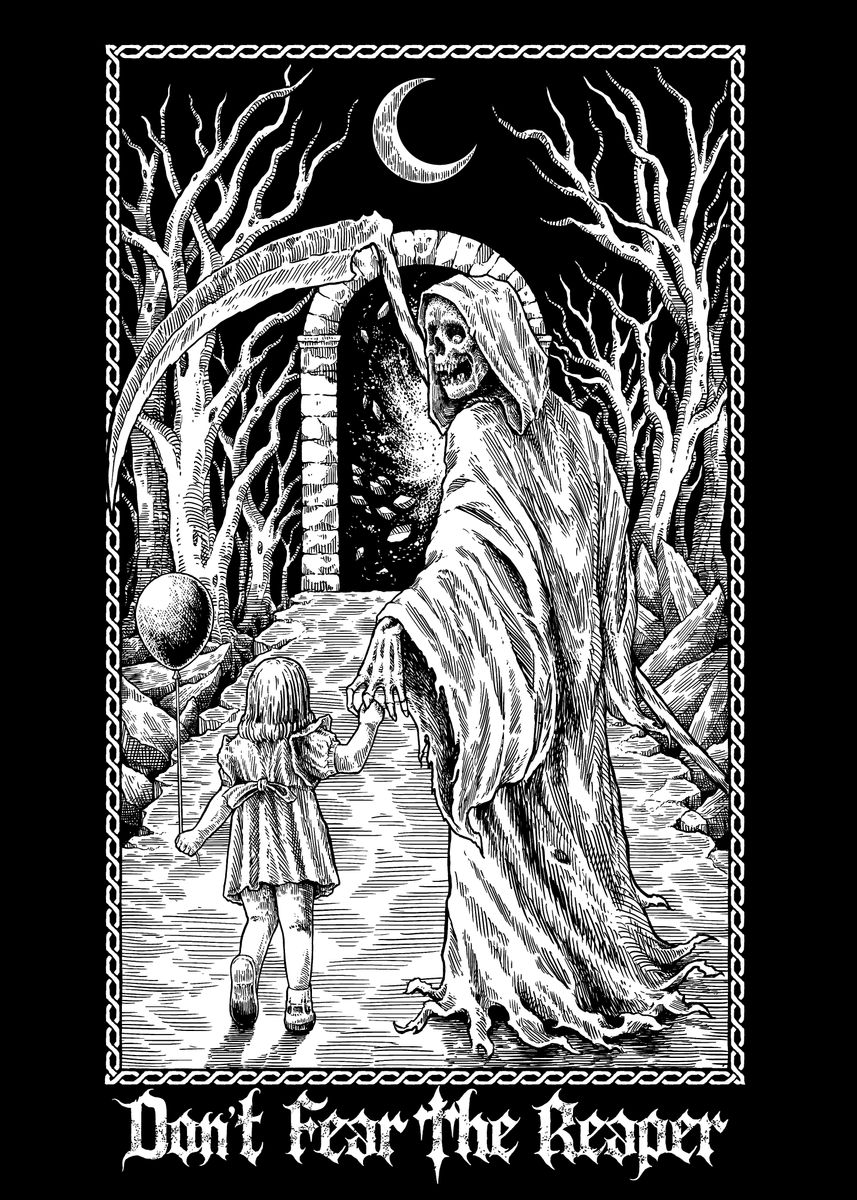
The Grim Reaper, the personification of death itself, has come to be a fairly normal part of our Halloween tradition. It's a normal Halloween costume and lawn ornament. But the harbinger of human demise was once seen much differently, as was death itself. The history of how we choose to personify death is a record of what we faced in life.
Freelance writer William Harris writes on the website How Stuff Works. Clearly, what happens as we die as well as what happens after we die is a major concern, and it has been for thousands of years. To make sense of dying and mortality, humans rely on a tried-and-true method. They give death a form they recognize. Personifications of death are among the oldest myths on earth, with perhaps the oldest being described in the Canaanite Ugaritic texts dating to the 12th or 13th century BC when the personification of death called Mott constantly struggles with Baal, a god of fertility and kingship. While the struggle between Mott and Baal is traditionally thought to represent the agricultural cycle, there is not full scholarly agreement on that, and texts are incomplete. But what we do have sounds pretty reaperish, with the line in one text being, "So it is my greed to kill, to kill. So it is my yearning to kill heaps and heaps." Mott rules over the netherworld and wields a rod of bereavement and a rod of widowhood.
Ombberto Kasut, a scholar of Ugaritic texts, explained in 1940, "Mott is death, the all-consuming power that puts an end to every kind of life, swallowing up everyone and everything that has reached its prescribed term." The personification of death is common in many cultures, but the contexts vary. The New Yorker explains on their YouTube channel, "Death is like pasta. Every culture deals with it in its own way."
The Slavic goddess Marenna is generally seen as part of the agricultural cycle, part of the cycle of death and rebirth. Each year, effigies are made by children and thrown into the river to celebrate the coming of spring. The Aztec god Mitsacus Towattle is a protector who watches over the bones of the dead. The Buddhist god Lord Yan and the likely related Hindu god Yama are gods of justice who judge the deeds of the dead. Death riding the white horse is one of the four horsemen of the apocalypse mentioned in the New Testament book of Revelations and is generally also seen as part of the final process of divine judgment.
Very commonly, the personification of death is a psychopomp whose primary role is to convey the souls of the dead to the netherworld or afterlife. One of those is the Greek personification of death, Thanatos, half-brother of Hypnos, the god of sleep. He's given a more sinister description, though, by the poet Hesiod, who says, "He has a heart of iron, and a spirit with him is pitiless as bronze. Whomsoever of men he has once seized, he holds fast, and he is hateful even to the deathless gods, although he is really seen as indiscriminate and unavoidable rather than malicious." The personification of death may also be related to Kronos, called Father Time, the king of the Titans and the father of Zeus. Personification of time sends the message that nothing lasts forever.
Personifications of death still today sometimes include an hourglass representing the inevitability of time and the time we have left. Many cultures include some personification of death as part of a ritual of moving people safely to the afterlife. The Hopi god Masau, for example, is generally seen as a friend of humanity that teaches balance and stewardship and highlights the interconnection between life and death. These personifications of death come in many forms and can be both male and female, but they rarely resemble the dancing skeleton that we recognize today. Thanatos is portrayed as a young attractive male. Robert D. Miller II of the Catholic University of America argues in a 2021 edition of the journal Ugarit Research that Mott is envisioned as a wolf with a gaping maw.
While the fourth horseman in the book of Revelations is often portrayed today as a skeletal rider, the book merely says, "I looked, and there before me was a pale horse. Its rider was named Death, and Hades was following close behind him. They were given power over a fourth of the earth to kill by sword, famine, and plague, and by the wild beasts of the earth." The Hindu version of Yama is usually depicted riding a water buffalo. He's wreathed in flames and has four arms and protruding fangs and the complexion of storm clouds. Whereas the Buddhist version often has the head of a buffalo and three eyes.
In the ancient Sumerian Gozer cult, the personification of death was actually chosen by a believer. As Lewis Tully explained in 1984, during the third reconciliation of the last of the Mcketric supplicants, they chose a new form for him, that of a giant slore. Many Chevs and Zuls knew what it was to be roasted in the depths of a slore that day, I can tell you.
But the form of the personification of death started to solidify in Europe in the late Middle Ages. The story "The Three Dead and the Three Living," with the first known written version appearing in 1280, has various versions of three men meeting three corpses in varying states of decay, which might be future versions of the men themselves. While the story was told by many authors in many ways over centuries, these talking corpses remind the men that death is inevitable. Often the men are portrayed as wealthy, emphasizing that power and status cannot save them from death. Frequently, the dead give a message for them to repent while they have time.
The stories developed over time, with the dead being portrayed as more menacing by the late 15th century. The representation of the personification of death as a decayed human took on new meaning during the 14th century. Encyclopedia Britannica explains, "It is estimated that about one-third of Europe's entire population perished as a result of the pandemic, with some areas of the continent suffering far greater losses than others. The original outbreak of the Black Death occurred during 1347 to 51. And the outbreaks then recurred several times after that. So clearly, death was something that the surviving Europeans had on their mind, and it's not surprising that they conjured up an image to represent it. That image began to take a familiar form." R. Andrew Chestnut of Virginia Commonwealth University wrote in 2012, "It was at this time when disease claimed at least one-third of European lives that death first became personified as the skeletal figure we know today. Painters, sculptors, and priests began to employ the skeletal representation of death in their work.
Harris writes that the dance macabre, a dance of death, was a type of play that emerged in the wake of the Black Death. The purpose of these plays was to prepare churchgoers for the inevitability of death. The play usually took place in a cemetery or churchyard and dramatized victims meeting with death personified as a skeleton. Still, these images would not be easily recognized as what we know as the Grim Reaper today. These skeletons were not commonly associated with the scythe until roughly the 15th century. This might have to do with the tool itself, which, although likely ancient in origin, did not come into common use in Europe until around the 9th century when hay started to be commonly cut and stored for livestock.
The website Faith and Verse writes that in the early Middle Ages, the scythe was seen as a companion tool but not as a replacement for the sickle. This was because the website Modern Homestead explains it was not much used in the harvest of grains since harvesting with the scythe resulted in significant loss of grain. Later, the introduction of the scythe cradle, a set of wooden tines or a bent wood bow with strings attached to the scythe, made possible efficient use of the scythe for grain harvesting.
This shift, Faith Inverse explains, also carried symbolic meaning. As a harvesting blade, the scythe entered into medieval Christian art and symbolism. By the 14th century, in the aftermath of the Black Death, the figure of death began to appear as a skeletal reaper bearing a scythe. The image was immediate and sobering. Just as a blade swept through wheat, so did death sweep through lives. The New Yorker wrote in 2017, "The scythe was significantly more efficient and productive than the ancient one-handed sickle. With it, death could mow down huge swaths of the population. However, the scythe might also tie to the old Greek legends of Kronos, who by the Renaissance period was conflated with the Titan Kronos, a god of agriculture and is often depicted with a scythe, perhaps representing the cycle of death and rebirth.
The tarot developed during the late Middle Ages, and by the 15th century commonly included the card death, often portrayed as a skeleton. The card doesn't, however, traditionally represent death, but a period of transition. The scythe became a perfect symbol of the mass death caused by the plague. Death portrayed as a skeleton carrying a scythe became a common motif in paintings of the 15th century where the dance of death had given way to the triumph of death. A common motif in medieval Renaissance art that emphasized the mass death of the era and the arbitrary nature of death regardless of class and status. Death was often portrayed riding a wagon carrying a corpse. This is also the period when some of the earliest paintings of the biblical four horsemen started to depict the fourth rider as skeletal or corpse-like.
Still, most of these representations were of a naked skeleton. While it is often asserted that the black robes are derived from robes worn by medieval clergy at funerals, depictions of the era don't seem to include them until the 17th century. Some of the skeletal army and Dutch Renaissance artist Peter Bruel the Elders, the triumph of death, painted in 1652, wore robes. Likewise, in Trier Cathedral in Germany, a 17th-century sculpture of the personification of death with scythe and robe begins to look like the traditional form that we see today. The image of death evolved, but the character we recognize today, a skeleton with a robe and scythe, sometimes portrayed with wings, an angel of death, didn't start to be common until the 19th century. The name we know now also came in the 19th century with the Oxford English Dictionary noting that the earliest known use of the noun grim reaper was in an 1847 edition of the Milwaukee Evening Courier when the term was used to reference famine in Ireland. Although other uses of the term were noted the same year and illusions to death as a reaper of souls might go back farther. Once again, the challenges of the day affected the perception of death. Art historian Marissa Lupus explains in a 2022 edition of Art and Object. Between the mid-9th and 20th centuries, much of the Western world became ensnared by the tendrils of war and pestilence. Death became the status quo and mourning traditions were forced to evolve. Private grieving events became public spectacles and vast cemeteries were built out of need for space. Once more, the figure of death became popular with the visual landscape. The personification of death became a common theme in art and literature.
An 1874 poem by Frenchman Henri Kazales called Dance Macabre has death rise in a cemetery and play a jig on a fiddle making the dead dance until the rooster crows. Zigg Zig Zigg death in cadence striking with his heel a tomb. Death at midnight plays a dance tune. Zig Zig Zigg on his violin. While the idea of a devil's midnight dance existed since medieval times, Kazales' poem, a cadence poem often accompanied by a xylophone, became very popular and was later rewritten as a symphony poem. A personified death was a common component of Gothic fiction. For example, in Edgar Allan Poe's The Mask of the Red Death, the frightening ghost of Christmas Future and Charles Dickens' A Christmas Carol is described as shrouded in a deep black garment which concealed its head, its face, its form, and left nothing of it visible save one outstretched hand.
But the Grim Reaper underwent another change in the 20th century. Larry Bush explained on the website Humor in America. While earlier, more superstitious societies may have taken the symbol of death more seriously, in our age of science, the image is outdated and quaint. That makes it a perfect vehicle for satire. This accompanied a general change in attitudes. The ancient Celtic tradition of sin became the modern tradition of Halloween. Food left out for the dead became candy to trick-or-treaters. Vegetables carved as lanterns used to ward off evil spirits became jack-o'-lanterns. Costumes meant to disguise people from malevolent spirits became children's costumes, and the Grim Reaper became one of the more popular of those costumes. Halloween became something where scary became fun, and so did the personification of death. While the Grim Reaper was not particularly associated with Halloween previously, the association between a figure of death and the celebration of Halloween became natural, and the Grim Reaper became a favored costume and decoration.
But there had been deeper changes. The representations of death in the past, while personified, were not humanized. The new version of death in the 20th century might have started with Italian playwright Alberto Cassella's 1924 play La Mortin Vicza, in which death takes on human form in order to understand why people fear him. The play was the basis for a 1934 film called Death Takes a Holiday, which then inspired a 1998 film where the once terrifying death is played by heartthrob Brad Pitt. While a serious take, the 1957 film The Seventh Seal, generally regarded as one of the greatest films in history, portrayed a white-faced death playing chess with a knight. The movie humanizes death in a way that maybe invites satire. And that satire was direct in the 1991 film Bill and Ted's Bogus Journey where instead of a game of chess to delay death, Bill and Ted beat death at Battleship, Clue, Electric Football, and Twister. Death ends up playing bass in their band. This demonstrates the significance of the shift. Benitos was disliked because he could not be bargained with and the message of The Seventh Seal was that you cannot cheat death.
Between 2000 and 2002, a cartoon was even produced called The Grim Adventures of Billy and Mandy on the premise that death had become enslaved as a personal friend of the two children after losing a limbo contest. The arrival of death at a dinner party in the 1983 Monty Python film The Meaning of Life is portrayed as comically mundane as guests at a dinner party casually converse with the Grim Reaper, apparently not understanding that they are actually dead. It's a Mr. Death or something. He's come about the reaping. Literary scholar Anna Artichenko notes a similar trend in literature on the arts and humanities website Arcadia that the Grim Reaper or death is portrayed differently by modern authors such as Terry Pratchett and Neil Gaiman. If the earlier representations of death in fiction were more violent, seductive, or simply ominous, the contemporary ones, especially those in the fantasy genre, are much more approachable. On the contrary, in modern fiction, death interacts with other beings, experiences the human world, has personality, desires, family, or friends. Contemporary stories still present death as an inevitable force, but with the purpose of inviting people to look at it from a different perspective instead of fear.
But death has changed more than that. The New Yorker magazine has produced more than 100 cartoons featuring the Grim Reaper since 1937. The magazine opines, "Comedy feels good when it's aimed at a perpetrator of injustice, and the Grim Reaper looms large at the top of that totem pole." Even when we try to take the Grim Reaper seriously, in the modern world, we don't seem to do a very good job of it. The Blue Oyster Cult song, "Don't Fear the Reaper," is a classic rock song about the inevitability of death. And yet it has been transformed by a classic Saturday Night Live skit about knitting more cowbell.
This transition of the personification of death from a, if not clearly malevolent, at least terrifying symbol of inevitability to the butt of jokes is interesting because one thing we have not managed in our modern world of technology is to defeat death itself. Yet somehow we've managed to trivialize its manifestation. Maybe in a world of technology, we just are less afraid of death because there is less superstition. Or maybe the inability of our technology to change the fact that all of us will at one time or another still have to dance with the Grim Reaper scares us even more. And our more friendly version of the personification of death is just our way of avoiding the conversation.
I hope you enjoyed watching this episode of The History Guy. And if you did, please feel free to like and subscribe and share The History Guy with your friends. And if you also believe that history deserves to be remembered, then you can support The History Guy as a member on YouTube, a supporter on our community at Locals, or as a patron on Patreon. You can also check out our great merchandise shop or book a special message from The History Guy on Cameo.
[Music]
[Applause]
[Applause]
[Music]YouTube transcript reformatted at textformatter.ai
2
posted on
01/08/2026 9:06:15 PM PST
by
SunkenCiv
(NeverTrumpin' -- it's not just for DNC shills anymore -- oh, wait, yeah it is.)
To: StayAt HomeMother; Ernest_at_the_Beach; 1ofmanyfree; 21twelve; 24Karet; 2ndDivisionVet; 31R1O; ...
3
posted on
01/08/2026 9:07:13 PM PST
by
SunkenCiv
(NeverTrumpin' -- it's not just for DNC shills anymore -- oh, wait, yeah it is.)
To: SunkenCiv
Everything I know about the Grim Reaper came from “Monty Python’s The Meaning of Life.”
4
posted on
01/08/2026 9:11:42 PM PST
by
ConservativeMind
(Trump: Befuddling Democrats, Republicans, and the Media for the benefit of the US and all mankind.)
To: ConservativeMind
I was going to say, “Deconstructing Harry”, but I can’t even link to it, it’s really dirty. Whoops, I forgot to delete the link before I clicked “post”.
(time index 14:57)
https://www.youtube.com/watch?v=zPRguw03W6c
5
posted on
01/08/2026 9:15:09 PM PST
by
SunkenCiv
(Say Goodnight, Gracie.)
To: ConservativeMind
6
posted on
01/08/2026 9:20:49 PM PST
by
xp38
To: SunkenCiv
7
posted on
01/08/2026 9:59:47 PM PST
by
Nateman
(Democrats did not strive for fraud friendly voting merely to continue honest elections.)
To: SunkenCiv
8
posted on
01/09/2026 12:43:07 AM PST
by
MikelTackNailer
(If we comprehended the value of our limited time at an early age...)
To: MikelTackNailer
9
posted on
01/09/2026 7:56:27 AM PST
by
SunkenCiv
(NeverTrumpin' -- it's not just for DNC shills anymore -- oh, wait, yeah it is.)
To: SunkenCiv
10
posted on
01/09/2026 8:14:44 AM PST
by
Salamander
( Please visit my profile page to help me go home again. https://www.givesendgo.com/GCRRDa)
To: xp38
But I didn’t even have the salmon!
11
posted on
01/09/2026 8:26:19 AM PST
by
Salamander
( Please visit my profile page to help me go home again. https://www.givesendgo.com/GCRRDa)
To: MikelTackNailer
I wish Disturbed would cover it.
They own The Sound Of Silence now.
DFTR would be interesting.
12
posted on
01/09/2026 8:36:06 AM PST
by
Salamander
( Please visit my profile page to help me go home again. https://www.givesendgo.com/GCRRDa)
To: SunkenCiv
13
posted on
01/09/2026 8:41:27 AM PST
by
Salamander
( Please visit my profile page to help me go home again. https://www.givesendgo.com/GCRRDa)
To: Salamander
Oooh, just clicked on and like it already. Some of those old folk songs just have the right feel, like “The Magpie”. Hmm, the version I know didn’t pop right up, so here’s a really nice one, vocal and huge three string bowed psaltery.
https://www.youtube.com/watch?v=fQ9MRda65eo
14
posted on
01/09/2026 9:21:59 AM PST
by
SunkenCiv
(NeverTrumpin' -- it's not just for DNC shills anymore -- oh, wait, yeah it is.)
To: SunkenCiv
I love the Appalachian folk music and the Scots/Irish it came from.
Always give me really “ spooky” chills, like I’m remembering my ancestors.
Hard to explain.
15
posted on
01/09/2026 11:59:34 AM PST
by
Salamander
( Please visit my profile page to help me go home again. https://www.givesendgo.com/GCRRDa)
To: SunkenCiv
Have a biker friend who played the standing bass in a Bluegrass band.
They did House Of The Rising Sun and it brought me to tears.
Full moon was over the mountain where my house is, mist rising up in the holler and I somehow knew life would never be the same or that sweet, ever again.
I think that’s why I cried.
That was on a Friday night and the next week was the 9/11 horror.
It was like some kind of supernatural experience.
16
posted on
01/09/2026 12:06:21 PM PST
by
Salamander
( Please visit my profile page to help me go home again. https://www.givesendgo.com/GCRRDa)
To: ConservativeMind; SunkenCiv
Everything I know about the Grim Reaper came from...
17
posted on
01/09/2026 12:56:15 PM PST
by
GingisK
To: Salamander
Before I retired I spent time outdoors in downtown Grand Rapids, in the summer, and when, for no known reason, a small ensemble of bagpipers would start playing, the sound would carry, and that’ll draw me like peanut butter attracts mice. As with Americans in general, I’ve got ancestors from a lot of different places, and little bits of each of them are in there someplace/somehow.
18
posted on
01/09/2026 1:36:26 PM PST
by
SunkenCiv
(NeverTrumpin' -- it's not just for DNC shills anymore -- oh, wait, yeah it is.)
To: Salamander
I wish Disturbed would cover it. They own "The Sound Of Silence" now. Their version is outstanding but they have competition:
"Sound Of Silence" - Tico & the Man Frank Maglio
19
posted on
01/10/2026 4:19:08 AM PST
by
MikelTackNailer
(Classical was hard rock before electicity.)
To: SunkenCiv
20
posted on
01/10/2026 4:42:50 AM PST
by
sauropod
Navigation: use the links below to view more comments.
first 1-20, 21 next last
Disclaimer:
Opinions posted on Free Republic are those of the individual
posters and do not necessarily represent the opinion of Free Republic or its
management. All materials posted herein are protected by copyright law and the
exemption for fair use of copyrighted works.
FreeRepublic.com is powered by software copyright 2000-2008 John Robinson