Posted on 01/07/2026 11:48:50 AM PST by Red Badger
Key Points
* Headlight brightness has doubled in a decade, with widespread driver complaints and frustration.
* Regulatory loopholes allow manufacturers to increase brightness because of outdated federal standards.
* Regulations capping maximum brightness for LED headlights have still not been formulated.
=============================================================
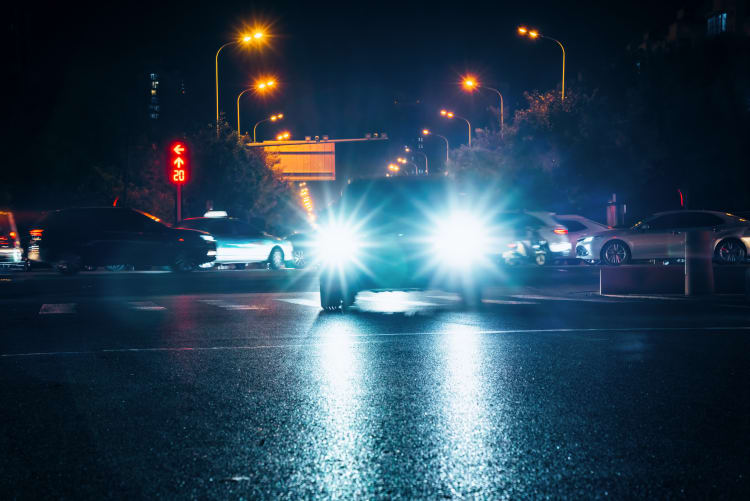
Illuminated headlights on an urban street at night
The Bright Headlights Crisis Is Far From Over
If you find yourself squinting while driving at night, you’re not alone. The IIHS reports that average headlight brightness has roughly doubled in the last decade. The NHTSA receives growing consumer complaints regarding headlight brightness. There’s a real, widespread anger out there; there’s even a subreddit with over 44,000 members complaining about this growing and very real crisis.
The numbers support the public’s frustration. Older halogen bulbs produced approximately 1,000 lumens. Newer factory-fitted LEDs produce up to 4,000 lumens or more. Some aftermarket LEDs have been found to produce 10,000 lumens or more. But the problem is that the federal brightness standards for automotive headlights have not changed for decades.
Regulatory Loopholes Made The Issue Worse
The Federal Motor Vehicle Safety Standard No. 108 hasn’t had significant updates since 1986, with an addition allowing Adaptive Driving Beam (ADB) headlights coming only in 2022. The NHTSA last investigated the issue of headlamp glare in 2003. The current standards include huge loopholes for auto manufacturers to emit as much light as desired, as long as the manufacturer meets the requirements of the other parts of the regulation.
LEDs can be made to focus light using lasers, and auto manufacturers use this ability to their advantage. The regulatory standard prohibits excessive light in certain areas by referencing old technologies, but manufacturers design the areas in question to be shaded so that the total light output can still be increased greatly overall. Manufacturers want as much light as possible in order to get a high score for the IIHS headlight safety ratings.
Blinding Headlights Are a Global Problem
Blinding headlights are something that people from all over the world are complaining about, but very few countries have taken proactive measures. The UK has decided to require all new vehicles sold after December 2025 to have adaptive headlights. Since 2010, European countries have utilized ADB technology, which automatically dims the light in areas that are directly ahead of oncoming vehicles. Although the U.S. finally approved the ADB technology in 2022, manufacturers are wary of implementing it because of conflicting regulations, with a few exceptions, such as Rivian.
Less Brightness, More Logic
To fix this problem, the first step is to update Standard 108 with a cap on the maximum allowable brightness for LED technology. Next, states should begin requiring headlight alignment inspection during vehicle inspections. Finally, NHTSA should enforce a ban against the sale of aftermarket LEDs that exceed the allowed brightness, at least for on-road use.
The Soft Lights Foundation has collected over 77,000 signatures calling for federal action to limit headlight brightness. People are frustrated with being temporarily blinded while driving, and it’s high time some regulation was put into place. Vehicles have become cleaner and safer through smart regulation; the same just needs to be done with headlights.
==============================================================
About the author
Simran Rastogi News Editor, Autoblog
Simran Rastogi is an automotive journalist with over a decade of experience writing and road testing for leading Indian and international outlets, including OVERDRIVE, India Today, and HotCars. Passionate about both modern and classic cars, he combines deep research with engaging storytelling to make automotive content accessible to all audiences.
False.
As a result of this I can now drive around in my 02 f350 with the brights on and no one flashes their lights at me.
Good luck with that one. A quick check shows that only "14 to 16" states require annual vehicle inspections.
So true!
It is not the brightness, it is the poor placement of the LED in the housing that makes it just shine everywhere.
These are aftermarket LED. Manufacturer LED do just fine, usually.
My rear view mirror still has the dimmer switch and thank god it does. These lights are a true safety hazard.
Ah, the old photon torpedo.
This is one reason I’ve thought about getting a dashcam.
We live on a mountain road, with lots of ups and downs. The lights we have on one of our cars chops off the beam on the top to reduce glare for other drivers. When headed downhill toward a dip with a rise beyond, the power of the beam has the eyes responding such that it renders the rest of the field completely dark. We’d be better off with a lower and more diffuse projected beam.
Ultimately, while one would like lights that followed the eyes of the driver, there would still need to be a way to back off when looking at opposing traffic or at mirrors.
It’s a complicated problem.
Supposed to be illegal here in Virginia, but.........
Most high-line autos today are equipped with “auto-dimming rear view mirrors. They auto sense when the guy behind you is using their high beams, and they auto dim. There is no longer any need to flip the dimmer switch. A very handy little convenience.
My 2023 Santa Fe has the old flip-style rearview mirror. Love it. But I don't like driving at night, so I rarely do. Getting old sucks...
Are the side mirrors so equipped?
There is such a thing, yes. I just googled your question.
Every year my headlights were "out of alignment" and the only way to get a sticker was to pay them to "align" them.
Guess I should have made friends with someone who did inspections.
I got them from JC Whitney with no clue what they were until they arrived.
They easily lit up long stretches of the interstate. People in oncoming cars started flashing their lights as soon as they topped faraway hills.
Even at 100 mph you could not over drive them.
Another problem is the headlight cover cataract problem. After five years they look cloudy opaque.
IIRC, that has been resolved with a different formulation of the plastic lenses, however older cars still have it..........
Not so much brightness as poorly aimed beams.
One problem is LEDs are ON or OFF. There is no in between. Dimming an LED is done with PWM (Pulse width modulation) which basically switches them on and off very fast to give the appearance the are dimmer. but the LEDs are just as bright. One can probably notice if you shift your view quickly it will look like the LEDs are flashing. They are. Car companies won’t fix this. It will cost a few extra dollars.
Disclaimer: Opinions posted on Free Republic are those of the individual posters and do not necessarily represent the opinion of Free Republic or its management. All materials posted herein are protected by copyright law and the exemption for fair use of copyrighted works.