
Posted on 01/06/2026 5:32:30 AM PST by MtnClimber
The big news in 2025 for the climate scare was that all of a sudden this scare wasn’t such big news any more. We’re talking here about something that all of the right people had agreed for decades was an “existential” threat to humanity. It was supposedly the single most important thing that we all needed to focus on and transform our lives to stop. We only had ten years to “save the planet”; or maybe it was only five. If we failed, we would shortly be inundated by sea level rise, or maybe devastated by floods and droughts, or burned up by wildfires.
And then, during 2025, quite rapidly the scaremongering stories became less frequent. Several prominent priests of the climate cult turned apostate (e.g., Bill Gates, Matthew Yglesias). The political push for “net zero” dramatically slowed. Why? There have undoubtedly been many reasons for the shift. Among those have been Trump administration regulatory changes and de-funding of scare-promoting bureaucracies and NGOs, plus the emerging extreme costs and ineffectiveness of the “net zero” energy transition.
But here’s another issue that, although I rarely see it mentioned, could play a big role in the ongoing eclipse of the climate cult: The failure of global tropospheric temperatures to closely track the rise in atmospheric CO2.
The asserted basis for the climate scare is the proposition that greenhouse gases (GHGs) in the atmosphere, primarily CO2 from the burning of hydrocarbon fuels, cause the atmosphere to warm. The hypothesis is that atmospheric temperatures are essentially stable in the absence of human influences, and that human-produced GHGs are introducing a forcing mechanism that causes atmospheric heat to track rising GHG levels, leading to higher and higher temperatures.
As our frequent and curmudgeonly commenter Richard Greene points out, you will be hard pressed to find any legitimate climate scientists to dispute the proposition that CO2 and some other human-produced gases (e.g., methane) are GHGs whose accumulation in the atmosphere is likely to lead to at least some warming. But, assuming that you accept that proposition, the question remains: Will the resulting warming be large, or moderate, or small? Indeed, could the GHG-induced warming be so small as to be even near or below the limit of detectability by available instruments? Could observed changes in temperatures be principally caused by other factors? And how could you assess those questions?
I suggest that the right way to assess the question is to look at the best available evidence. In other words, try using the Scientific Method! For these purposes, I propose as the best available evidence the record of global average lower tropospheric temperatures from the University of Alabama at Huntsville (based on NASA satellite readings); and the record of atmospheric CO2 levels from the NOAA observatory at Mauna Loa, Hawaii. It so happens that both of those records have just been updated through December 2025. Here are screenshots of the graphs from the two websites. First, here is the UAH global temperature record since 1979:
And here is the atmospheric CO2 record from NOAA since 1958:

A few things leap off the graphs. The CO2 trend has a small annual seasonality (associated with plant growth in the Northern Hemisphere, which has much more land area than the Southern); but aside from that, the trend is smoothly upward, with even a small amount of acceleration.
The trend of temperatures, on the other hand, is anything but smoothly upward. If you look at the UAH graph holistically, you will undoubtedly perceive an overall rising trend of temperatures as the years progress. But unlike the CO2 graph, the temperature graph is punctuated by periodic and significant reversals, where temperatures decline quite rapidly, and by amounts that are very large in relation to the overall rise.
Consider just the most recent 22 months, from April 2024 to December 2025. The UAH temperature anomaly has declined from +0.94 deg C to +0.30 deg C over that period, a decline of 0.64 deg C. The entire temperature rise in the UAH record from its inception in 1979 to its all-time record in April 2024 was from -0.47 deg C to +0.94 deg C, or 1.41 deg C. The recent 0.64 deg C decline represents almost half of that.
And yet even as world temperatures were giving back almost half of their increase over the past 46 years, the CO2 level continued its slow and steady rise, going from about 421 ppm to 427 ppm over those 22 months, according to the NOAA graph.
If you look at the NOAA graphs of the other GHGs, you will see that they follow a rising trend similar to the trend of CO2.
So, if CO2 and the other GHGs are the main factor in determining changes in atmospheric temperatures, why have the temperatures gone down for almost two years now while the GHGs have continued their rise?
I’m not saying that I know the answer to that question. I am saying that the know-it-alls who claim that the GHGs are the control knob for average atmospheric temperatures don’t know either.
Clearly, there are factors at play other than the GHGs, and the impact of those factors is not small relative to the impact of the GHGs. Whatever those factors are, they are capable of driving global average temperatures down by at least 0.64 deg C even as the concentration of GHGs continues to go up. In fact, they are capable of driving temperatures down even much more than that.
If you look at the other parts of the UAH temperature graph, you will see that this phenomenon of rapidly declining temperatures, as in the past 22 months, has also occurred repeatedly over the 46 year period of the satellite temperature record, all while the GHGs were continuously rising. Among the larger declines in the satellite temperature record were one of about 0.80 deg C from early 1988 to early 1989; one of more than a full 1 deg C from early 1998 to early 2000; one of about 0.80 deg C from early 2010 to early 2012; and one of more than 0.70 deg C from early 2016 to early 2018.
Something that was not GHGs drove temperatures down repeatedly by amounts ranging from 0.70 deg C to over a full 1 deg C over the past 46 years. And now that you know that, how exactly do you know that the increases in temperatures that have occurred over these years were not also caused in part or mostly, or even entirely, by these same unidentified forces? And if these forces are capable of driving temperatures down by more than 1 deg C, how exactly do we know that the current decline is not going to continue until temperatures have gone below the place where they started at about -0.47 deg C back in 1979? And if the temperatures do not go back to -0.47 deg C in the current round of decline, how do we know that they won’t go below that level in the next decline, or the one after?
There are obviously many hypotheses as to factors in play other than the GHGs. Some of those include: variations in solar irradiation; volcanic activity; atmospheric aerosols; level of cloudiness; and various oscillations in ocean temperatures. That list is by no means comprehensive. It may well be that there are other factors as yet unidentified. Moreover, I haven’t seen anyone who has put together a set of proposed factors that when combined can reproduce a pattern comparable to the satellite temperature record. You can call the unknown factors “noise,” but the “noise” may be as significant as all the other factors put together.
But the hypothesis that the GHGs are the main factor, the effective “control knob” of global temperatures? That looks to me to be falsified by the satellite temperature record. If commenters can explain why that is not the case, I’m very interested to hear why.
It is too bad the satellite data does not go farther back, but we all know why. Recall that the late 1970’s was a global cooling period where the scientists were crying “Industrial Winter”. So slight warming from the 1979 point is not abnormal.
Unless the science doesn't suit your narrative - then lie your ass off.
Many of the higher temperatures seen in the last five years are very slightly higher than were seen in the 1930’s.
Our global temperature record is far, far from complete. This is what the satellite record is useful. It is an actual measurement of the entire planet.
Going back thousands and millions of years, the “global” temperature of the earth is near its lowest point now. It has been far warmer previously. When the Earth is warmer, it tends to be much more biologically productive.
I don’t know the answer to all this, but that first graph clearly shows a warming trend.
The atmospheric carbon dioxide level follows temperature change, it doesn’t lead it. When the earth’s climate is accurately defined and described as the thermodynamic system that causes earth’s weather, all the old-wive’s tales and junk-science mythology fall away, leaving climate to stand on its own rather than being subservient to weather.
Carbon dioxide is a TRAILING indicator of variations in the level of warmth or cooling in the atmosphere, and has ZERO net effect on retention or loss of heat energy.
Because there is one “greenhouse gas” that has VASTLY more effect on warming and cooling of the atmosphere, and the entire biosphere, and that is water vapor, which can exist at a “triple point”, simultaneously in the solid (ice), liquid (fluid water) and gaseous (water vapor) forms, at the freezing point of water, 32 degrees Fahrenheit or 0 degrees Centigrade, under the atmospheric conditions existing on earth. Carbon dioxide has a similar “triple point”, but only under some extreme conditions of very low temperatures and heightened atmospheric pressure.
It was sunny and 48 degrees in Ohio yesterday, week earlier it was in high teens.
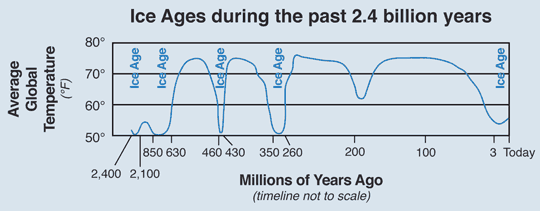
What caused ice ages to come and go?
What is “normal climate “ for earth.
Then there is the sun, the oceans, and volcanoes 😂
Yes. But the 1970's was a cooling period so coming back to normal would be a warming trend.
 Source:
 And the mini ice age lasted for 500 years and ended around 1850. Why did it happen, why did it end, and would some warming afterwards be unusual?
More questions than answers, but the adage follow the money always applies
I have always thought that if the CO2 level has consistently risen, as seen in the 2nd chart, that the warming would have to be cumulative. Since we see fluctuations, there has to be other substantial factors that are not being addressed. Those factors are either not fully understood, or they cannot be leveraged for political purposes.
I had often heard that temperature change LED atmospheric CO2 levels. I guess somebody saw it going the other way? Sounds like they are going against the facts.
Mauna Loa?
We’re tracking CO2 on top of a volcano, adjacent to other volcanoes?..............
Great explanation of the disconnect between atmospheric temperature changes and CO2 changes. However, it disregards the question of what is causing the observed rise in atmospheric CO2 concentration. Global warming acolites assume that it is caused by burning hydrocarbons. Conversely, one of the warmists’ own sources disproves this theory. The Vostok ice cores show that changes in atmospheric temperature precede changes in CO2 levels by about 800 years. And wouldn’t you know it, the medieval warming period happened about 800 years ago.
Yet other science experimentation shows that ocean-absorbed CO2 takes about 800 years to rise into the atmosphere, raising CO2 concentration. Only now we are likely seeing the rise in atmospheric CO2 concentration caused by the Medieval warming period.
And even this factor ignores the Milankovitch ice cycle’s insistence that earth is 10,000 years into a 20,000 year interglacial period. The atmosphere is supposed to be warming. How rapidly should the Milankovitch cycle cause atmospheric temperature to rise? That topic is being debated, but the answers only amount to guesswork.
All over the northern hemisphere, everywhere, volcanos are issuing record CO2 emissions. The simultaneous volcanic output skews all historical records to the point of irrelevancy.
The inconvenient truth is that when water vapor condenses in clouds, heat is released and a good portion radiates into outer space and the temperature is in equilibrium.
I think that the most likely theory is that the sun has variable cycles that affect the intensity of solar radiation. One cycle short enough for us to observe is the 11-year sun spot cycle. There is likely a longer cycle that causes the regular glacial and interglacial periods and an even longer cycle that causes the ice ages and warm ages. Most people do not know that we are currently in an Ice Age, just in an Interglacial Warm Period of the Ice Age.
.
All I know is that we have had the coldest December in 45 years.
Disclaimer: Opinions posted on Free Republic are those of the individual posters and do not necessarily represent the opinion of Free Republic or its management. All materials posted herein are protected by copyright law and the exemption for fair use of copyrighted works.