A 1690 map illustrated by Joseph Moxon entitled "Paradise or the Garden of Eden." On this map, the Garden of Eden is located on the right, in the land of Assiria. Archeologists hypothesize the Garden of Eden's true location lies in Mesopotamia
Posted on 12/29/2025 8:28:33 PM PST by SeekAndFind
When God banished Adam and Eve from the Garden of Eden, the Bible says that he placed a cherubim and flaming sword at the entrance that scholars believe is used to guard against their return to this paradise on Earth. But this clear expulsion of human beings hasn’t stopped archaeologists, theologians, and tourists alike from trying to find their way back.
The Bible’s vivid geographical description of Eden gave seekers a head start. Readers are initially told that the Eden is “in the east” and that “in the midst of the garden” were the Tree of Life and the Tree of the Knowledge of Good and Evil—the latter with its tempting fruit that Eve accepted despite God’s warnings, resulting in their expulsion (Genesis 2:9; Genesis 3:3).
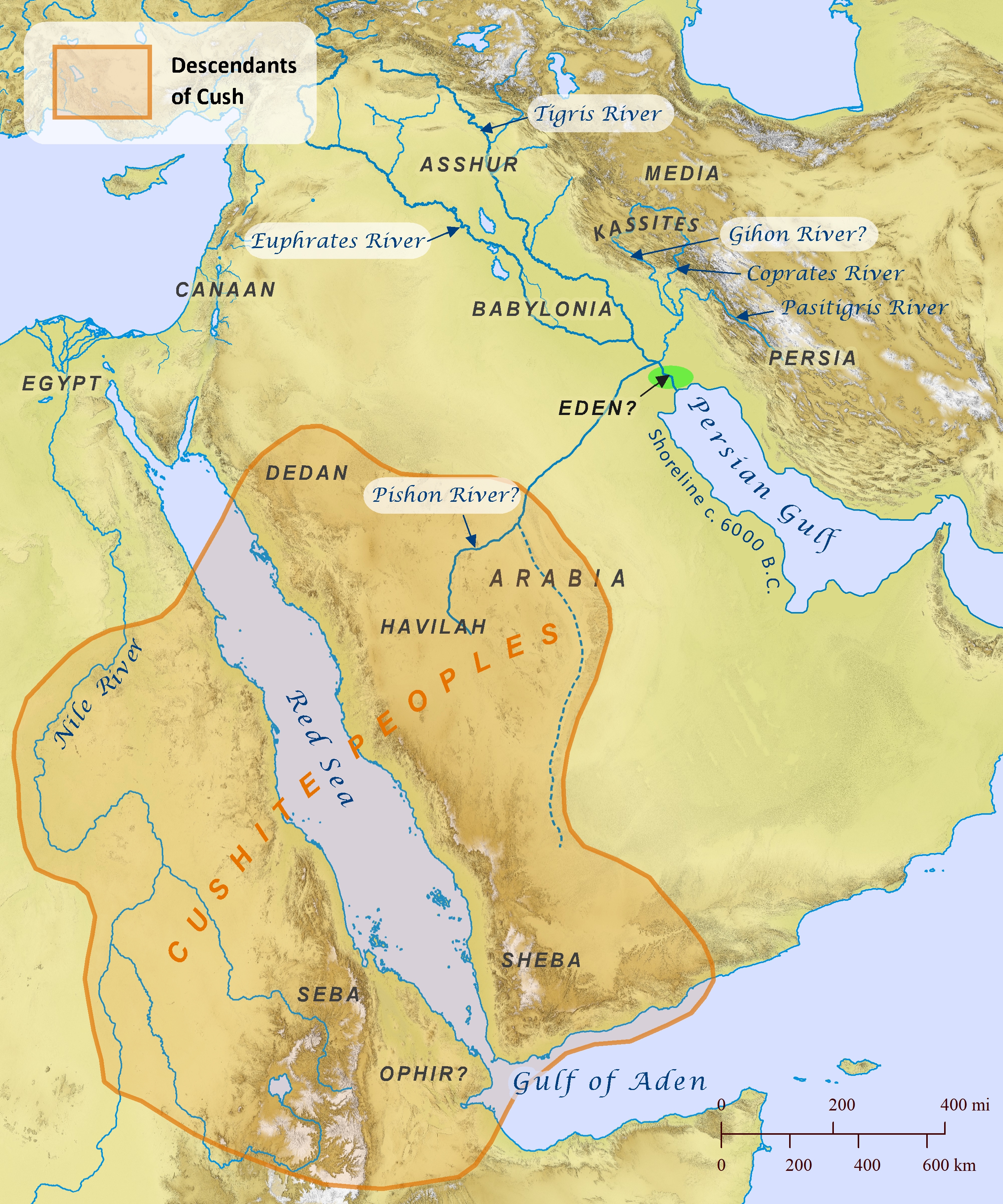
But Genesis 2:10-14 narrows down the location saying, “a river flows out of Eden to water the garden, and from there it divides and becomes four tributaries,” that include the Tigris and Euphrates rivers, located in southwestern Asia, and the Pishon and Gihon, which researchers are still searching for.
This level of detail is unusual for the Bible and lent an air of authenticity to the story, giving early readers confidence that Eden was a real place.
“Scholars have long exercised their imaginations trying to pin down whether Genesis has some actual [if general] location in mind for where Eden may have been, or where might have inspired the story,” says Joel Baden, professor of divinity and of religious studies at Yale University.
Modern scholars doubt that the Garden of Eden actually existed, arguing that it is a myth designed to explain the world as we currently find it. Still, some archeologists are searching for the real-world setting behind one of the Bible’s most famous stories.
Here are the leading theories of the possible location of the Garden of Eden.
A 1690 map illustrated by Joseph Moxon entitled "Paradise or the Garden of Eden." On this map, the Garden of Eden is located on the right, in the land of Assiria. Archeologists hypothesize the Garden of Eden's true location lies in Mesopotamia
The Pishon and Gihon are harder to pin down. Genesis explains that Pishon is “the one that flows around the whole land of Havilah, where there is gold,” while the Gihon flows around the land of Cush. Scholars say Havilah was in South Arabia, a region known for precious metals. Cush’s location is a bit elusive, “because [the] name [Cush] is used in the Bible for two distinct regions: one in Mesopotamia, and the other in Africa, around Nubia,” says Baden.
Ethiopian tradition associates the Gihon with the Blue Nile, building upon the reference to “the land of Cush” (which Baden says is usually identified with Sudan and Ethiopia). However, this identification doesn’t match the geography laid out in Genesis. Baden says the theory that the Pishon and Gihon are the Nile and the Ganges rivers is false “because those rivers aren't ever called by those names, and because the geography is off.” The Ganges is about 2,350 miles in the wrong direction, he explains. Also, the Nile and the Ganges do not connect to the Euphrates and Tigris, as the rivers in Genesis do.
Some scholars argued the Pishon and Gihon rivers were seasonal or lost waterways that survived only as dry riverbeds. In an article published in Biblical Archaeology, archaeologist James Sauer hypothesized that the Pishon should be identified with the Wadi al-Batin, an intermittently dry channel that runs from Western Saudi Arabia to Kuwait. You May Also Like
The Mesopotamian region was notorious for its wealthy families and idyllic royal gardens filled with a rich array of plants and trees which may have inspired the biblical story.
The Tigris and Euphrates corroborate the Mesopotamia theory as the rivers supplied water to an extensive floodplain, known as the Fertile Cresent. The region spanned the modern-day countries of Iraq, Turkey, Syria, Lebanon, Palestine, Israel, and [some argue] Egypt. During rainy seasons the rivers would flood the valleys, creating fertile soil in an otherwise dry region.
The Fertile Crescent’s stable climate and reliable water source allowed ancient peoples to develop of agricultural systems, cities, and systems of government at the heart of the two rivers. The area is also known as the “cradle of civilization” which was coined in the 19th-century by Egyptologist James Henry Breasted, who argued that human civilization originated there, against the prevailing opinions of the time that prioritized ancient Greece and Rome.
Climate change and sea level rise are critical elements in this theory. At the end of the last Ice Age the Red Sea was largely dry, extending the region identified with the land of Cush into the southwest tip of the Arabian Peninsula. At the time Genesis was written, melting snow and ice on the mountains would have made the rivers major waterways at the time.
However, no marine archaeology has supported Zarins’ theory. It continues to receive a controversial reception among modern archaeologists and biblical scholars. In his research on the location of Eden, biblical archeologist Joel Klenck says that “Zarins’s theory contradicts the Bible.” While Zarins’ theory would have all four rivers flowing into Eden, Klenck says Genesis “clearly states that all rivers proceeded ‘from’ and not ‘to’ Eden.” These studies, however, rely on the assumption that the Garden of Eden is a real place that can be located on a map or unearthed by archeology.
University of Exeter professor Francesca Stavrakopoulou says the Garden of Eden was a symbolic space based on ancient royal gardens and conceptually located in Jerusalem itself. Mark Leutcher, a professor of ancient Judaism and the Hebrew Bible at Temple University, explains that the Garden of Eden is not a single place for ancient authors and audiences of the tale. According to Leutcher, the garden symbolizes the ancient west Asian world.
“It represents ideas that are valuable for real human societies to think about, but it uses the language of symbolism and metaphor to impart those ideas,” Leutcher says. “In other words, the Garden of Eden represents the entire cultural world from the coast of the Mediterranean Sea to the eastern frontiers of the Assyrian and Babylonian empires.”
Grounded in landscapes of the west Asian world, the Garden of Eden remains shrouded in mystery. But thousands of years later, faith in the it’s existence endures, outlasting and outweighing the evidence that it ever existed at all.
YES Eden was (and is) a real place.
Who cares what “expert” “archaeologists” “think”. I’ll go with the Word of GOD, thank you very much.
Considering that this piece came from National Geographic, I am surprised it wasn’t MORE critical about the existence of Eden.
I think you can figure out where it might be by the locations of civilizations that arose suddenly and seemingly out of nowhere. I could be wrong, but civilizations would fan out from a central location. So, they would only have to map out where these civilizations are and see if there is a central location where they seem to fan out from.
God invented borders to prevent unwarranted entry.
https://biblemapper.com/blog/index.php/2022/04/04/the-garden-of-eden/
https://biblemapper.com/blog/wp-content/uploads/2022/08/Eden-1.jpg
James A Sauer hits:
https://search.brave.com/search?q=Biblical+Archaeology+pishon+James+Sauer
https://acorjordan.org/named-fellowships/sauer-fellowship-2019-20/
https://www.amazon.com/Archaeology-Jordan-Beyond-Harvard-Publications/dp/1575069016
https://www.goodreads.com/author/show/5502257.James_A_Sauer
https://archive.org/search?query=James+Sauer
Why would you expect people that don’t believe that God exists, or don’t care one way or the other, to “investigate” the Garden of Eden? Next they will “investigate” whether Goliath was really a giant or just a very tall man...and when they get to Hell, they will be just as surprised as the catholics that there isn’t a place like “purgatory” where they can get a second chance...
Did Noah's ark just hover over that area in the Middle East for the entire flood? Water moves ships around. And it changes landscapes.
The Tigris and Euphrates in Iraq were named after the originals in the area around Eden, wherever that was.
There's a Colorado River in Texas, and one bordering California and Arizona. Same name doesn't imply same river.
That Old Serpent 🐍 Called the Devil and Satan:
Yea, hath God said?
The same old tricks from That Old Serpent 🐍
The existence of the Garden of Eden is outside of the competency of archaeologists who get their evidence from artifacts and and ancient writing, neither of which were present when the Garden of Eden was occupied by Adam and Eve. Just because archaeologists haven’t found physical evidence of it doesn’t mean it never existed. Lots of new discoveries of unknown civilizations are always being found. Did they not exist before they were found? Absence of evidence is not evidence of absence.
During the Ice Age, sea levels were a couple of hundred feet lower, and those four rivers converged at a site now submerged under the Persian Gulf, as Zarins asserted. Humans’ 900-year lifespans were abetted by the lack of granitic radiation in the alluvial soil.
I don’t think God has ever been cited as the author of the book of Genesis. Do you think He said “Let there be light.” Who’d he say it to? Who heard it? Do you believe in the literal biblical account of the Tower of Babel as an explanation for the many languages?
Yes, “was” is the operative term for its appearance and configuration in the antediluvian world. Funny how science acknowledges the Great Flood (while trying to deny it at the same time; doublethink) but somehow fails to conceive of geographical changes caused by it.
nts
Ever read the first verses of the Gospel of John? Then you will know who He said it to. Although of course there were the angels, although they aren’t eternal but created.
Considering that this piece came from National Geographic, I am surprised it wasn’t more critical about the existence of God.
I’ve always believed that the Garden was in heaven and not of this earth. Can’t find an angel with a flaming sword on Google Maps. And unless we are actually immature Pak, the Tree of Life is not found on this earth, nor is the Tree of Knowledge of Good and Evil.
Genesis chapter 2 describes the location of the Garden of Eden in relationship to four rivers. Three of these rivers are known, and one is a mystery. Watch this episode of Expedition Bible as Joel travels across Saudi Arabia in search of The Lost River of Eden.
Searching for The Garden of Eden’s Pishon River
28:11
Expedition Bible
1.06M subscribers
6,829,553 views
January 27, 2024
https://www.youtube.com/watch?v=jwCdZ4CbA-E
[Brave inquiry result]
The Tigris River is known by various names across different languages and cultures. In Sumerian, it is called Idigna or Idigina.
The Akkadian name is Idiqlat.
In Arabic, it is known as Dijlah or Ḥudāqil.
Aramaic speakers refer to it as Diglath.
The Armenian name is Tigris or Dglatʿ.
In Greek, it is called hē Tígrēs or hē, ho Tígris.
Hebrew names include Ḥiddéqel.
The Hurrian name is Aranzah.
In Persian, it is referred to as Old Persian: Tigrā, Middle Persian: Tigr, and modern Persian: Dejle.
Syriac names are Deqlaṯ.
Turkish speakers call it Dicle.
Kurdish names include Dîcle, Dijlê, and دیجلە.
The river is also known by the biblical name Hiddekel.
AI-generated answer. Please verify critical facts.
The Turkish name for the Euphrates River is Fırat.
This name is used in modern Turkish and is derived from the Old Persian Ufratu, which itself traces back to Elamite or Sumerian origins.
The river is also referred to as “Fırat” in Kurdish as Ferat, and it holds significant historical and cultural importance across the region.
AI-generated answer. Please verify critical facts.
Disclaimer: Opinions posted on Free Republic are those of the individual posters and do not necessarily represent the opinion of Free Republic or its management. All materials posted herein are protected by copyright law and the exemption for fair use of copyrighted works.