Skip to comments.
Interstellar comet 3I/ATLAS swings by Earth this week as an early Christmas gift
Accuweather ^
| December 16, 2025
| Staff
Posted on 12/16/2025 9:06:28 AM PST by Red Badger
The Dec. 19 flyby of Comet 3I/ATLAS gives astronomers a rare chance to study only the third known interstellar object to pass through our solar system.
VIDEO AT LINK...............
Astronomers and skywatchers are hoping to spot interstellar Comet 3I/ATLAS on Dec. 19 when it makes its closest — but safely distant — flyby of Earth.
The comet has drawn global attention as only the third confirmed interstellar object observed passing through our solar system.
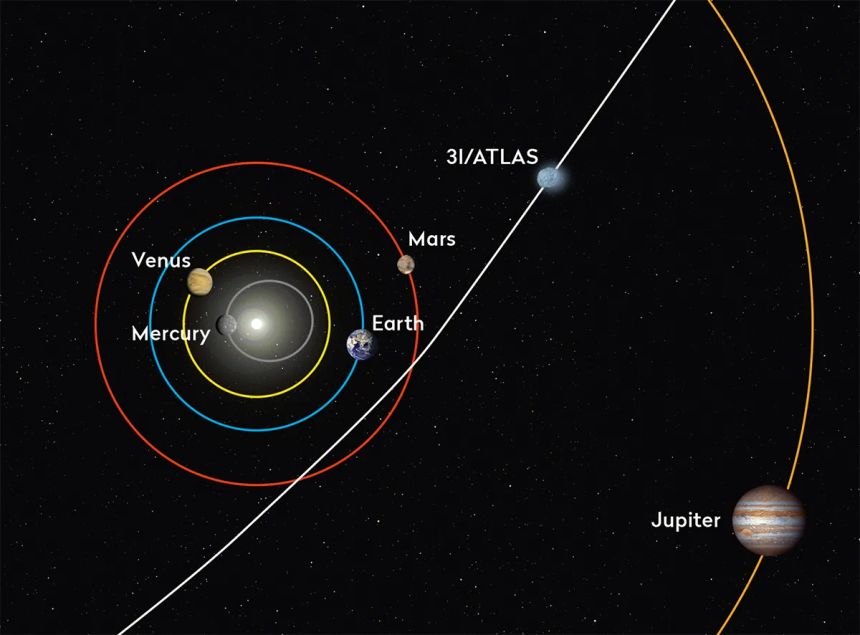
According to NASA, Comet 3I/ATLAS will not pose any threat to Earth during its pass. The object is expected to remain about 170 million miles from the planet on Dec. 19. Still, astronomers plan to use the flyby to learn more about this mysterious visitor.
Since its discovery in July, NASA, the European Space Agency (ESA) and other international space organizations have used ground-based telescopes and spacecraft throughout the solar system to observe Comet ATLAS. NASA’s Mars rover even captured images of the object during its close approach to the Red Planet.
More recently, NASA’s Hubble Space Telescope photographed the comet with its Wide Field Camera for the first time since July.
The National Science Foundation’s NOIRLab Gemini North telescope in Hawaii also collected new observations around Thanksgiving, revealing how the comet changed after its Oct. 30 close pass by the sun.
Earlier Gemini images showed Comet 3I/ATLAS with a reddish hue, but after swinging past the sun, it now appears with a faint greenish glow. According to NOIRLab, this shift is caused by light emitted from gases in the comet’s coma, including diatomic carbon, which glows green at certain wavelengths.
Comet 3I/ATLAS streaks across stars and galaxies in this image captured by the Gemini Multi-Object Spectrograph (GMOS) on Gemini North on Maunakea in Hawai‘i. Despite speculation surrounding the comet’s origin, NASA and ESA experts say there is no evidence it is an alien or artificial object. Its color, speed and trajectory are all consistent with natural comet behavior, NASA said.
After its March flyby of Jupiter, Comet 3I/ATLAS will depart our solar system—leaving behind new clues about the mysteries of interstellar space.
TOPICS: Arts/Photography; Astronomy; History; Outdoors
KEYWORDS: 3iatlas; comet; interstellar; naturalobject
Navigation: use the links below to view more comments.
first previous 1-20, 21-40, 41 next last
To: Red Badger
167-170 million miles away from Earth is the closest it will get. 1.8 times the distance from the Sun to the Earth.
21
posted on
12/16/2025 10:39:05 AM PST
by
jacknhoo
(Luke 12:51; Think ye, that I am come to give peace on earth? I tell you, no; but separation.)
To: GingisK
“One ping....One ping only Guntak”.
To: Red Badger
How long before it catches VGER?
23
posted on
12/16/2025 11:02:00 AM PST
by
citizen
(A transgender malel competing against women may be male, but he's no man.)
To: RetiredArmy
But, but, but, I thought someone, named Avie, said it was a spaceship!!!
—
No Harvard astronomer Avi Loeb did not. He said, based on the 12-14 anomalies, there was a 40% chance it was not a comet. There is still no conclusive explanation for them. It is not a comet, as they are defined but, at the minimum, a new sort of object.
24
posted on
12/16/2025 11:15:19 AM PST
by
PIF
(They came for me and mine ... now its your turn)
To: Red Badger
If this thing starts slowing down, then we can panic.
—
Well it dis speed up with no apparent loss of mass, while pointing million kilometer long jets of material at the Sun, while rotating every 16.5 hours with no loss of jet definition. No known natural object can do that.
25
posted on
12/16/2025 11:18:57 AM PST
by
PIF
(They came for me and mine ... now its your turn)
To: Red Badger
They’ll probably moon us out of their spaceship porthole.
To: Red Badger; Phinneous; SunkenCiv; The Spirit Of Allegiance; Larry Lucido; ...
The Dec. 19 flyby of Comet 3I/ATLAS gives astronomers a rare chance to study only the third known interstellar object to pass through our solar system.
Earlier Gemini images showed Comet 3I/ATLAS with a reddish hue, but after swinging past the sun, it now appears with a faint greenish glow.
>>>
♫ There's a reason for the colors in your story.
There's a picture, though you cannot see it yet.
Every thread has a purpose, and soon you'll see your part in this tapestry.
When you feel like nothing is connecting, and you're searching for an answer you can't find.
Just remember that each strand is intersecting, to reveal what the Creator has designed.
Any masterpiece is going to take some time. ♫ *
<<<
DAVID (2025) - “Tapestry” | Official Song by Brandon Engman & Miri Mesika | Angel
Since its discovery in July, NASA, the European Space Agency (ESA) and other international space organizations have used ground-based telescopes and spacecraft throughout the solar system to observe Comet ATLAS. NASA’s Mars rover even captured images of the object during its close approach to the Red Planet.
*I just love it when a tagline comes together. ⬇️
27
posted on
12/16/2025 11:38:10 AM PST
by
Ezekiel
(🆘️ "Come fly with US". 🔴 Ingenuity -- because the Son of David begins with MARS ♂️, aka every man)
To: Ezekiel
At least they got David’s hair color right..............
28
posted on
12/16/2025 11:47:57 AM PST
by
Red Badger
(Iryna Zarutska, May 22, 2002 Kyiv, Ukraine – August 22, 2025 Charlotte, North Carolina Say her name)
To: freebird5850
29
posted on
12/16/2025 11:48:23 AM PST
by
GingisK
To: fwdude
Try 680 lunar distances from earth. It’s not a fly-by, and we should be thankful for that. If that thing hit us, it would ruin your whole day.
30
posted on
12/16/2025 12:16:02 PM PST
by
Campion
(Everything is a grace, everything is the direct effect of our Father's love - Little Flower)
To: All
Should we not check out the blue planet, Captain?
No, cadet, we learned many centuries ago that blue planets are contaminated with hydrogen dioxide in all its forms. Life could not possibly survive such a harsh environment.
31
posted on
12/16/2025 12:35:34 PM PST
by
Peter ODonnell
(Do not go gentle into that good night; rage, rage against the dying of the light -- Dylan Thomas)
To: Red Badger
32
posted on
12/16/2025 1:42:44 PM PST
by
SuperLuminal
(Where is rabble-rising Sam Adams now that we need him? Is his name Trump, now?)
To: SuperLuminal
What does Kamalala Harris have to do with this?...............
33
posted on
12/16/2025 4:02:50 PM PST
by
Red Badger
(Iryna Zarutska, May 22, 2002 Kyiv, Ukraine – August 22, 2025 Charlotte, North Carolina Say her name)
To: Red Badger
The last I saw was that it was headed out into deep space.
There’s so much conflicting information on so many things now.
What’s to believe?
34
posted on
12/16/2025 8:15:12 PM PST
by
laplata
(They want each crisis to take the greatest toll possible.)
To: laplata
It is headed back out. But we are at it's closest approach right now............ Perhaps this diagram will help visualize the matter:
35
posted on
12/16/2025 8:18:32 PM PST
by
Red Badger
(Iryna Zarutska, May 22, 2002 Kyiv, Ukraine – August 22, 2025 Charlotte, North Carolina Say her name)
To: Red Badger
36
posted on
12/16/2025 9:32:58 PM PST
by
SuperLuminal
(Where is rabble-rising Sam Adams now that we need him? Is his name Trump, now?)
To: Red Badger
37
posted on
12/16/2025 9:59:56 PM PST
by
laplata
(They want each crisis to take the greatest toll possible.)
To: PIF
He did on Newsmax one night a couple of weeks ago!!! He was on Finnery’s show at 8 pm EST.
38
posted on
12/17/2025 8:34:08 AM PST
by
RetiredArmy
(The Bible speaks truth! Don't believe it, you do so at your own peril. You'd better be right!!)
To: RetiredArmy
Be careful there are a number of AI fakes of Leob going around on YT.
39
posted on
12/17/2025 11:49:34 AM PST
by
PIF
(They came for me and mine ... now its your turn)
To: Red Badger
Papers released detail more unusual characteristics. As you know the anti-tail is around a million kilometers long facing toward the Sun, despite the solar wind, this tail never wavers or becomes fuzzy as expected, given its 16.1 hour rotation, the tail remains sharp.
Also as you know, the tail remains pointed at the sun regardless of the objects motion, approaching it was pointed at, and now receding it is pointed beck at the Sun.
The solar wind at 1.5 AU, the object’s current distance is 1.44 million km/h. No other comet has been able to project a tail more than a few hundred km toward the Sun.
Now we learn that the anti-tail maintains a wobble around a presumed core at 8 degrees while emitting unknown particles directly toward the Sun. The core maintains a position in the general direction of the Sun, regardless of the line of the object’s travel. How is this possible?
40
posted on
12/18/2025 10:07:05 AM PST
by
PIF
(They came for me and mine ... now its your turn)
Navigation: use the links below to view more comments.
first previous 1-20, 21-40, 41 next last
Disclaimer:
Opinions posted on Free Republic are those of the individual
posters and do not necessarily represent the opinion of Free Republic or its
management. All materials posted herein are protected by copyright law and the
exemption for fair use of copyrighted works.
FreeRepublic.com is powered by software copyright 2000-2008 John Robinson