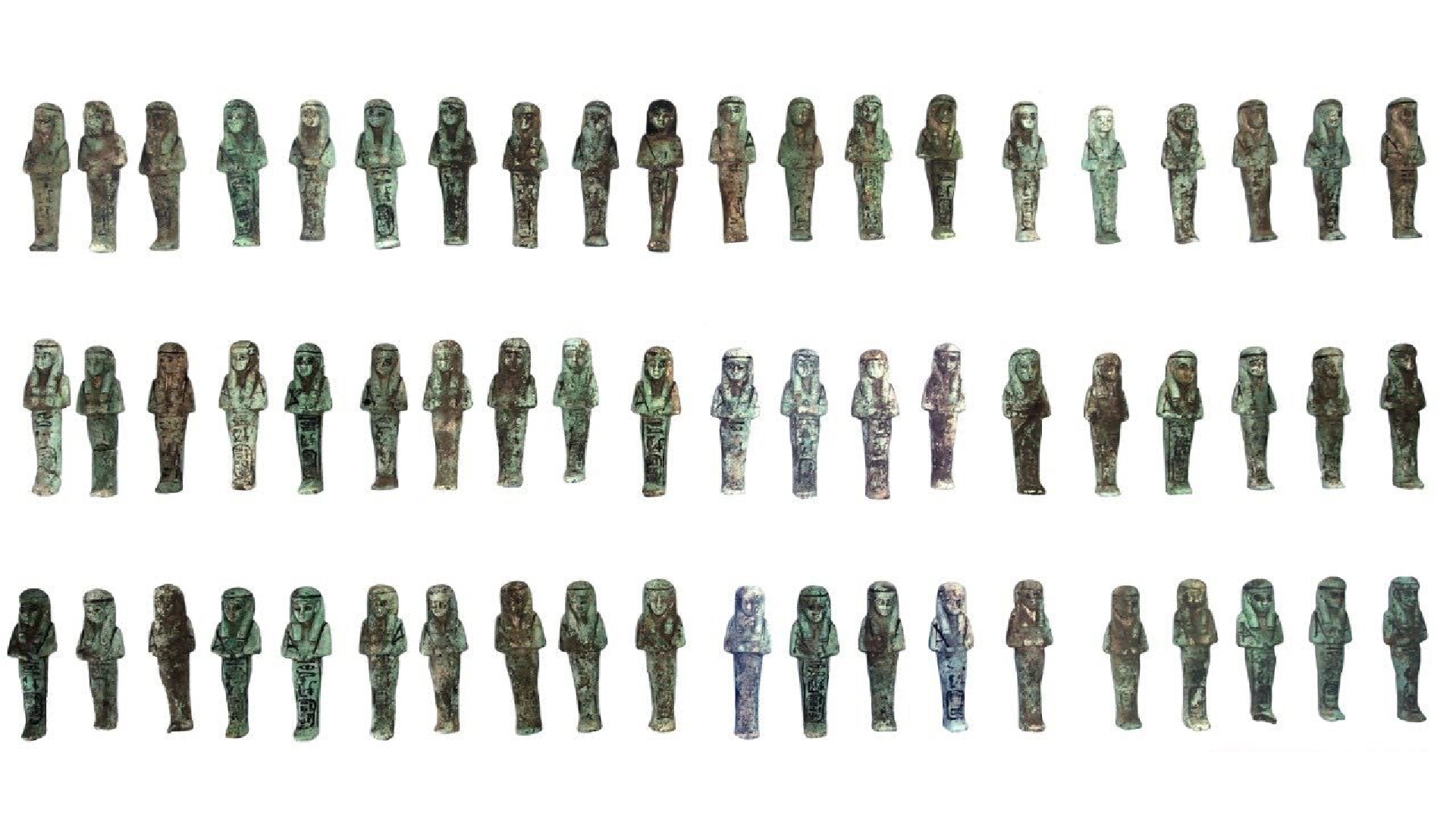
Some of the shabtis, which are made of faience.Image credit: Egyptian Ministry of Tourism and Antiquites
Posted on 12/06/2025 7:09:21 AM PST by SunkenCiv
Archaeologists in Egypt have discovered 225 shabtis -- figurines meant to act as servants for the deceased in the afterlife -- that belonged to the pharaoh Shoshenq III inside a tomb of a different pharaoh.
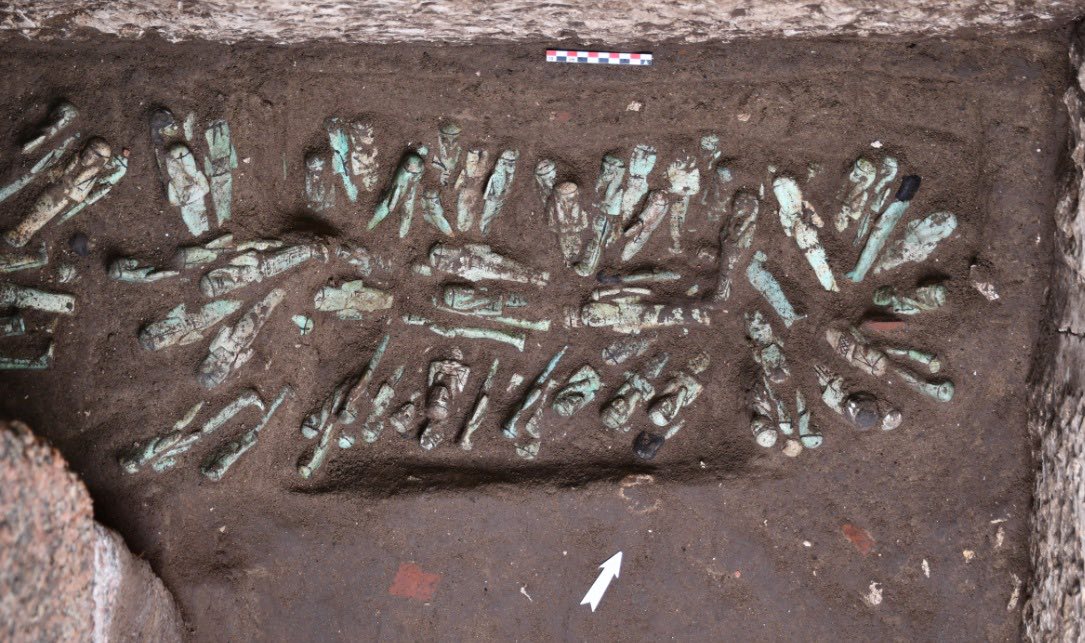
The figurines were found at the site of Tanis, in northern Egypt, in the northern chamber of the tomb of Osorkon II, near an unmarked sarcophagus. Hieroglyphs on the shabtis allowed the team to identify who they belonged to.
Although the tomb and sarcophagus were discovered in 1939, the shabtis were recently found by an Egyptian-French team that is conducting conservation work, the Egyptian Ministry of Tourism and Antiquities said in a translated statement. The team also uncovered new inscriptions that they are in the process of deciphering and analyzing...
The discovery of the shabtis, which are made of faience (glazed ceramic), inside Osorkon II's tomb indicates that Shoshenq III was not buried in his tomb but rather in an unmarked sarcophagus in the tomb of Osorkon II. Researchers have long known about this tomb, but they didn't know that Shoshenq III was buried there...
Some of the artifacts in Shoshenq III's tomb carry the name of Shoshenq IV, who ruled during the following 23rd dynasty, said Aidan Dodson, an Egyptology professor at the University of Bristol in the U.K who was not involved with the research...
In ancient Egypt, it wasn't unusual for tombs to be reused. However, why Shoshenq IV might have reused the tomb of Shoshenq III and moved him to the tomb of Osorkon II is unclear.
(Excerpt) Read more at livescience.com ...
Some of the shabtis, which are made of faience.Image credit: Egyptian Ministry of Tourism and Antiquites
“Who’s burried ‘n Grant’s tomb? Well…I can tell ya who’s gunnabe! Hengh!” —Go Brandon
Ahram Online reports that a collection of some 225 ushabti figurines has been discovered in a tomb chamber in northern Egypt by a team of researchers led by Egyptologist Frédéric Payraudeau of Sorbonne University. The figurines were found in layers of silt near a granite sarcophagus now thought to belong to Shoshenq III, a pharaoh of the 22nd Dynasty who ruled from about 825 to 773 B.C. Shoshenq III is known for his building projects in the city of Tanis, his capital. The tomb belonged to Osorkon II, an earlier ruler of the dynasty. “It remains uncertain whether the king was interred directly inside Osorkon II’s tomb or whether his funerary equipment was relocated there,” Payraudeau explained. Mohamed Abdel-Badie of Egypt’s Supreme Council of Antiquities added that inscriptions were discovered in the same chamber that could help archaeologists understand how the tombs were used. To read about a recent study of a sarcophagus that had been reused in antiquity, go to "A Pharaoh's Coffin." [Archaeology magazine]
Ushabtis in situ, Tanis, EgyptEgyptian Ministry of Tourism and Antiquities
...The modern designation Shoshenq III refers to King Usermaatre Setepnamun Shoshenq Sibaste Meryamun Netjerheqaon,[4] who reigned for about four decades, c. 841–c. 803/799 BC [5] or c. 831–c. 791/788 BC.[6] His highest attested regnal year is Year 39.[7] Although he apparently retained control of Tanis and, for the most part, of Bubastis and Memphis, for most of his long reign, Shoshenq III had to reckon with rival kings in parts of the country.[8]
...Recent scholarship has corrected a number of earlier assumptions about the reign of Shoshenq III Sibaste. He was long thought to be the successor of Takelot II Siese and predecessor of Pami I Sibaste, and to have reigned for 52 years on the basis of the burial of a 26-year-old Apis Bull, installed in Year 28 of Shoshenq III, in Year 2 of Pami I.[13] It is now recognized that an additional king, designated Shoshenq IV, Hedjkheperre Setepenre Shoshenq Sibaste Meryamun Netjerheqaon, reigned between Shoshenq III and Pami for at least a decade, and that Shoshenq III and Shoshenq IV reigned for 52 years altogether.[14] Further, most Egyptologists now agree that Takelot II Siese did not intervene as king between Osorkon II Sibaste and Shoshenq III, but reigned as a rival or regional king, apparently somewhere in Upper Egypt, from the last years of Osorkon II Sibaste until Year 22 of Shoshenq III; therefore, Shoshenq III Sibaste was the direct successor of Osorkon II Sibaste.Shoshenq III | Wikipedia
One of the Shoshenqs has traditionally been assumed to be the Shishak of the Bible (I Kings 14), but Rohl's chronology claimss Shishak was Ramesses, who would have attacked Jerusalem in Rehoboam's reign, as opposed to Yul Brynner competing with Charleton Heston for Anne Baxter.
This situation is known as “The Shoshenq Deception.”
Surprising. If anyone was going to steal someone else's tomb, I would assume it would be Sir Takelot.
Suggests more grant money to prove...
Well played!
The pun is funny, and remarkably, that was the title of the private FR message with a link to a different article about this.
I'm familiar with Rohl, he's wrong about his ID although the general idea of a screwed up New Kingdom chronology is a good one. Rohl and Peter James et al were part of the Glasgow Chronology, one of at least three (and counting) failed attempts to supplant the Ages In Chaos reconstruction, but clearly inspired by it. 🏛
I tomb believe it!
Mummy told me there’d be days like this.
Over 2,000 years and still no arrest. Egyptian justice is as slow as it is in the US.
(Sorry!)
When Ed Asner finally croaks...
Whoops. 2021.
That’s my idea of com-med-dee!
lol
A queen of old Egypt named Cleo
Conducted her loving ‘con brio’.
She felt quite at home in
The arms of a Roman
But preferred to be part of a trio.
Cleopatra killed both of them.
“’twat, did you say?”
You heard me.
“She put them both in the tomb?”
She kept reviving them.
Disclaimer: Opinions posted on Free Republic are those of the individual posters and do not necessarily represent the opinion of Free Republic or its management. All materials posted herein are protected by copyright law and the exemption for fair use of copyrighted works.