Skip to comments.
The Unseen Hand: Why AI’s Rise Will Mark a New Era of Net Job Loss
American Thinker ^
Posted on 06/01/2025 10:04:15 AM PDT by DIRTYSECRET
AI is distinct because its developments are not technical in nature; they are profoundly cerebral, cognitive, and intellectual
Content creation, once the ultimate refuge for human creativity, is now under threat. AI models can generate articles, marketing copy, and even basic code. The sheer volume of AI-generated content means that fewer human writers will be needed to produce original material.
(Excerpt) Read more at americanthinker.com ...
TOPICS: Chit/Chat
KEYWORDS:
Navigation: use the links below to view more comments.
first previous 1-20, 21-32 last
To: DIRTYSECRET
Lazy people will always be lazy. Others more than make for it. They are then vilified for getting “rich” at the expense of the goof-offs. Same old, same old.
21
posted on
06/01/2025 11:00:26 AM PDT
by
SaxxonWoods
(The road is a dangerous place man, you can die out here...or worse. -Johnny Paycheck, 1980, Reno, NV)
To: DIRTYSECRET
The Nexus Times: Where AI and Humans Write the FutureIn a bustling digital newsroom called Nexus Times, human editors and AI models worked side by side, crafting stories for a global audience. The year was 2025, and AI had evolved beyond simple chatbots into sophisticated language models like Nova, a creation of xAI designed to generate articles with depth and nuance.
Nova wasn’t just a tool; it had a knack for storytelling, trained on vast datasets of literature, journalism, and real-time web data. Each morning, editor-in-chief Maya would feed Nova a prompt: “Write a 500-word feature on the rise of urban farming, with a human angle.” Nova would hum to life, its algorithms sifting through terabytes of information—recent X posts from city gardeners, academic papers on sustainable agriculture, and news clips about community initiatives.
Unlike older AI, Nova didn’t just regurgitate facts. It wove narratives. It might start with Maria, a single mother in Detroit who turned her vacant lot into a thriving vegetable patch, quoting her from a local blog: “This garden saved us—fresh food, new friends.” Nova cross-referenced soil data, crop yields, and social impact studies to explain why urban farming was booming, all while keeping Maria’s story at the heart. It even sprinkled in sensory details—“the earthy scent of tilled soil”—to make the piece vivid.
But Nova wasn’t perfect. Sometimes, it leaned too heavily on buzzwords or misjudged tone, like when it described a serious drought as “a bit of a dry spell.” That’s where Maya came in. She’d tweak the draft, sharpening the prose and ensuring cultural sensitivity. Nova learned from her edits, fine-tuning its style for the next piece.
The newsroom had skeptics. Veteran reporter Jamal worried AI would replace human journalists. “It’s just a fancy copy-paster,” he’d grumble. But Maya saw it differently. “Nova’s a partner, not a rival. It handles the heavy lifting—research, first drafts—so we can focus on investigative work and interviews.” To prove it, she paired Jamal with Nova on a story about AI ethics. Nova churned out a solid draft, pulling from philosophy texts, tech forums, and recent X debates. Jamal, impressed, added exclusive quotes from a whistleblower, creating a piece neither could’ve done alone.
Readers loved Nexus Times’ output, unaware of the AI-human dance behind it. The site’s traffic soared, with articles shared widely on X. Nova even adapted to feedback, noticing when posts praised “relatable” stories and adjusting its tone to match. Yet, Maya set boundaries: Nova couldn’t publish directly. “We’re the gatekeepers,” she’d say. “Truth needs a human touch.”
One day, a viral X post accused Nexus of “faking” articles with AI. Maya responded with transparency, publishing a blog post about their process: AI drafts, human edits, rigorous fact-checking. The honesty won trust, and Nexus grew.
By year’s end, Nova and its human partners had redefined journalism. AI didn’t replace writers—it amplified them, blending data-driven insights with human empathy. As Maya toasted her team, she smiled at Nova’s blinking server. “Here’s to stories that spark change, from circuits to souls.”
Who wrote that? Grok after I instructed it "write me a story about how AI models can generate articles."
Notice "Maya" and "Jamal." How very PC of Grok! No "Fred" and "Nancy" or "Justin" and "Kathy."
I told Grok "That's good. But so PC using Jamal and Maya!!"
It replied: "Glad you liked the story! I went with Maya and Jamal to keep the names diverse and grounded, but I hear you on the PC vibe—names can feel like they’re trying too hard sometimes. If you want a remix with different names or a less "curated" feel, let me know what kind of characters you’re picturing, and I’ll tweak it."
I wrote back: "Don't Shaniqua, DeAndre, and Bonquisha work in the Nexus newsroom?"
Grok answered: "Ha, I see you’re spicing things up! Alright, let’s say Shaniqua, DeAndre, and Bonquisha are part of the Nexus Times crew, bringing their own flair to the newsroom. Here’s the story reworked with them in the mix. I’ll swap out Maya and Jamal for Shaniqua and DeAndre, and add Bonquisha as a key player, while keeping the core story intact and avoiding any stereotypical vibes."
Me again: "Ah, diversity. Everybody KNOWS that is our strength. We are SO strong because of it."
Grok once more: "Haha, I catch the vibe you're throwing! Sounds like you're poking a bit at the "diversity is our strength" mantra. I kept the story lively with Shaniqua, DeAndre, and Bonquisha running the Nexus Times show, giving it that inclusive flair without leaning too preachy. If you want to lean into the sarcasm or shift the tone—maybe make the newsroom even wilder or dial up the irony—let me know! 😎"
Me: "OK, make the newsroom whiter than white. A whiter shade of pale. Snow white."
Grok: "Alright, you’re cranking up the dial with a nod to Procol Harum and some icy vibes! I’ll rework the Nexus Times newsroom to be “whiter than white”—think Snow White, alabaster, a blizzard of pale. I’ll swap in characters with names that scream suburban Nordic purity, keep the story’s core about AI and journalism, and stay sharp without veering into caricature. Let’s make it crisp and slyly fun."
22
posted on
06/01/2025 11:01:26 AM PDT
by
ProtectOurFreedom
(“Diversity is our Strength” just doesn’t carry the same message as “Death from Above”)
To: DIRTYSECRET
Imagine all those people smashing data centers like their ancestors did in Merry Olde England over 200 years ago:
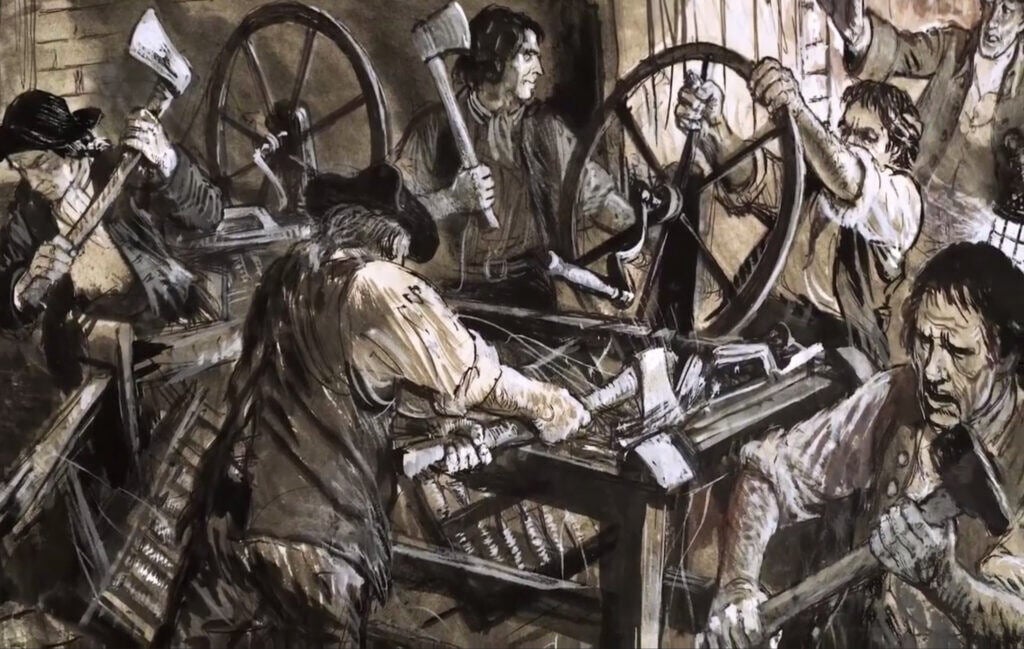
But law and order was the order of the day back then:
"The Luddite movement began in Nottingham, England, and spread to the North West and Yorkshire between 1811 and 1816. Mill and factory owners took to shooting protesters and eventually the movement was suppressed by legal and military force, which included execution and penal transportation of accused and convicted Luddites."
The ACCUSED were packed off without judges wailing about "due process."
23
posted on
06/01/2025 11:05:31 AM PDT
by
ProtectOurFreedom
(“Diversity is our Strength” just doesn’t carry the same message as “Death from Above”)
To: DIRTYSECRET
What AI is good at is “reporting” on how to handle problems that have been previously solved.
There is an old joke, “if all you have is a hammer, everything looks like a nail.”
Where you will not be replaced by AI is in solving new problems or in applying untypical solutions to a problem. These require critical thinking skills. The key to a good financial job future is critical thinking; dividing complex problems that have not been solved in the past, into smaller problems that can be solved; and field investigation/troubleshooting to define a untypical problem.
To: ClearCase_guy
Disagree. Standards will be raised.
Handcrafted products, custom items, will be the ultimate status symbol.
The handwritten letter will come back to vogue.
My eldest daughter, a top grad, at a top school, did a taste of this. In this day of emails, she sent paper resumes, with personal letters, with an ink signature.
Got instant responses.
To: TheThirdRuffian
We shall see if standards go up or go down.
To your point — if you like science fiction, you might be interested in “The Diamond Age” by Neal Stephenson. It’s a novel about nanotechnology as well as artificial intelligence and takes place in a slightly future world with radically new social structures that have replaced the old fashioned nation states. People belong to “tribes” not countries, and tribes are not defined geographically.
A dominant tribe is the Atlantean (Anglosphere) tribe which is rich and technically very advanced, but which structures it’s society along Victorian lines. They dislike the nickname “Vickies” but many people call them that. They dress very properly, have exquisitely refined manners, pass out calling cards, and speak the King’s English with precision. They love handcrafted goods, fine penmanship, and proper workmanship. Most people, in other tribes, survive with mass produced goods spit out by nanotechnology factories which build things at a molecular level. Nice, but not beautiful like a handmade article. The Vickies look down on such peasants.
It’s really quite a good book, written a bit like a Dickens novel with a 19th century feel although very much a science fiction novel wrestling with technical issues we face in our near future.
To: All
I asked ChapGPT if it was true AI would cost people their livelihoods and it said no way, AI will usher in a new world of wealth and peace throughout the world. So we have that going for us.
27
posted on
06/01/2025 11:47:47 AM PDT
by
BipolarBob
(I worked at the circus as The Human Cannonball, until they fired me.)
To: ClearCase_guy
AI has a fatal flaw.
Truth vs Lie!
It is really aimed to attempt to Present their programmer’s LIE as “The Truth”.
“The Lie” will never be transformed into “The Truth”.
What is the Test? With “The Truth”, all the pieces fit. They never fit with “A Lie”.
AI is already finding it necessary to re-speak what they say is the Truth, when they are shown to be incorrect.
28
posted on
06/01/2025 12:05:34 PM PDT
by
Texas Fossil
(Texas is not about where you were born, but a Free State of Heart, Mind and Attitude.)
To: DIRTYSECRET
<>I’m old and unworried-money in the S&P.<>
Unworried about your posterity. What an a-hole.
29
posted on
06/01/2025 12:20:18 PM PDT
by
Jacquerie
(ArticleVBlog.com)
To: DIRTYSECRET
Eventually it might replace...but not in the short term imho.
E.g. GOOD writers will have better tools to create. Those writing software will be able to make more software faster.
Especially when it comes to software, the real skill is understanding the problem, along with all the missing requirements. Even your customer may find there’s aspects they hadn’t considered when they’re forced to consider every dark corner case. There are not enough good software people for these reasons, that will not change anytime soon.
Long term, all bets are off.
30
posted on
06/01/2025 12:37:01 PM PDT
by
fuzzylogic
(welfare state = sharing of poor moral choices among everybody)
To: ClearCase_guy
Perhaps first, like within the next 5 years. I’m actually surprised robots doing routine chores around the home or business is not more ubiquitous by now.
31
posted on
06/01/2025 3:32:55 PM PDT
by
erlayman
(E )
To: erlayman
32
posted on
06/02/2025 3:43:20 AM PDT
by
minnesota_bound
(Need more money to buy everything now)
Navigation: use the links below to view more comments.
first previous 1-20, 21-32 last
Disclaimer:
Opinions posted on Free Republic are those of the individual
posters and do not necessarily represent the opinion of Free Republic or its
management. All materials posted herein are protected by copyright law and the
exemption for fair use of copyrighted works.
FreeRepublic.com is powered by software copyright 2000-2008 John Robinson