Posted on 08/23/2024 12:57:55 PM PDT by MtnClimber
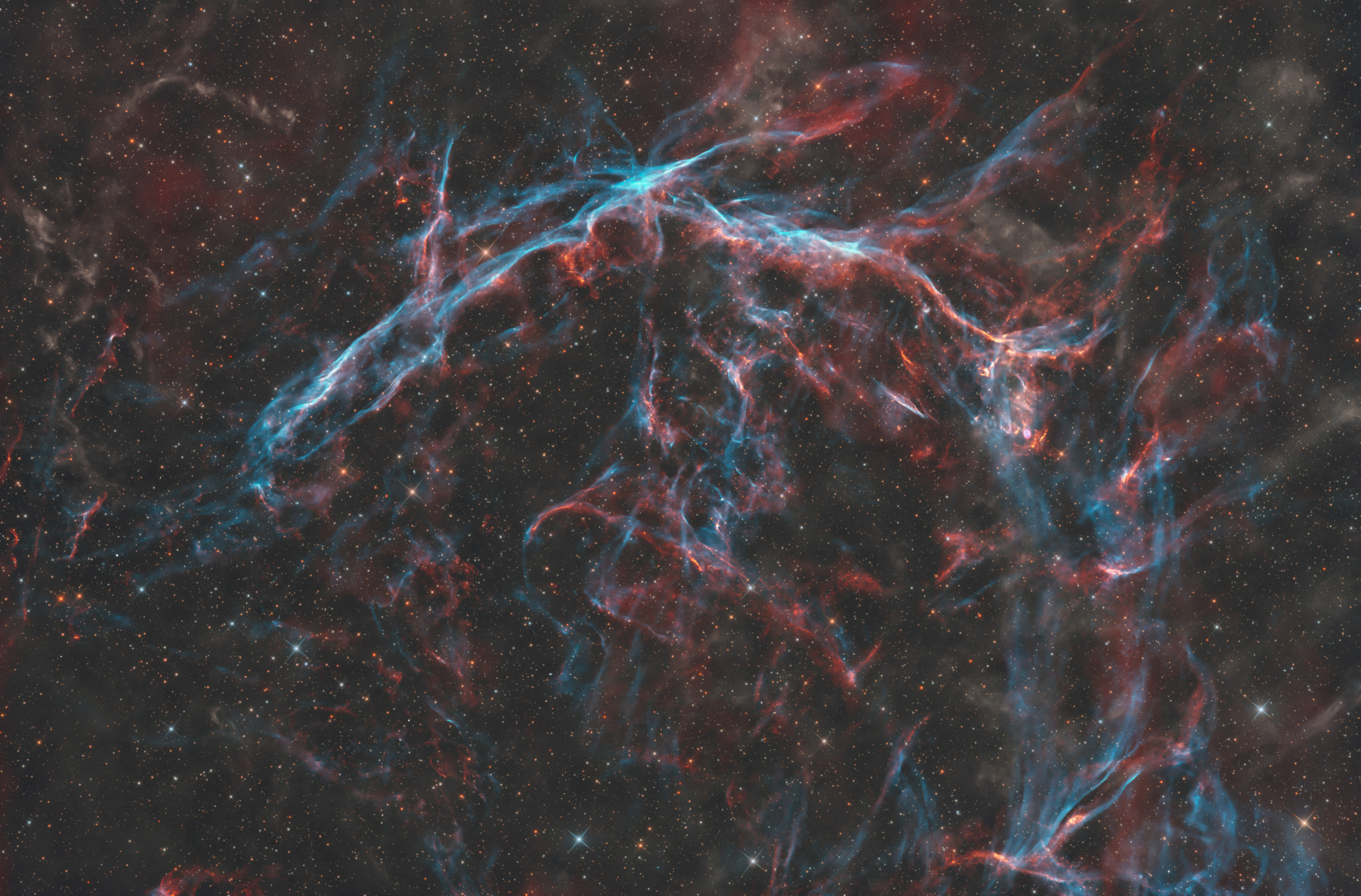
Explanation: There is a quiet pulsar at the heart of CTA 1. The supernova remnant was discovered as a source of emission at radio wavelengths by astronomers in 1960 and since identified as the result of the death explosion of a massive star. But no radio pulses were detected from the expected pulsar, the rotating neutron star remnant of the massive star's collapsed core. Seen about 10,000 years after the initial supernova explosion, the interstellar debris cloud is faint at optical wavelengths. CTA 1's visible wavelength emission from still expanding shock fronts is revealed in this deep telescopic image, a frame that spans about 2 degrees across a starfield in the northern constellation of Cepheus. While no pulsar has since been found at radio wavelengths, in 2008 the Fermi Gamma-ray Space Telescope detected pulsed emission from CTA 1, identifying the supernova remnant's rotating neutron star. The source has been recognized as the first in a growing class of pulsars that are quiet at radio wavelengths but pulse in high-energy gamma-rays.
For more detail go to the link and click on the image for a high definition image. You can then move the magnifying glass cursor then click to zoom in and click again to zoom out. When zoomed in you can scan by moving the side bars on the bottom and right side of the image.
Like a retro Formica kitchen counter top.
The the name of a British band from the 1960’s
I see a submarine getting ready to crash into some guy…..who is eating a cheeseburger.
I see that too.
This is part of the eastern Veil Nebula, the remains of a supernova, a cataclysmic explosion of a massive star that detonated about 8,000 years ago. This nebula is located about 1,450 light years from earth.

150x90sec
Chicago Transit Authority-1?
Nice! What kind of camera did you use, a dslr, or ccd? I have a Player One Mars-C, but it’s forte is planetary photography.
This shot was taken with a consumer grade unmodified Cannon 60D.
Make that a Canon....☺
Great job! I’m just a beginner, photographed the Sun a few times. The software has a bit of a learning curve.
Yep, processing the data to pull out as much as possible can be very tedious. A whole new realm...lol
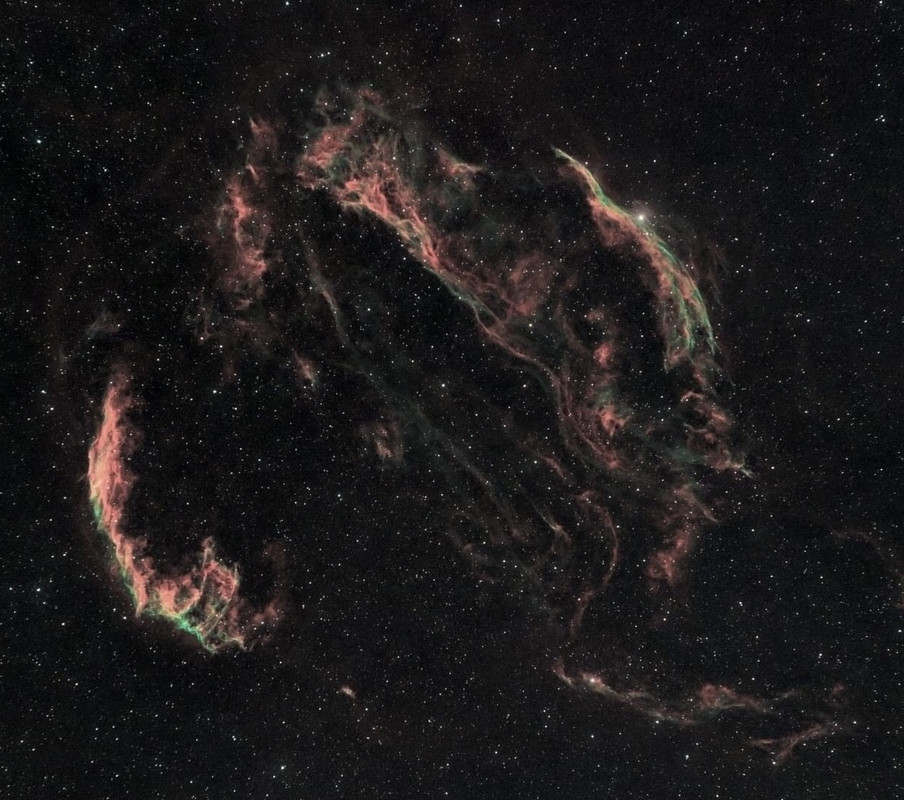 This is my image of the Veil Nebula. 123 images X 3 minutes each stacked and processed in Siril. Nikon 200mm lens with a dedicated astronomy camera.
Nice photo!
Disclaimer: Opinions posted on Free Republic are those of the individual posters and do not necessarily represent the opinion of Free Republic or its management. All materials posted herein are protected by copyright law and the exemption for fair use of copyrighted works.