Skip to comments.
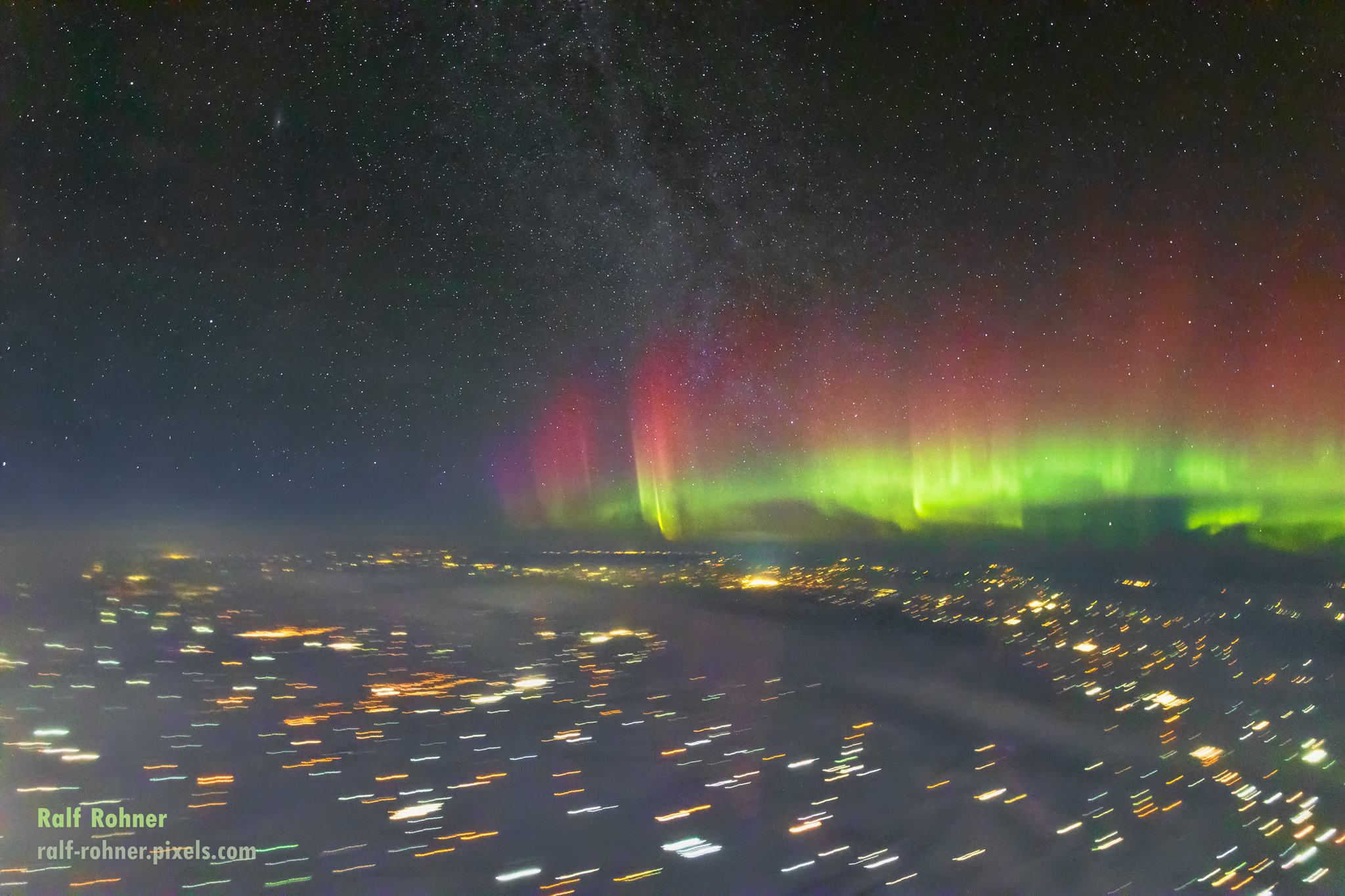
Astronomy Picture of the Day - Northern Lights from the Stratosphere
NASA ^
| Image Credit & Copyright: Ralf Rohner
Posted on 01/18/2024 12:29:13 PM PST by MtnClimber
Explanation: Northern lights shine in this night skyview from planet Earth's stratosphere, captured on January 15. The single, 5 second exposure was made with a hand-held camera on board an aircraft above Winnipeg, Canada. During the exposure, terrestrial lights below leave colorful trails along the direction of motion of the speeding aircraft. Above the more distant horizon, energetic particles accelerated along Earth's magnetic field at the planet's polar regions excite atomic oxygen to create the shimmering display of Aurora Borealis. The aurora's characteristic greenish hue is generated at altitudes of 100-300 kilometers and red at even higher altitudes and lower atmospheric densities. The luminous glow of faint stars along the plane of our Milky Way galaxy arcs through the night, while the Andromeda galaxy extends this northern skyview to extragalactic space. A diffuse hint of Andromeda, the closest large spiral to the Milky Way, can just be seen to the upper left.
TOPICS: Astronomy; Astronomy Picture of the Day; Science
KEYWORDS: apod; nasa
To be added or removed from the Astronomy Picture of the Day ping list please send me a request via "Private Reply" (Mail). For more detail go to the link and click on the image for a high definition image. You can then move the magnifying glass cursor then click to zoom in and click again to zoom out. When zoomed in you can scan by moving the side bars on the bottom and right side of the image.
To: MtnClimber
2
posted on
01/18/2024 12:29:29 PM PST
by
MtnClimber
(For photos of scenery and wildlife, click on my screen name for my FR home page. More photos added.)
To: 21stCenturion; 21twelve; 4everontheRight; abb; AFB-XYZ; AFPhys; Agatsu77; America_Right; ...
Pinging the APOD list.
🪐 🌟 🌌 🍔
3
posted on
01/18/2024 12:30:04 PM PST
by
MtnClimber
(For photos of scenery and wildlife, click on my screen name for my FR home page. More photos added.)
To: MtnClimber
4
posted on
01/18/2024 12:55:40 PM PST
by
sauropod
(The obedient always think of themselves as virtuous rather than cowardly.)
To: MtnClimber
Thanks for posting.
At least I get some good results from Fed. expenditures on occasion.
5
posted on
01/18/2024 12:57:37 PM PST
by
Paladin2
To: MtnClimber
Why is the color different based on Altitude?
6
posted on
01/18/2024 12:58:36 PM PST
by
Paladin2
To: Paladin2
Stratification of the atmosphere? Composition and temp varying with altitude?
7
posted on
01/18/2024 1:12:14 PM PST
by
gundog
( It was a bright cold day in April, and the clocks were striking thirteen. )
To: MtnClimber
8
posted on
01/18/2024 1:43:08 PM PST
by
No name given
(Anonymous is who you’ll know me as)
To: MtnClimber
I love astronomy overall, but I think my favorite celestial events are auroras.
I’ve seen far fewer than I’d have liked to.
9
posted on
01/18/2024 1:47:02 PM PST
by
metmom
(He who testifies to these things says, “Surely I am coming soon.” Amen. Come, Lord Jesus…)
To: Paladin2
Why is the color different based on Altitude? Short answer: different light emitting oxygen species take different amounts of time to do so, and at lower altitudes the one that emits red can't survive long enough to emit a photon on its own before bumping into something else (atmosphere is denser the lower you get), which rob it of the energy needed to emit light.
Straight from the NOAA Space Weather Prediction Center's
"Aurora Tutorial" page:
Different auroral colors come from different heights in the atmosphere primarily because the life-time of an excited atom or molecule (time spent in its excited state) is vastly different for different colors of the aurora. The green aurora from oxygen in the 1S state typically occurs from 120 to 400 km (80 to 250 miles) above the surface of Earth. The red aurora from oxygen in the 1D state is restricted to altitudes above 300 km (180 km). This is because oxygen in the 1D state has a very long lifetime (>150 sec) and can only survive in the thinner atmosphere above 300 km. At lower altitudes the oxygen in the 1D state collides with other atmospheric atoms or molecules before it can emit a photon which deactivates or quenches the excited oxygen. The 1S state of oxygen has a lifetime of about 1 second and therefore emits a photon more quickly and thus can emit at lower altitudes where the density is higher. The aurora sometimes has a purplish lower border which comes from emissions from molecular nitrogen. This "prompt" emission is emitted from excited states of nitrogen that have almost no delay between excitation and emission. It survives at even lower altitudes between 120 and 200 km (80 to 120 miles). In the video sequence at the end of this readme document, the purple emissions from the nitrogen seems to lead the green emissions from the oxygen. This is an example of the difference between the prompt emission of nitrogen vs the emission from the longer-lived excited state of oxygen.I recommend visiting the page. It's a pretty good primer on the aurora.
10
posted on
01/18/2024 2:00:12 PM PST
by
verum ago
(I figure some people must truly be in love, for only love can be so blind.)
To: verum ago
11
posted on
01/18/2024 3:36:55 PM PST
by
Paladin2
To: MtnClimber; All
M.C. Love aurora pictures! Thanks for posting! Here is a Youtube Video of ISS views of the night side of Earth, some showing lightning flashes, some showing aurora. (Unfortunately it does not provide the music titles.
Video from ISS Set to music by Stellerdrone
I watch it now and then. Search Stellerdrone for other music.
To: Pete from Shawnee Mission
Very nice. I jumped ahead a lot. That is a long video! Over four hours!
13
posted on
01/18/2024 5:18:33 PM PST
by
MtnClimber
(For photos of scenery and wildlife, click on my screen name for my FR home page. More photos added.)
To: MtnClimber
It is long. I also jump around and try to guess which continent they are passing over sometimes. (I might watch for 10 or 15 min at a sitting.)
YouTube also has some good videos with back ground white noise or brown noise that I can play while I do something else. (Rain on a Hanock roof in Korea, or Rain in Japanese Garden are good ones.)
Disclaimer:
Opinions posted on Free Republic are those of the individual
posters and do not necessarily represent the opinion of Free Republic or its
management. All materials posted herein are protected by copyright law and the
exemption for fair use of copyrighted works.
FreeRepublic.com is powered by software copyright 2000-2008 John Robinson