Posted on 09/15/2023 6:30:13 AM PDT by Diana in Wisconsin
Before I became an editor at Madison Magazine, I managed community programs at Pasture & Plenty on Madison’s near westside for a year and a half. One of the many hats I wore in that position involved wrangling spreadsheets. In fact, it was a hat I wore almost every day as I planned the restaurant’s virtual events. We used these spreadsheets to make sure our ticket prices accurately reflected our production cost.
Each virtual event came with a kit, and among the easier things to itemize were the costs for individual ingredients. It took time to decipher the invoices from farms and suppliers, but it was relatively simple math. A few dozen eggs divided by two per kit — or the cost of a bag of bread flour, etc. — plus the cost to pay the event instructor. A similar method, minus the instructor cost, could be applied to breaking down the expense of a single dish at any restaurant.
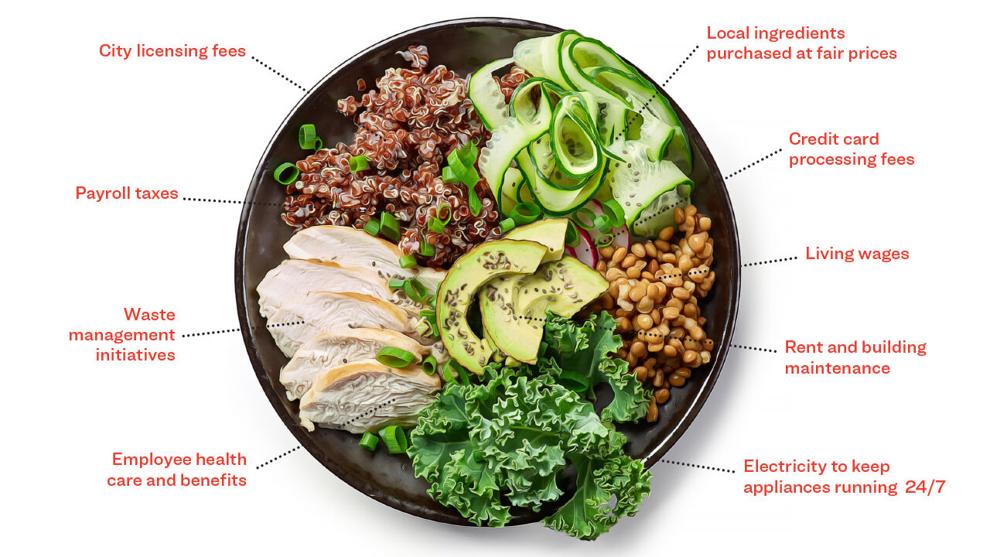
But the tricky part lies in calculating all of the additional line items that factor into the cost of a dish — items that people might not necessarily expect on their bill unless they’re immersed in the daily life of restaurant business.
The “hidden costs” include labor (which has hidden costs of its own, like payroll taxes and employer-funded benefits), overhead (everything from rent to city licensing fees to keeping the refrigerators running 24/7) and credit card processing. With a lot of luck, there’s a little bit of profit left over to pay off any debts — which a lot of our favorite restaurants had to shoulder to stay open through the pandemic — and to reinvest in the restaurant.
These costs are often intangible — it’s difficult to nail down how many hands worked on a dish and for how long, or how much electricity, water and other overhead costs went into it. It can become even more complicated to break down each ingredient into its smaller costs — transportation, labor, agricultural inputs, etc. — because the farmer needs to make money, too. This cost goes up when restaurant owners are committed to supporting the local economy by purchasing from nearby farmers and producers — something that Madison tends to applaud and demand, but maybe not fully embrace when it comes to the reality of menu prices.
There’s a perceived value on familiar dishes (like a burger and fries, or a plate of breakfast food) that many restaurant diners assume are easy and inexpensive to prepare. Often these perceptions are guided by fast-food chains setting a cost expectation by preparing food as quickly and cheaply as possible, which puts local restaurants in a difficult position. That perceived value doesn’t take into account the wealth that circulates back into the local economy, the sourcing of ingredients from local farmers and producers who also need to keep their businesses afloat and earn a living wage, or the immeasurable value a small business like a restaurant can bring to a community.
In the aftermath of a pandemic that continues to fray the fabric of the local restaurant industry, the chance of menu prices coming down again is slim. As diners, we could take this opportunity to reevaluate our paradigm of “cheaper” and “quicker” and prioritize spending money on the dishes that feed into a vibrant and unique local economy.
Kinda takes the fun out of eating out, doesn’t it?

“Kinda takes the fun out of eating out, doesn’t it?”
Spending something like $50 per person for food that might cost $10 per person to cook at home certainly took the fun out of it for me. However, now that waiters are paid a ‘living wage’ (actually higher), there’s no longer a need to tip, and I’m getting better at avoiding that expense...so the $50 is closer to $40, which is still too high, but a bit lower.
It sure shows the reasons why start up restaurants often last only a couple of years.
It also explains the rise in food trucks.
In addition to supply and demand, prices are determined by costs of production. Rises in costs of production are caused by government interventionism. Rises in costs of production in addition to raising prices, also cause a reduction of the productivity of capital goods and undermines capital formation in the economic system.
Prices are determined by what they think will make the most profit. It has little to do with costs of production.
For sure! I happen to love the idea of food trucks, especially if there are several in one area, so that I have a variety of menu options to choose from. Most of them have a limited menu, but are usually very good at the few items they make.
No wonder so many restaurants and/or fast food places are shedding their staffs - the model now seems to either be to order from a Kiosk or from a counter and they’ll either call your number or bring it out to you.
We went to one of our favorite restaurants the other evening - Fish Grill. There is no one taking orders any longer, all ordering if from a kiosk where the registers used to be. I can see my elderly relatives walking straight out the door, but this model saves the restaurant a lot of money, considering they’ll soon be mandated to pay their staff $22/hour:
“California fast-food workers could see their wages reach $22 an hour next year”
“California Gov. Gavin Newsom on Monday signed a nation-leading measure giving more than a half-million fast food workers more power and protections, despite the objections of restaurant owners who warned it would drive up consumers’ costs.”
I expect a lot of fast food outlets to close in the near future - along with a LOT of other businesses - we just lost Gorden Biersch and Mandarin 88, both of which had been in my city for decades.
I like the chart. For fast food places and some restaurants, advertising and paper products are added to the mix.
When I worked at Pizza Hut as a cook in the early 80s, I had heard that paper products were almost 10% of expenses (boxes, napkins, straws, to go cups).
“If you’re short on time, here’s a quick answer: California waiters earn $13-$15 per hour on average, with top earners making $50,000-$60,000 annually including tips.”
And if you tip well, your tip is larger because of the increased expense and price of your meal.
https://www.eyeandpen.com/how-much-do-waiters-make-in-california/
Well, as we know, there’s a lot more to the expenses of running a restaurant than just the food cost.
Any food you make at home, will always be a lot cheaper than the cost of eating out.
Just in general, most restaurants have narrow profit margins.
Yes, restaurants seem to come and go. Many just can’t hack it long term.
Did they put a price on the waiter’s spit?
Spit in your food is always free. ;)
LOL!
It’s a very difficult business.
Cursory internet search reports, that average profit margins for restaurants are between 3 and 5 percent.
Anecdotal evidence, at least in my area, is that there is a lot of competition for the food dollar, for going out to eat. So restaurants are constrained in just continually raising prices to generate more revenue.
Then again, that’s just capitalism. And the other anecdotal evidence, is that restaurants seem to come and go. A lot of places start up but don’t last long term.
Disclaimer: Opinions posted on Free Republic are those of the individual posters and do not necessarily represent the opinion of Free Republic or its management. All materials posted herein are protected by copyright law and the exemption for fair use of copyrighted works.