Posted on 09/12/2023 12:56:26 PM PDT by MtnClimber
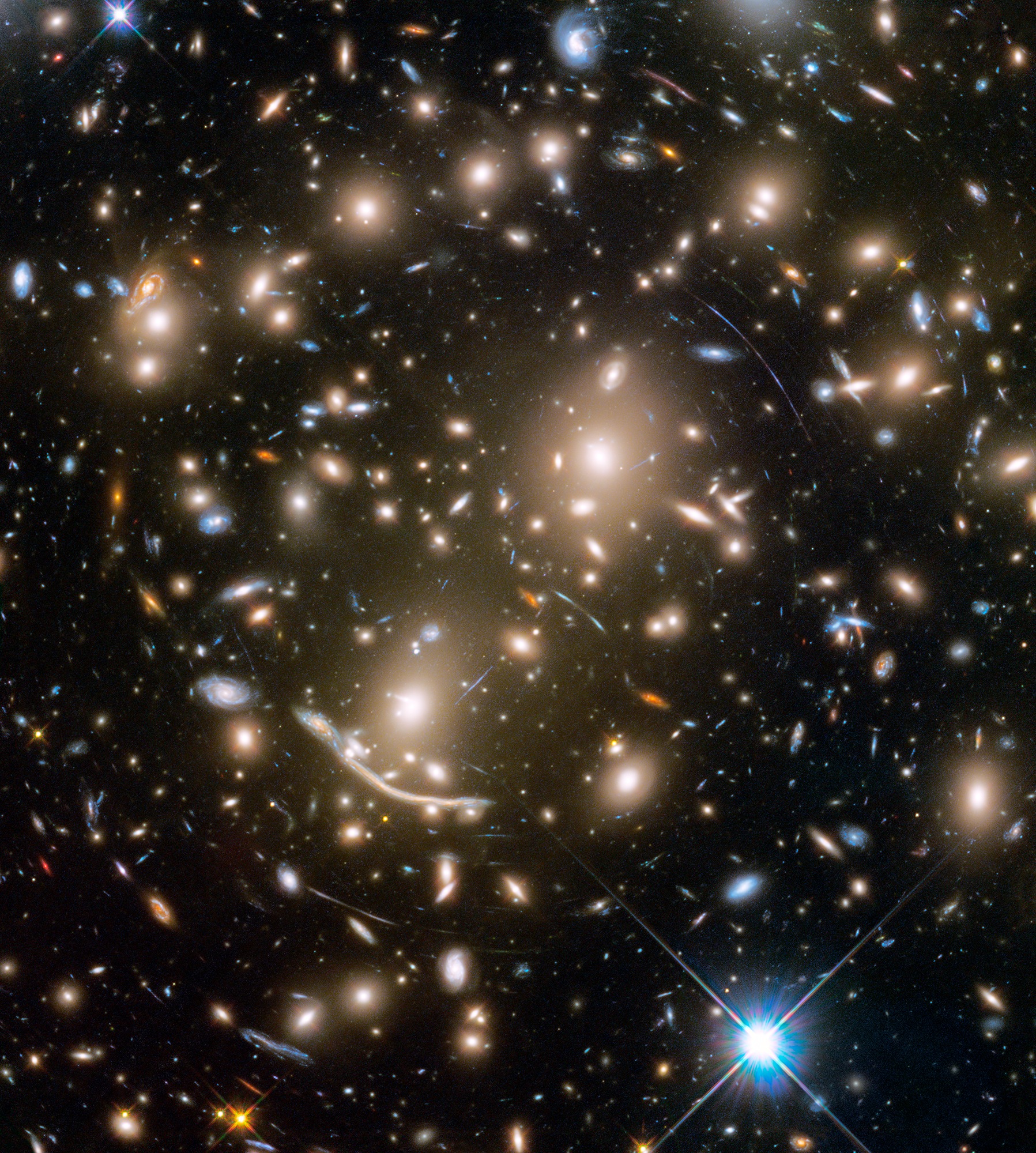
Explanation: Some 4 billion light-years away, massive galaxy cluster Abell 370 is captured in this sharp Hubble Space Telescope snapshot. The cluster of galaxies only appears to be dominated by two giant elliptical galaxies and infested with faint arcs. In reality, the fainter, scattered bluish arcs, along with the dramatic dragon arc below and left of center, are images of galaxies that lie far beyond Abell 370. About twice as distant, their otherwise undetected light is magnified and distorted by the cluster's enormous gravitational mass, overwhelmingly dominated by unseen dark matter. Providing a tantalizing glimpse of galaxies in the early universe, the effect is known as gravitational lensing. A consequence of warped spacetime, lensing was predicted by Einstein almost a century ago. Far beyond the spiky foreground Milky Way star at lower right, Abell 370 is seen toward the constellation Cetus, the Sea Monster. It was the last of six galaxy clusters imaged in the Frontier Fields project.
For more detail go to the link and click on the image for a high definition image. You can then move the magnifying glass cursor then click to zoom in and click again to zoom out. When zoomed in you can scan by moving the side bars on the bottom and right side of the image.
All those blue galaxies are coming towards us, right?
Andromeda will hit us first. The halos of the two galaxies are already interacting. Just wait another 250 million years.
And we think we’re significant. So, how many galaxies do you think are shown?
I used the zoom feature at the link and there are many barely visible galaxies that don't show up in the normal size photo. I can't even guess how many. There could be 10,000 galaxies or maybe more.
Yeah, it shows how really insignificant we really are.
Wow.
Wish I was there...
Cool! Fireworks in space!
I just wish we could enjoy them with a naked eye...
Cool! Fireworks in space!
I just wish we could enjoy them with a naked eye...
It’s an amazing photo, I wonder how many worlds like our own are out there…
It boggles the mind.
I looked up what the estimated number of galaxies is here in the Hubble/Webb era. I found estimates of 100 billion to 200 billion and I found another estimate of about 2 trillion. Those are staggering numbers.
I found another estimate of about 2 trillion. Those are staggering numbers.
Disclaimer: Opinions posted on Free Republic are those of the individual posters and do not necessarily represent the opinion of Free Republic or its management. All materials posted herein are protected by copyright law and the exemption for fair use of copyrighted works.