Free Republic
Browse · Search
General/Chat
Topics · Post Article

Skip to comments.

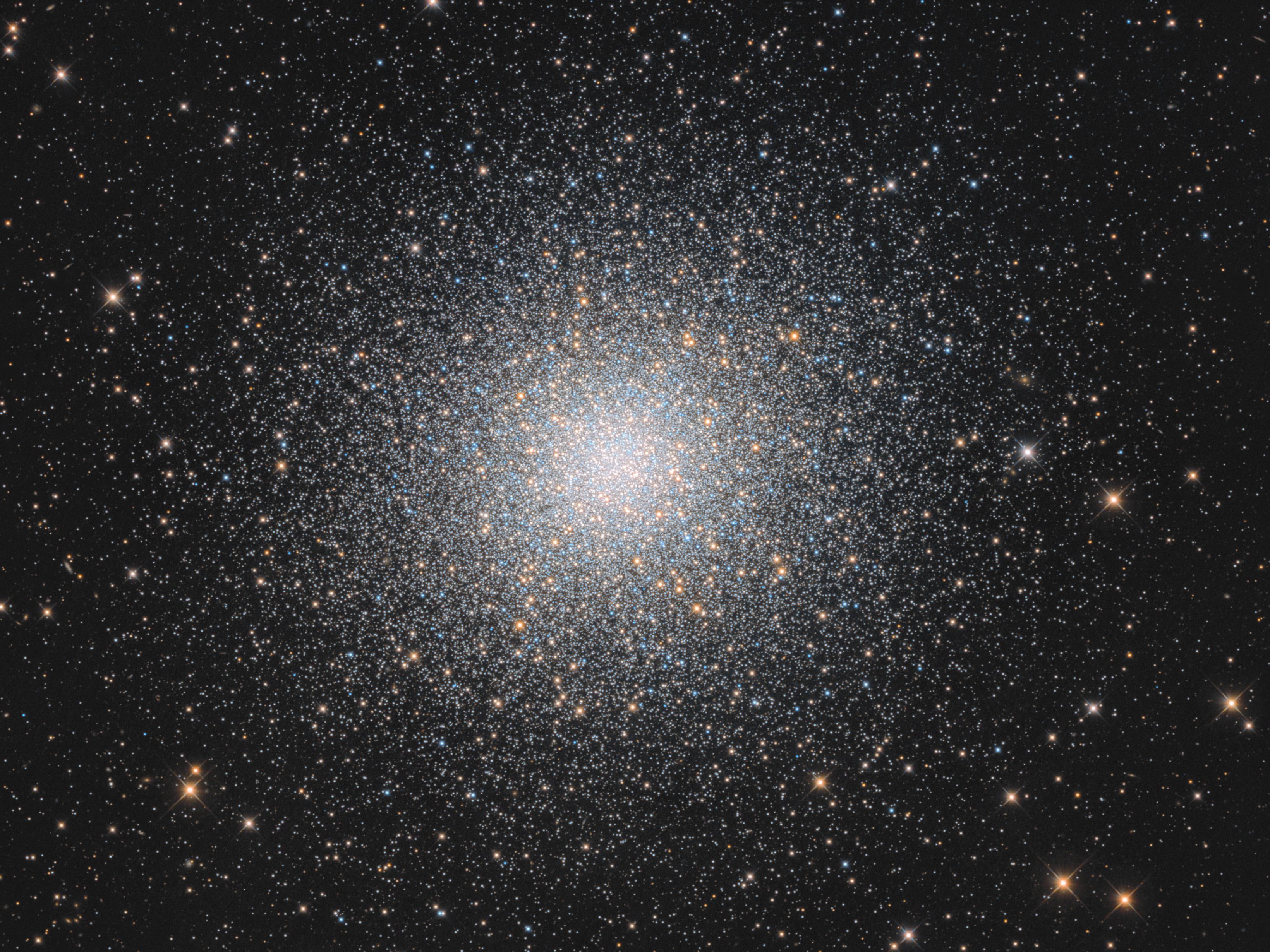
Astronomy Picture of the Day - The Great Globular Cluster in Hercules
NASA ^ | 1 Sep, 2023 | Image Credit & Copyright: Serge Brunier, Jean-FranΓ§ois Bax, David Vernet OCA/C2PU

Posted on 09/01/2023 11:04:44 AM PDT by MtnClimber

Explanation: In 1716, English astronomer Edmond Halley noted, "This is but a little Patch, but it shows itself to the naked Eye, when the Sky is serene and the Moon absent." Of course, M13 is now less modestly recognized as the Great Globular Cluster in Hercules, one of the brightest globular star clusters in the northern sky. Sharp telescopic views like this one reveal the spectacular cluster's hundreds of thousands of stars. At a distance of 25,000 light-years, the cluster stars crowd into a region 150 light-years in diameter. Approaching the cluster core, upwards of 100 stars could be contained in a cube just 3 light-years on a side. For comparison, the closest star to the Sun is over 4 light-years away. The remarkable range of brightness recorded in this image follows stars into the dense cluster core.


TOPICS: Astronomy; Astronomy Picture of the Day; Science
KEYWORDS: nasa
To be added or removed from the Astronomy Picture of the Day ping list please send me a request via "Private Reply" (Mail).

For more detail go to the link and click on the image for a high definition image. You can then move the magnifying glass cursor then click to zoom in and click again to zoom out. When zoomed in you can scan by moving the side bars on the bottom and right side of the image.

1 posted on 09/01/2023 11:04:44 AM PDT by MtnClimber
[ Post Reply | Private Reply | View Replies]

To: MtnClimber

2 posted on 09/01/2023 11:05:00 AM PDT by MtnClimber (For photos of Colorado scenery and wildlife, click on my screen name for my FR home page.)
[ Post Reply | Private Reply | To 1 | View Replies]

To: 21stCenturion; 21twelve; 4everontheRight; abb; AFB-XYZ; AFPhys; Agatsu77; America_Right; ...
Pinging the APOD list.

πŸͺ 🌟 🌌 πŸ”


3 posted on 09/01/2023 11:05:36 AM PDT by MtnClimber (For photos of Colorado scenery and wildlife, click on my screen name for my FR home page.)
[ Post Reply | Private Reply | To 2 | View Replies]

To: MtnClimber

Really cool to see in a big Dobsonian.


4 posted on 09/01/2023 11:08:01 AM PDT by telescope115 (I NEED MY SPACE!!! πŸ”­)
[ Post Reply | Private Reply | To 2 | View Replies]

To: MtnClimber

The Great Goo-Goo Cluster....................

5 posted on 09/01/2023 11:09:49 AM PDT by Red Badger (Homeless veterans camp in the streets while illegal aliens are put up in hotels.....................)
[ Post Reply | Private Reply | To 3 | View Replies]

To: MtnClimber
Here is my artist's rendition of the night sky as seen from a planet near the core of this cluster:


It's the small details that brings it to life.
6 posted on 09/01/2023 11:43:41 AM PDT by Telepathic Intruder
[ Post Reply | Private Reply | To 1 | View Replies]

To: Telepathic Intruder

πŸ˜‚πŸ˜‚πŸ˜‚πŸ˜‚πŸ˜‚


7 posted on 09/01/2023 11:54:48 AM PDT by buckalfa (Gut feelings are your guardian angels)
[ Post Reply | Private Reply | To 6 | View Replies]

To: MtnClimber

All those stars/galaxies are receding, going away from us.


8 posted on 09/01/2023 12:28:15 PM PDT by SkyDancer (If At First You Don't Suceed, Well So Much For Skydiving ~)
[ Post Reply | Private Reply | To 2 | View Replies]

To: SkyDancer
All those stars/galaxies are receding, going away from us.

False!

M13 is 22,200–25,000 light-years away from Earth, and the globular cluster is one of over one hundred that orbit the center of the Milky Way.

-Wikipedia

Aside from the fact that this cluster is locked in orbit around the center of our galaxy, it is also far too near to us for Hubble Expansion to be a factor. (Hubble Expansion is significant only for distances on the order of tens of millions of light-years.)

Regards,

9 posted on 09/01/2023 1:10:10 PM PDT by alexander_busek (Extraordinary claims require extraordinary evidence.)
[ Post Reply | Private Reply | To 8 | View Replies]

To: alexander_busek
When stars or galaxies are red, they're receding, when they're blue in color they're heading towards the telescope.

In physics, the longer the wave length the redder it becomes, the shorter the wave length the bluer it come.

I don't use Wikipedia for knowledge or information.

10 posted on 09/01/2023 1:22:58 PM PDT by SkyDancer (If At First You Don't Suceed, Well So Much For Skydiving ~)
[ Post Reply | Private Reply | To 9 | View Replies]

To: SkyDancer
When stars or galaxies are red-shifted, they're receding, when they're blue-shifted in color they're heading towards the telescope. In physics, the longer the wave length the redder it becomes, the shorter the wave length the bluer it come.

These are well-established facts which should be known to anyone who has taken high school physics, so I don't understand why you are repeating them (to me).

The fact stands that the Globular Cluster in Hercules is far too close to us - actually still within our own galaxy - for Hubble's Law to be applicable to them. Your initial observation - that "all those stars" in the Cluster were receding from us - was thus incorrect.

I don't use Wikipedia for knowledge or information.

Your prerogative. I could, of course, have instead quoted these facts from memory, or I could have transcribed a passage from my old high school physics textbook - but I thought that it would be more convincing and accessible if I cited a generally-available source like Wikipedia. When the question at hand doesn't concern, e.g., Global Warming, Wikipedia is a quick way to establish basic science facts.

Regards,

11 posted on 09/01/2023 1:50:00 PM PDT by alexander_busek (Extraordinary claims require extraordinary evidence.)
[ Post Reply | Private Reply | To 10 | View Replies]

To: alexander_busek
Hmm, well I was just offering up like basic astro stuff, not really about the cluster.

But thanks.

I still don't trust Wikipedia though.

Regards, J

12 posted on 09/01/2023 2:22:06 PM PDT by SkyDancer (If At First You Don't Suceed, Well So Much For Skydiving ~)
[ Post Reply | Private Reply | To 11 | View Replies]

To: SkyDancer

When dealing with cosmological distances there are two competing forces at large: gravity and expansion. Gravity gets weaker with distance while expansion gets stronger. At some point, maybe around 25 or 50 million lightyears (depending on the local density), dominance switches from gravity to expansion, so that galaxy groups and clusters tend to remain bound while galactic superclusters get torn apart.


13 posted on 09/01/2023 3:59:56 PM PDT by Telepathic Intruder
[ Post Reply | Private Reply | To 12 | View Replies]

To: SkyDancer
Hmm, well [...]

Still skeptical of my statements?

[...] I was just offering up like basic astro stuff [...]

There rapidly comes a point, when you're simplifying stuff, that you start distorting and falsifying it.

[...] not really about the cluster.

In your post #8, you had claimed, "All those stars/galaxies are receding, going away from us." That was in reference to the main article and image, I assumed. But the Hercules Globular Cluster is most certainly not receding from us. Nor are any of a number of galaxies - some millions of light years away - belonging to our Local Group.

For what it's worth:

The Hubble constant is most frequently quoted in (km/s)/Mpc, thus giving the speed in km/s of a galaxy 1 megaparsec (3.09Γ—1019 km) away, and its value is about 70 (km/s)/Mpc.

Mentioning the expansion of the Universe and the Hubble Shift in the context of an article about the Hercules Globular Cluster is like pointing to the corner drugstore and proclaiming, "You know, because of Continental Drift, that drugstore is receding from us!"

Regards,

14 posted on 09/02/2023 12:08:18 AM PDT by alexander_busek (Extraordinary claims require extraordinary evidence.)
[ Post Reply | Private Reply | To 12 | View Replies]

To: Telepathic Intruder
When dealing with cosmological distances there are two competing forces at large: gravity and expansion.

"Expansion" is not actually a "force."

It would be better to say that there were two factors involved.

And to clarify: The accepted theory is now that the Universe is expanding both because of the residual momentum of the "Big Bang" and the inflation of Space, itself.

Hope that I haven't mangled things all too badly by formulating it so simply.

Regards,

15 posted on 09/02/2023 12:14:11 AM PDT by alexander_busek (Extraordinary claims require extraordinary evidence.)
[ Post Reply | Private Reply | To 13 | View Replies]

To: alexander_busek
"Force" is a very nebulous term. It can be anything that carries energy. Gravity, for example, carries gravitational potential energy, but is not really a force so much as a space-time curvature.
16 posted on 09/02/2023 12:25:12 AM PDT by Telepathic Intruder
[ Post Reply | Private Reply | To 15 | View Replies]

To: alexander_busek

By the way, I like your tag line. It reminds me of someone...


17 posted on 09/02/2023 12:30:13 AM PDT by Telepathic Intruder
[ Post Reply | Private Reply | To 15 | View Replies]

To: Telepathic Intruder
"Force" is a very nebulous term.

Yes, and I decry the fact that today - in our post-Newtonian world of Physics - you are right! /humor

Why don't you try on a tag-line for size?

Regards,

18 posted on 09/02/2023 12:39:57 AM PDT by alexander_busek (Extraordinary claims require extraordinary evidence.)
[ Post Reply | Private Reply | To 16 | View Replies]

To: alexander_busek

-0-


19 posted on 09/02/2023 7:11:24 AM PDT by SkyDancer (If At First You Don't Suceed, Well So Much For Skydiving ~)
[ Post Reply | Private Reply | To 14 | View Replies]

Disclaimer: Opinions posted on Free Republic are those of the individual posters and do not necessarily represent the opinion of Free Republic or its management. All materials posted herein are protected by copyright law and the exemption for fair use of copyrighted works.

Free Republic
Browse · Search
General/Chat
Topics · Post Article

FreeRepublic, LLC, PO BOX 9771, FRESNO, CA 93794
FreeRepublic.com is powered by software copyright 2000-2008 John Robinson