Posted on 06/25/2023 5:47:54 AM PDT by DoodleBob
I recently picked up Mark Twain’s A Connecticut Yankee in King Arthur’s Court for the first time. Finding the plot rather amusing, I began relaying it to my father over the weekend. Because he had never read the book, I was rather surprised when he began asking informed questions about the story. In no time at all, he was the one schooling me on plot elements I had not yet reached.
“Wait a minute,” I asked. “Are you sure you’ve never read this book?”
“No, never have,” he replied, “but I saw a cartoon version of the story when I was younger and everything I know comes from that.”
His revelation was intriguing, and to be honest, not the first of its kind. Like many in the Boomer generation, my father grew up watching classic cartoons, numbers of which were produced by the likes of Warner Bros.
But those cartoons did more than mind-numbingly entertain a generation of children. They also introduced millions of young people to key facets of cultural literacy, particularly in the realm of literature and music.
Beyond the aforementioned case of Mark Twain’s novel, these cartoons introduced children to stories such as Robert Louis Stevenson’s Strange Case of Dr Jekyll and Mr Hyde through the medium of Bugs Bunny. Key quotations and scenes from William Shakespeare’s works were the main theme in a Goofy Gophers cartoon known as A Ham in a Role. And Henry Wadsworth Longfellow’s epic poem The Song of Hiawatha was placed front and center in a Walt Disney short called Little Hiawatha.
Perhaps even more famous than the literature references are the many ways in which cartoons introduced children to the world of classical music, including both instrumental and operatic selections, one of which is the famous Rabbit of Saville. American film critic Leonard Maltin describes the situation well:
“An enormous amount of my musical education came at the hands of [Warner Bros. composer] Carl Stalling, only I didn’t realize it, I wasn’t aware, it just seeped into my brain all those years I was watching Warner’s cartoons day after day after day. I learned Liszt’s Second Hungarian Rhapsody because of the Warner Bros. cartoons, they used it so often, famously when Friz Freleng had a skyscraper built to it in Rhapsody and Rivets.”
But Maltin wasn’t the only one learning from these classical music forays. In fact, as the famous pianist Lang Lang testifies, it was Tom and Jerry’s rendition of Liszt’s Hungarian Rhapsody in The Cat Concerto which first inspired him to start piano at age two.
These examples just brush the surface of the cultural literacy lessons which the old cartoons taught our parents and grandparents. Even if they never learned these elements in school, they at least had some frame of reference upon which they could build their understanding of the books and music and even ideas which have impacted culture and the world we live in today.
But can the same be said of the current generation? Admittedly, I’m not very well-versed in current cartoon offerings, but a quick search of popular titles seems to suggest that the answer is no. A majority of the time they seem to offer fluff, fantasy, and a focus on the here and now.
In short, neither schools, nor Saturday morning cartoons seem to be passing on the torch of cultural knowledge and literacy. Could such a scenario be one reason why we see an increased apathy and lack of substance in the current generation?
Bugs Bunny and Looney Tunes mercilessly mocked Hitler. The writers of today ring hollow for lack of any knowledge of the classics, history or culture. All they know about are video games and comic books.
I grew up with a TV not hooked up for broadcast viewing unless my father would connect it; it was limited to times when the Arabs were actively killing people and we needed some foreknowledge.
We used VHS (or Beta) that had many of these.
I first discovered a love for classical music by watching Bugs Bunny cartoons!
.jpg)
Before your comment I rewatched the entire cartoon and that thought did occur to me as well. Bugs of course was never serious and everyone knew he was just messing with EF. Though I can’t think of an example I’m pretty sure this wasn’t the only Bugs in drag appearance.
It’s sad to see how culture has declined.
Good question!

What’s Opera, Doc? is a 1957 American Warner Bros. Merrie Melodies cartoon directed by Chuck Jones and written by Michael Maltese.[1] The short was released on July 6, 1957, and stars Bugs Bunny and Elmer Fudd.[2]
The story features Elmer chasing Bugs through a parody of 19th-century classical composer Richard Wagner’s operas, particularly Der Ring des Nibelungen (The Ring of the Nibelung), Der Fliegende Holländer (The Flying Dutchman), and Tannhäuser. It borrows heavily from the second opera in the “Ring Cycle” Die Walküre, woven around the typical Bugs–Elmer feud. The short marks the final appearance of Elmer Fudd in a Chuck Jones cartoon.
It has been widely praised by many in the animation industry as the greatest animated cartoon that Warner Bros. ever released, and has been ranked as such in the top 50 animated cartoons of all time. In 1992, the Library of Congress deemed it “culturally, historically or aesthetically significant”, and selected it for preservation in the National Film Registry, the first cartoon short film to receive such honors.
more....
https://en.wikipedia.org/wiki/What%27s_Opera,_Doc%3F
I fondly recall the Puppetoons version of John Henry.
Academy Award winner.
We simply understood Bugs was playing a role, and sex never entered the equation.
Wasn’t the only time, and we never gave it a second thought as we understood the context, even as children.
Correction: Oscar nominee.
Those cartoons brought a great deal to children. So did Walt’s version of Disney.
I go to meet Chuck Jones once after a lecture he gave in 1968 era.
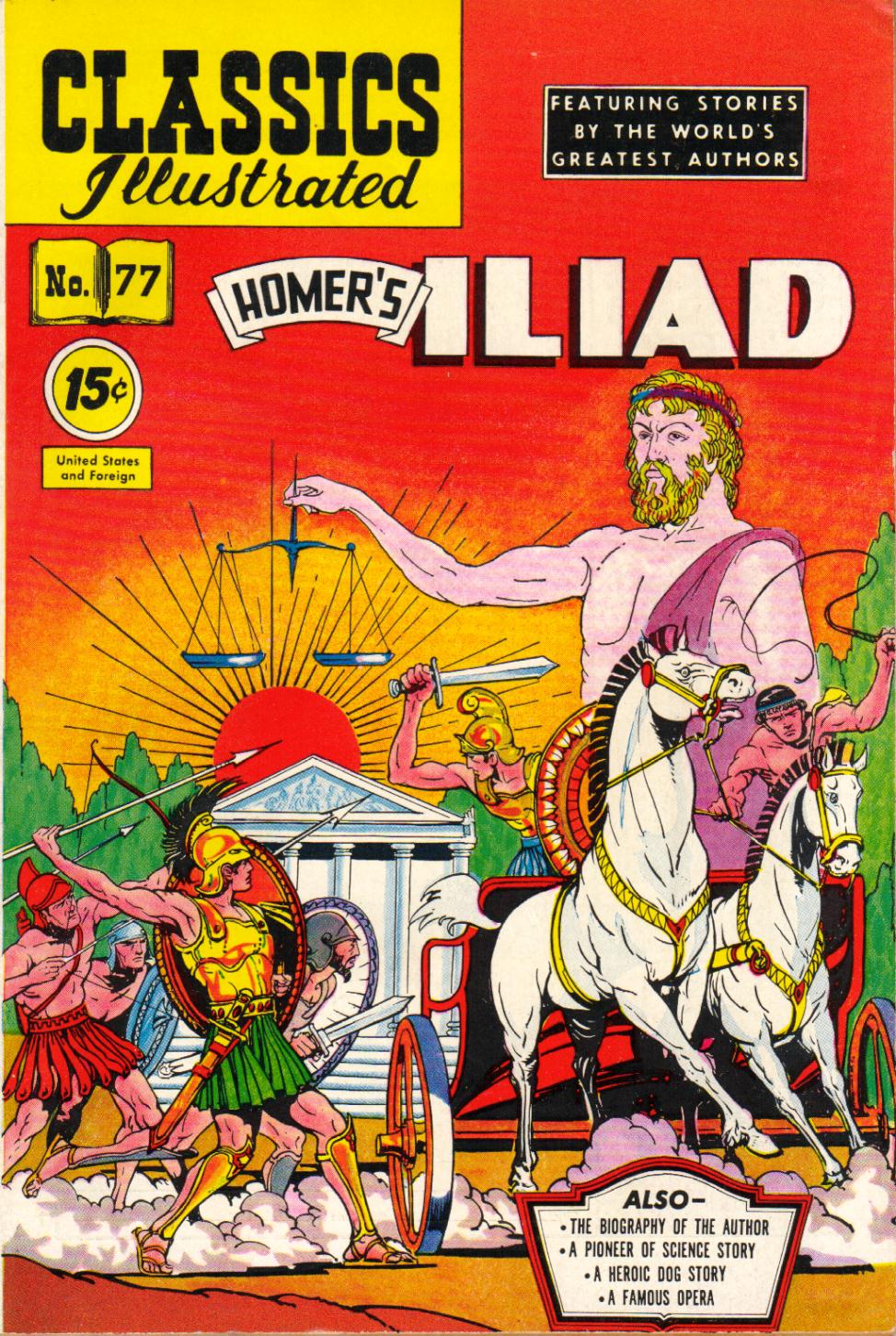
Remember “Classics Illustrated” comic books. I was exposed to so many of the classics that way!
https://storage.googleapis.com/hipcomic/p/795afd92e3552e8d87991a2885edb5c4-800.jpg
21. Gain control of key positions in radio, TV & motion pictures.
22. Continue discrediting American culture by degrading all form of artistic expression. An American Communist cell was told to "eliminate all good sculpture from parks and buildings," substituting shapeless, awkward and meaningless forms.
23. Control art critics and directors of art museums. " Our plan is to promote ugliness, repulsive, meaningless art."
24. Eliminate all laws governing obscenity by calling them "censorship" and a violation of free speech and free press.
25. Break down cultural standards of morality by promoting pornography and obscenity in books, magazines, motion pictures, radio and TV. [Note: This is the Gramscian agenda of the "long march through the institutions" spelled out explicitly: gradual takeover of the "means of communication" and then using those vehicles to debauch the culture and weaken the will of the individual to resist.]
26. Present homosexuality, degeneracy and promiscuity as "normal, natural and healthy." [Note: Today those few who still have the courage to advocate public morality are denounced and viciously attacked. Most Americans are entirely unwitting regarding the motives behind this agenda.]
27. Infiltrate the churches and replace revealed religion with "social" religion. Discredit the Bible and emphasize the need for intellectual maturity, which does not need a "religious crutch." [Note: This has been largely accomplished through the communist infiltration of the National Council of Churches, Conservative and Reform Judaism, and the Catholic seminaries.]
And here I was, thinking we would be talking about “Schoolhouse Rock”.....
Disclaimer: Opinions posted on Free Republic are those of the individual posters and do not necessarily represent the opinion of Free Republic or its management. All materials posted herein are protected by copyright law and the exemption for fair use of copyrighted works.