Posted on 06/02/2023 8:43:15 AM PDT by Red Badger
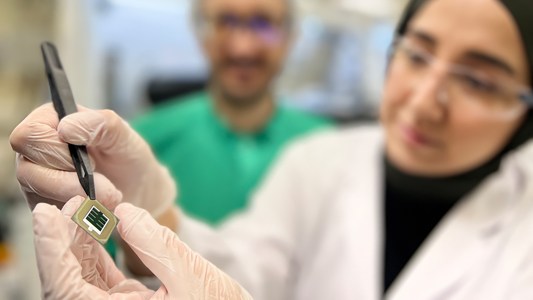
Researcher Esma Ugur displaying the perovskite/silicon tandem solar cell that broke the efficiency record in April 2023. Credit: KAUST
Researchers in Saudi Arabia have just broken a record they themselves set just two months ago: a tandem solar cell with an unprecedented 33.7% efficiency.
The challenge: Photovoltaic solar cells absorb light and convert it into electricity. You’ll find dozens of them in the average solar panel, and chances are they’ll be made from silicon, because it lasts a long time and is relatively cheap.
Silicon solar cells aren’t terribly efficient, though — most commercial silicon cells convert just 18-22% of the solar energy that hits them into electricity. That means you need more cells and more panels, increasing the cost and upkeep of the system.
The idea: To improve the efficiency of solar cells, some researchers are pairing the silicon in them with another material. In December 2022, for example, a team from Germany unveiled a solar cell consisting of the standard silicon with a layer of the mineral perovskite on top of it.
While the silicon layer absorbed and converted mostly infrared light into electricity, the perovskite layer did the same for visible light. As a result, the “tandem” solar cell was able to achieve a then-record-breaking efficiency of 32.5%.
What’s new? On May 30, Erkan Aydin, a research scientist at the King Abdullah University of Science and Technology (KAUST) in Saudi Arabia, announced the creation of a tandem solar cell that achieved 33.7% efficiency.
This breaks the current world record of 33.2%, which the same KAUST researchers set in April 2023.
“In two months’ time, we’ve set a new world record for perovskite/silicon tandem solar cells — again!” wrote Aydin in a LinkedIn post. “We hope that our new achievement will contribute to accelerating the green energy transition.”
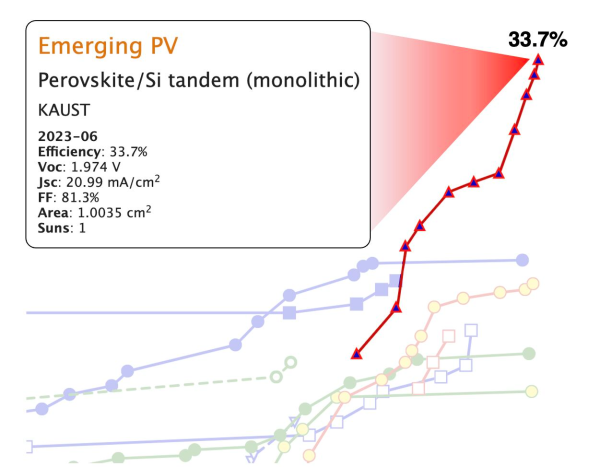
a chart displaying stats on the new tandem solar cell Credit: Erkan Aydin / LinkedIn
Black box: KAUST’s tandem solar cell has been certified by the European Solar Test Installation, a research lab that verifies the performance of solar tech for the European Union, so we know its efficiency claims are valid.
However, the researchers have revealed nothing on how they were able to squeeze that extra bit of electricity out of the cells.
When they broke the record in April, they noted that the silicon part of the cell was textured — that has helped improve efficiency in other tandem solar cells, so they may have taken the same approach with the new cell, but we don’t yet know for sure if that’s the case.
Looking ahead: Creating solar cells that can break efficiency records in the lab is one thing — achieving those same efficiencies with solar cells that could make a difference in the real world is another.
The next steps for the KAUST team will likely involve developing larger versions of their tandem solar cell. The current cell is just larger than one square centimeter, but the cells used in standard solar panels are usually around 240 cm2.
KAUST now needs to prove its tandem solar cell can make a difference in the real world.
Approximately 1,200 of those standard silicon solar cells are needed to produce enough electricity for the average home, so, even though KAUST’s cell is more efficient than any other perovskite/silicon tandem solar cell, we’d still need a lot of them to make any sort of dent in the world’s energy needs.
That means KAUST not only needs to be able to make their cells bigger, they need to be able to manufacture them at scale and at a competitive price.
Buyers also expect their solar panels to last at least 20 years, but perovskite-based cells tend to degrade more quickly than silicon ones — ensuring that its tandem solar cell can withstand environmental conditions for years will be another important goal for the KAUST team.
Tech Ping!....................
Wow 33% /s
Free beer next Friday. (Not AB)
The Devil is in the details.
33% batting average will get you into the Baseball Hall of Fame /s.
A utility probably would rather have 25% efficiency cells that last for 50 years than 30% efficiency cells that last for 15 years.
Does the breakthrough include making photovoltaic electricity by moonlight and starlight?
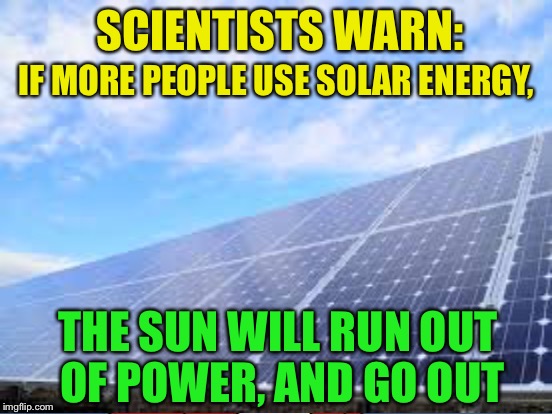
Remember, internet alerts are always right, especially when “scientists” are involved.
So forget about saving the Erf. Save the Sun!
Comparison cost please and availability.
Moving in the right direction - not there yet...
In order to convert 100%, they would have to invent a Black Hole Solar Cell...................
Cost per KW/HR is what matters for terrestrial use. Could be a game changer for space applications where cost is a secondary concern with space and weight being much more important. i used to be in the space solar cell business at Spectrolab.
Solar is freedom...independence and if done wisely is a good investment.

I was talking with someone at the laundromat...It takes years to recoup your investment and I think these solar companies are laughing all the way to the bank.
And match / exceed most internal combustion engins.

33.7%! Maybe I'll go power the city of Washington DC...by myself.
i am behind the push to solar panels 100%, 27.5% of the time... day time... that is...
“Researchers in Saudi Arabia…”
When you’re so much closer to the Sun as they are, of course your solar cell efficiency numbers are going to be the highest.
Disclaimer: Opinions posted on Free Republic are those of the individual posters and do not necessarily represent the opinion of Free Republic or its management. All materials posted herein are protected by copyright law and the exemption for fair use of copyrighted works.