Posted on 05/23/2023 2:02:01 PM PDT by MtnClimber
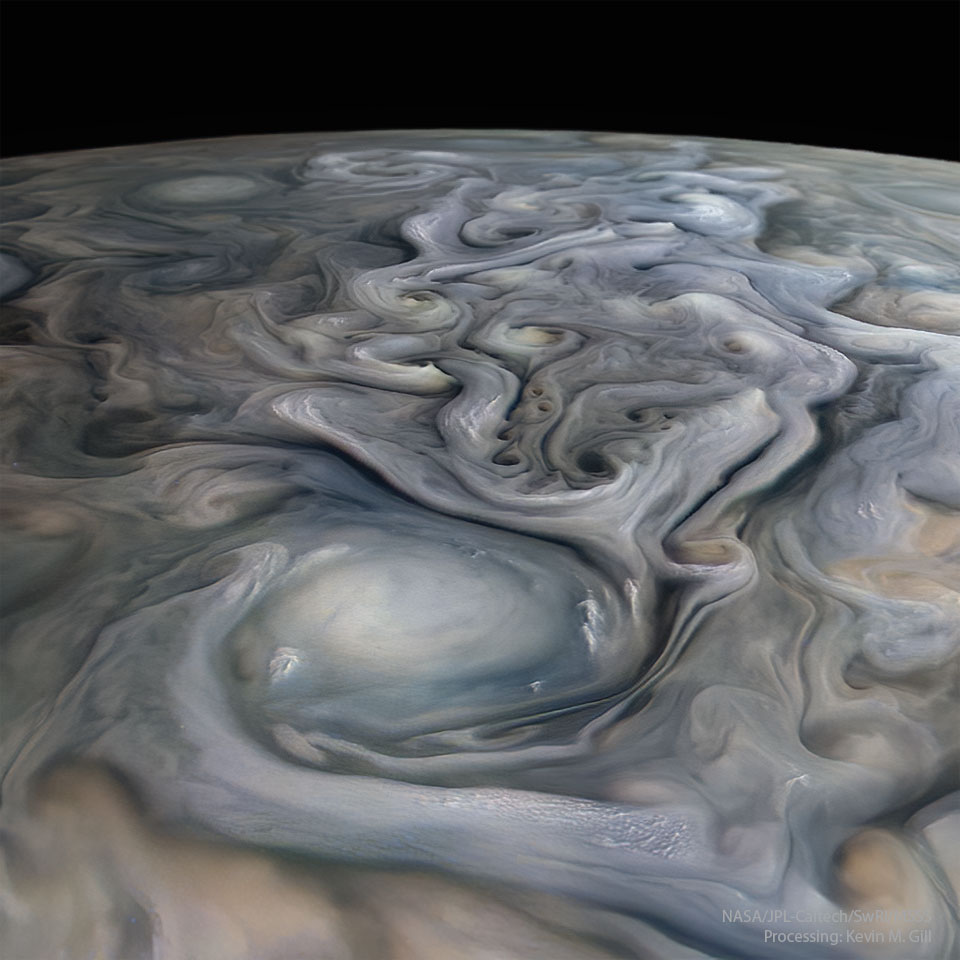
Explanation: Big storms are different on Jupiter. On Earth, huge hurricanes and colossal cyclones are centered on regions of low pressure, but on Jupiter, it is the high-pressure, anti-cyclone storms that are the largest. On Earth, large storms can last weeks, but on Jupiter they can last years. On Earth, large storms can be as large as a country, but on Jupiter, large storms can be as large as planet Earth. Both types of storms are known to exhibit lightning. The featured image of Jupiter's clouds was composed from images and data captured by the robotic Juno spacecraft as it swooped close to the massive planet in August 2020. A swirling white oval is visible nearby, while numerous smaller cloud swirls extend into the distance. On Jupiter, light-colored clouds are usually higher up than dark clouds. Despite their differences, studying storm clouds on distant Jupiter provides insights into storms and other weather patterns on familiar Earth.
For more detail go to the link and click on the image for a high definition image. You can then move the magnifying glass cursor then click to zoom in and click again to zoom out. When zoomed in you can scan by moving the side bars on the bottom and right side of the image.
Wow 🤩.
I say, “let’s take it around and land somewhere else!”
She acts like summer and walks like rain
Beautiful and amazing.
“’Scuze me while I kiss the Sky.”
She acts like summer and walks like rain
She listens like spring and she talks like June
The swirls remind me of a marble cake.
Geeze...you’ve got it wrong too! It’s “excuse me while I kiss this guy”. Hopefully you also understand that it’s “there’s the bathroom on the right”.
LOL!
Looks like modern art - but better than most of it.
Amazing photo. Spacecraft is launched to Jupiter and arrives exactly and a small camera takes photos with the right exposure and tracks the rotation of the planet and then they are transmitted back at slow speed and we see the great photos.
Meanwhile I have a fancy Canon EOS R6 and I am lucky to get a correctly exposed photo let alone a sharp one during daylight hours of a still object or a photo of the moon that is sharp.
Maybe I outta read the manual and practice and practice.
Find a exposure guide for different subjects.
Print out and also add to custom settings.
I am guessing the people that made the camera practice before launch.
Disclaimer: Opinions posted on Free Republic are those of the individual posters and do not necessarily represent the opinion of Free Republic or its management. All materials posted herein are protected by copyright law and the exemption for fair use of copyrighted works.