Posted on 05/01/2023 6:29:12 AM PDT by Red Badger
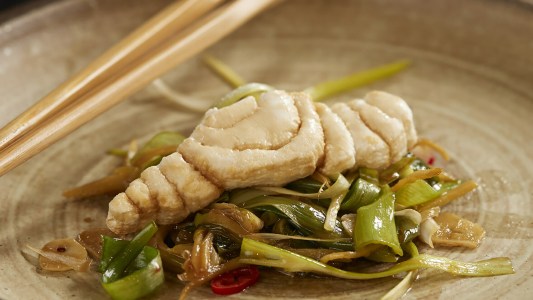
piece of white fish on a plate with vegetables and chopsticks...Credit: Moran Lidor / Shlomi Arbiv
VIDEOS AT LINK...................
A pair of food tech startups have teamed up to create what they say are the world’s first lab-grown fish filets — and they used a 3D printer to serve them.
The challenge: Demand for seafood is expected to nearly double by 2050 due to a growing population and increasing incomes, but overfishing, climate change, ocean pollution, and other factors pressure the seafood industry’s ability to satisfy the world’s hunger for fish.
Even if industry can source all the seafood we need from the ocean and fish farms, current fishing practices can harm the environment, via greenhouse gasses and marine ecosystem destruction, problems only likely to increase as the industry grows.
“We showcased a cultivated product that flakes, tastes, and melts in your mouth exactly like excellent fish should.” - MIHIR PERSHAD
Lab-grown fish: Rather than continuing to rely on our current sources of seafood, a handful of startups think we should also grow some of the fish we want to eat from cells in labs.
Two of those companies — Steakholder Foods in Israel and Umami Meats in Singapore — have now teamed up to create a cultivated fish filet prototype, which they recently served to a handful of special guests, including Israeli Prime Minister Benjamin Netanyahu.
“We are delighted to have produced the world’s first whole filet cultivated fish in partnership with Steakholder Foods,” said Mihir Pershad, CEO of Umami Meats. “In this first tasting, we showcased a cultivated product that flakes, tastes, and melts in your mouth exactly like excellent fish should.”
Making the meat: Making lab-grown fish (or any meat) starts with cells from living animals. The cells are then combined with nutrients in machines called “bioreactors” that produce the ideal conditions for the cells to multiply.
Because the cells that come out of bioreactors are molecularly identical to those found in “real” meat, they’re a great match for flavor. However, they aren’t structured like real meat, so the texture is often still lacking.
But Steakholder has developed a technique for turning lab-grown fish cells into a “bioink” that can be 3D printed into ready-to-cook filets.
Looking ahead: It’s not clear how much it cost Steakholder and Umami to produce their fish filets, and for lab-grown fish to be able to help meet future seafood demand — or even survive commercially at all — the cost will need to be at least somewhat comparable to the price of fish from the sea and farms.
We shouldn’t have to wait long for more information on the sustainable seafood alternative, though, as the companies say they will announce their plan to bring the fish to market “in the coming months.”
Fake Fish!...............
I could see this product satisfying some of the consumer market for seafood. Most processed fish has a very mild taste. Most of the pronounced flavor comes from the seasoning on outside surfaces.
Beef would require a more complex breakdown of flavors with their varying levels of sharpness or resonance.
This may be a worthwhile company to invest in.
The best fish is the fish that doesn’t taste like fish.............

At this point, the entire digestive system collapses
accompanied by uncontrollable flatulence
Until finally, the poor bastard is reduced to a quivering
wasted piece of jelly.

Ironically, that is often the case.
Off Topic: I like imitation crab, many times, more than the real thing.
I have been going mad looking for a brand of imitation crab that is not overly sweet. I’m sure I had some in the past that did not taste as though brushed with Log Cabin pancake syrup, but I cant find any.
Of course, the other possibility is that my taste buds have changed as Ive gotten older, and kept a low salt routine.
They could print babies for Hillary and the rest of the child-killer lot.
Oooooooo. That looks nasty.
imitation crab is made in a chemical process using otherwise inedible fish and fish parts along with dyes and anti-biotics. Enjoy.


I know, it sounds gross, but it tastes good. Another Kitchen Paradox.
That’s because fresh-from-the-boat Alaskan crab is mostly impossible to obtain in the lower 48. All the good stuff is air freighted to Japan.
I’m a ghoul at heart. I misread the header as, “recently fed some high profile diners,” and got really excited about the content.
Meat is crucial for human health, scientists say
Frankenfish!!
Ronco Fish-o-Matic!
Cheaper and better for mariculture....just grow the fish on fish farms...(not like the tilapia are sometimes done)...but clean. reservoir lakes and penned off areas at deserted coastlines could help.
Gonna need lots of printers....
They could use the lab grown cells for recipes that call for fish dishes that don’t need fish textures...
Disclaimer: Opinions posted on Free Republic are those of the individual posters and do not necessarily represent the opinion of Free Republic or its management. All materials posted herein are protected by copyright law and the exemption for fair use of copyrighted works.