Posted on 04/10/2023 4:41:10 AM PDT by MtnClimber
One of the core subjects of this site for several years has been doing reality checks on the schemes of Net Zero central planners. Is there any chance that these zero carbon economy schemes might work? Or are they just dreams that ignore obvious physical obstacles in a religious zeal to reach an imagined future utopia?
My prior writings on this subject are summarized in my December 2022 Report “The Energy Storage Conundrum,” and in my recent posts (here and here) on the work of Bill Ponton regarding the UK.
On April 5 Tesla dropped into the debate a big Report of their own, with the title “Sustainable Energy for All of Earth.” Tesla reaches the exact opposite conclusion from me and the people I have cited in my writings on this subject. From the Executive Summary:
This paper finds a sustainable energy economy is technically feasible and requires less investment and less material extraction than continuing today’s unsustainable energy economy. While many prior studies have come to a similar conclusion, this study seeks to push the thinking forward related to material intensity, manufacturing capacity, and manufacturing investment required for a transition across all energy sectors worldwide.
Could that be? After all, this Tesla Report is clearly backed by many millions of dollars of funding, with dozens of smart and highly-paid people beavering away for months or even years on sophisticated computer models to come up with impressive results. By contrast, the people on whose work I have relied — Roger Andrews, Ken Gregory, Bill Ponton — as well as myself, are all unpaid volunteers working on our own and with no resources other than the internet and perhaps an Excel spreadsheet program.
Before getting into some specifics, I should mention that I have a good deal of admiration for Tesla’s CEO, Elon Musk. He is a bona fide creative business genius. However, let’s not lose track of the fact that all of his main pre-Twitter businesses — electric vehicles, batteries, solar panels, space launches — are almost entirely if not entirely dependent for their revenue on the gaming of government subsidy and handout programs. The electric vehicle business, in particular, that underlies the lion’s share of Musk’s net worth, has a valuation that can only be justified by a faith that essentially all vehicles will soon be electrified. So far, the market share of EVs has been almost entirely dependent on a combination of government subsidies and compulsion (e.g., “fuel economy” standards that exempt EVs). If EVs don’t take over the auto market, then Musk may be no wealthier than you or I come 2030. I suggest keeping that in mind when considering the Tesla “Sustainable Energy” Report.
There is a huge amount of detail here, and I only have time for so much. But let’s take a look at how this Report proposes to deal with the energy storage for the U.S. Recall that Ken Gregory calculated that if the U.S. fully converted to wind and solar generation, it would need to store approximately 250,000 GWh (which would be 250 TWh) to make it through a full annual storage and discharge cycle, given the seasonal pattern of wind and solar generation. Try to provide the 250 TWh of storage with lithium ion batteries at $200/KWh, and that will run you about $50 trillion. That would be slightly unaffordable, given current U.S. annual GDP of under $25 trillion.
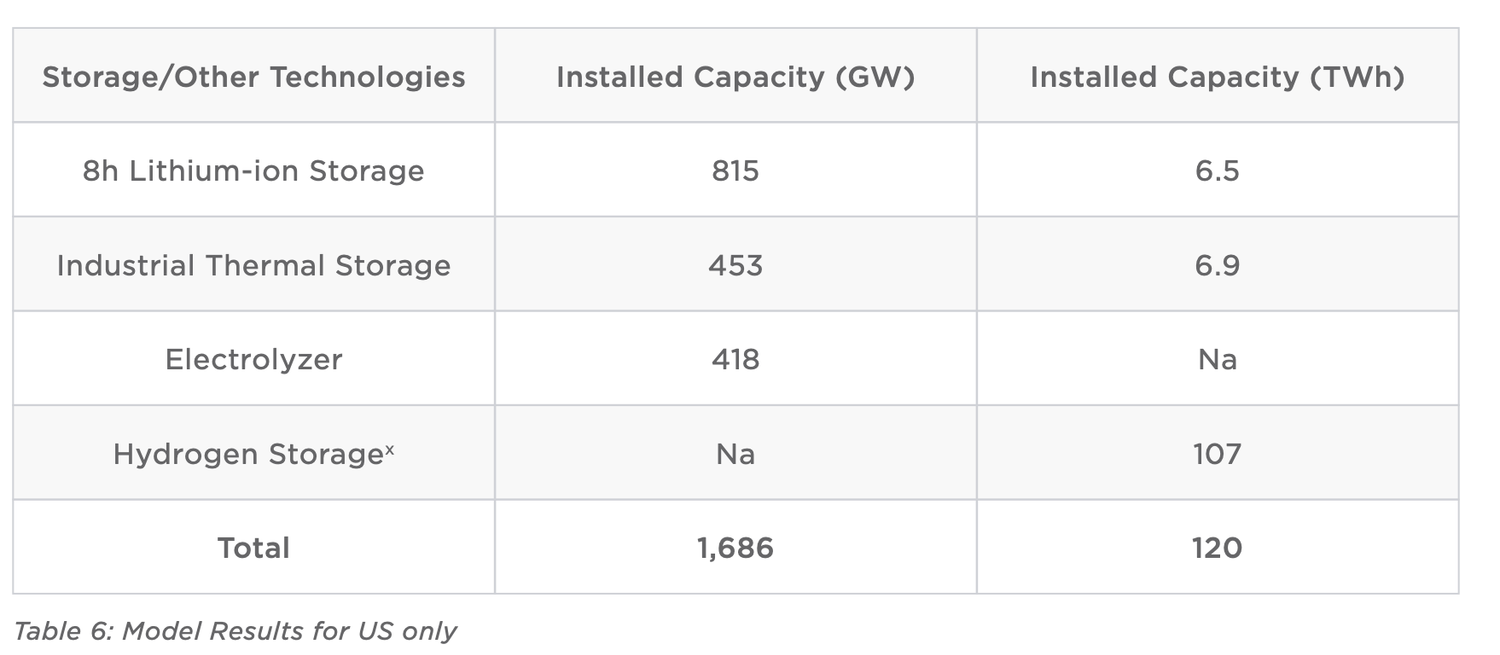
Here is the chart from the Tesla Report on how they propose to deal with storage for the U.S.:
As you can see, their answer is almost entire hydrogen. The total storage proposed, at 120 TWh, is less than half of what Gregory calculated as needed, but not wildly out of range.
In Tesla’s favor, the idea of using hydrogen for the storage is substantially less insane than relying mostly on batteries. But, as discussed in my energy storage Report, hydrogen produced by electrolysis from water using electricity only from renewables is far from cheap. For my Report, I found a figure of $4-6/kg for producing this “green” hydrogen, which translates to a price of $32 - 48/MMBTUs (the units in which natural gas prices are typically quoted). By contrast, natural gas prices fluctuate, but over the last ten years they have always been under $10/MMBTU, and mostly around $3-5/MMBTU. The current price is more like $2/MMBTU. The Tesla Report cites a price of about $3/kg ($24/MMBTU) just to store the hydrogen on an annual basis.
As also discussed in my energy storage Report, hydrogen is more challenging to deal with than natural gas in every respect. It is less energy dense (meaning, more pipeline capacity needed to transport the same amount of energy), it embrittles steel pipes, it is more explosive and dangerous, it is more prone to leaks, and so forth. To move to hydrogen as the vehicle of energy storage would mean creating an entire national infrastructure of new facilities. Next to none of that currently exists, nor is it under construction or even in the planning stage. I can’t find any effort in the Tesla Report to estimate a cost for any of this.
And private investment will not build it. Why? For the simple reason that natural gas is cheaper and better in every respect. Nobody is going to buy green hydrogen at $40/MMBTU when natural gas can be had for $5, and nobody is going to build the infrastructure to transport and store hydrogen until it is price competitive to do so.
So Tesla can say all they want that their zero carbon energy system “requires less investment and less material extraction,” but the fact is that the market is saying otherwise. The whole “hydrogen economy” thing is completely dependent on a new economy of government central planning and handouts, and is sitting around waiting for the next round of hundreds of billions of dollars of government subsidies to get it going.
Without going into detail on other sections of the Tesla Report, I’ll just say that there are plenty of obvious fantasies. For example, how about air travel? No problem!:
Longer distance flights, estimated as 80% of air travel energy consumption (85B gallons/year of jet fuel globally), can be powered by synthetic fuels generated from excess renewable electricity leveraging the Fischer-Tropsch process, which uses a mixture of carbon monoxide (CO) and hydrogen (H2) to synthesize a wide variety of liquid hydrocarbons, and has been demonstrated as a viable pathway for synthetic jet fuel synthesis.
Just another minor item to be invented new from scratch.
Why would a Tesla put out a Report like this? It doesn’t take much thought to understand the reason. Getting the bureaucrats excited about their utopia coming to pass is the route to the mandates and subsidies for EVs and batteries for decades to come, all of which will maintain Musk as the world’s richest man. And if it all doesn’t work in the end? Somebody else’s problem.
So, Mr. Musk, if all this can be done for “less investment” than our current system, there should be real money to be made by building the demonstration project to show us all how it works. How about taking one of the smaller Hawaiian islands (Maui?), and installing the wind turbines, solar panels, hydrogen electrolyzers, and storage facilities to go 100% carbon free? The Hawaiians will all save money, and you’ll make additional billions. I hereby call your bluff. Put up, or shut up!
I agree. Do a demonstration project and put it where it will impact the political geniuses, like Barkey Bama, when it does not work.
Build a toy to show it works in concept. Wireless energy might work, but I would need to see figures.
EVs get charged at night after the Sun sets and the winds calm. The operational model doesn’t fit with renewables.
I have an even simpler proposal. Rather than a whole island, how about just a single individual. A good example might be Elon Musk. With all his billions, he should be able to live on a hydrogen economy, with absolutely no fossil fuel usage at all. Once he demonstrates he can do it, I'll consider trying. And, if he runs out of money, who cares?
We can have all the electricity we want 24/7.
Without hydrocarbon generation.
It’s called nuclear power.
Works great. Ask France, Germany and the LA DWP, who owns 26% of the Palo Verde Nuclear Generating Station in Arizona.
Funny how they never mention that.
The problem is that we're not being told the real operational model. The real model is to grossly OVERBUILD the quantity of solar panels, wind turbines, batteries, and hydrogen storage, in order to make up for the difference. For example, a typical suburban home might need a quarter acre of solar panels to supply all of its electricity on a clear sunny day to get its occupants through the next day. Add maybe a couple of Tesla sized batteries and some hydrogen storage tanks, too. Of course, you need to double that to cover a cloudy day, and many times more to cover a rainy spell.
Add to that, the electrolyzers and hydrogen bottles for next winter. Remember, that even at 10,000 psi, the highest realistic storage pressure available, hydrogen requires 7 gallons of storage containers to equal the energy in a single gallon of gasoline. You get to add many more times the solar cells and batteries, and hydrogen bombs in order to get you through the winter! How's that for a whole lot of hydrogen bombs in your home. It makes the fires in the storage batteries seem quite trivial.
The 'operational model' is that it this extra capacity just sits idle during sunny spells.
Hmmm. I think I’m going to build a gasifier for my old pickup truck. Then it can run on all the horse poop the EV people keep shoveling
This is the sort of commercial endeavor I support in principle. Maybe the smart people can figure out “a better way”.
What if there really *IS* a way to move largely or partially past fossil fuels? That’s not a bad thing UNLESS the shift is ramrodded down our throats by an abusive and ill-considered public policy.
The industries in place across history have always felt a bit of “manifest destiny” entitled them to retain their primary role ‘forever.’ But technology progresses. Steam ships and railroads thought they had a manifest destiny to handle passenger traffic. The Us Post Office felt is had a manifest destiny to deliver messages and packages. The phone companies thought they had a manifest destiny to handle voice calls. And so on.
If Tesla or whoever in the COMMERCIAL sector can figure it out, I say go for it.
In my view, the brains assembled in massive depth by the various Musk endeavors have a solution to the problem of electricity generation
The solution will be revealed commercially at a time and place of their choosing for both profitable and political impact.
That solution will ultimately be nuclear, small and widely dispersed nuclear generators that will be connected to the existing grid. Cheap, safe and ubiquitous nuclear power will become poitically acceptable
Why is it that noone bothers to discuss, research, etc. the energy that the real Tesla tapped into and utilized over a century ago? It’s there for the taking and would power all things earth related. Wonder what ol J.P. actually acquired those many moons ago.
The energy to produce batteries, solar systems, windmills, etc. always exceed their output. It takes coal, gas, and nuclear to make those things.
I hope nobody does that. The problem with that is it's possible to find a use case where solar and hydrogen alone fully powers a house and one's car (at least for local driving, and with a hydrogen car we could be talking 500 mile range). They would show "it works" for that one person and demand we all be forced to implement it even though it's bad for most people.
As an example, our home solar provides 80% of all the power we need in our all-electric home, including charging our EV. It works that well because I live in Alabama and I did some hard-core analysis on mine and my wife's power consumption habits, then did some engineering on our solar exposure, etc. into what it'd take to meet most of our energy needs and wants. If just one of the variables changed, like if both my wife and I were still working in the office, which means little power consumption during the day (while we're out, but that's when we have free solar power) and virtually all of the power consumption when we come home and do chores, which means running many of our appliances at the same time. That scenario would mean I'd have to invest way more for battery storage (to run the house in the evening) and inverter capacity (to convert a lot of DC power to AC for all the appliances that would run at the same time). Thus, it would be infeasible for even us if my wife wasn't retired and I wasn't quasi-retired, working from home a lot. That's an example of solar working for use cases, but not the overall population.
I keep fearing they'll tout up this guy in New Jersey with a 100% solar/hydrogen home as an example we all have to follow. Of course they'll forget to tell you all the gobs of grant money he was given to fund the project.
It'd be infeasible for me to chase the remaining 20% of power I buy from the grid over the year and try to make us 100% energy independent. Where I'm at now with 80% energy independence I've reached the threshold where I start running into the law of diminishing returns. But I do keep an eye for if the Dims ramp up their stupid war on energy to the point where I have reason to try to be 100% energy independent. When thinking of that scenario, a hydrogen electrolyzer and fuel cell gets my attention as a possible solution for long term energy storage to make it through the winter.
Just another infomercial. Totally BS
Anyone that believes Elon Musk is a gift to conservatism, is not paying attention as to what Elon really is. Nothing more than a roadblock to conservatism., pretending to be something he is not.
In spite of his undoubted brilliance and talent, the majority of Elon Musk’s fortune is built on the back of the climate change fraud. Once it is accepted that burning fossil fuels to add more CO2 to the atmosphere is actually good for humanity, Tesla will go bankrupt.
Imho, Musk could do the job just by mass producing 4th generation small nuclear reactors. Do it in just the same way as he makes cars and trucks.
He’ll need a nuclear reactor for mars anyway.
Mass producing nuclear small modular reactors smr—would collapse the cost of electricity down to .01@kwh.
That’s revolution.
That also solves the monetary problem.
Gasoline and diesel work very good for cars and trucks.
The vehicles are far cheaper to buy. They cost what they do now due to destroying millions of used cars during the obama/biden years and deliberate blocking production of less expensive cars and trucks.
Batteries are not even close. They are storage devices that use nuclear, natural gas, coal to get the energy from. They do a poor job of storage as well.
4 gallons of gas has more energy then the entire battery pack of a electric F-150 and anyone can fill up a gas vehicle in 5 minutes and not worry about range anxiety or having a massive fire while driving down the road or your home burning up or insurance writing off the vehicle after a minor accident. You will still owe on that vehicle while you buy another.
Disclaimer: Opinions posted on Free Republic are those of the individual posters and do not necessarily represent the opinion of Free Republic or its management. All materials posted herein are protected by copyright law and the exemption for fair use of copyrighted works.