Posted on 03/02/2023 1:17:24 PM PST by Red Badger
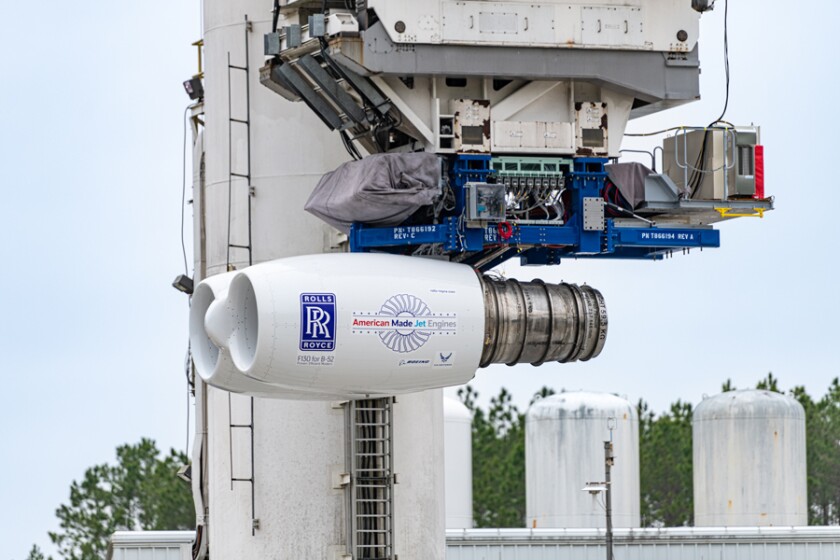
The F130 engines in dual-pod configurationRolls-Royce VIEW 1 IMAGES
At NASA's Stennis Space Center in Mississippi, Rolls-Royce has begun testing of the F130 jet dual-engine pods that will power the US Air Force's B-52H Stratofortress heavy bomber fleet for the remainder of its service life into the 2050s.
Entering service in 1955, The B-52 is so venerable that the grandchildren of the original pilots may now be serving aboard the same aircraft. It's a testament to over-engineering that the 76 remaining B-52Hs and the 12 held in reserve will continue to serve for another 30 years until their basic airframe becomes too fatigued to remain flightworthy.
However, like the Ship of Theseus thought experiment, the B-52s have had so many bits and pieces replaced that the question arises of whether they're still the same aircraft. They have been serviced and upgraded so many times that not much beyond the original airframe remains.
The new F130 engines being developed by the Rolls-Royce US division in Indianapolis, Indiana, will be the last engines to be fitted to the B-52 fleet. Under a US Air Force contract, Rolls-Royce is building 608 engines, which is eight per aircraft, and 42 spares. To speed up the refit, the company derived the F130 from its commercial BR725 engine that has already clocked up 30 million hours of flight time in the Gulfstream G650 business jet and other civilian and military transports.
(Excerpt) Read more at newatlas.com ...
Heck, the whole wing could be a solar panel.
The majority of the B-52 fuselage is unpressurized. The basic airframe sees very little stress compared to commercial airliners.
The wings are the component that sees the stress because they flex about 15 feet from takeoff to cruise. They flex even more during maneuvering.
Because of that, they have been reskinned, some more than once.
I agree with your statement that building brand new B52’s should be cheaper.
This brings to memory an article I read on the A1E Skyraider I think was built by Douglas. The aircraft could carry such a huge payload and loiter for so long that the USAF wanted them back in production. The problem was the cost was so atrocious it was deemed not worth it.
Boeing could do the same here. After all, the maid idea of the military industrial complex is to make money.
The B-52 is Getting New Engines... Why Does it Still Need 8 of Them?
https://www.youtube.com/watch?v=02_geGISTLg
To cut to the chase, it’s because way back when they sized the rudder to be just big enough to deal with the asymmetric thrust of flight with only seven of the eight engines turning and burning (seven engines split 57/43). The existing rudder would be overpowered by the asymmetry of thrust when it’s one engine inop in a 4-engine configuration (three engines split 67/33). And beefing up the rudder would mean putting more stress on the fuselage, so they’d also have to re-engineer and reinforce the empenage.
The existing pylons are too spindly for the thrust of a two-engine configuration, plus the asymmetric thrust problem would be even worse one engine inop in a 2-engine configuration (split 100/0).
If they had re-engined them in the 1980’s the engine they would have put on them would have been Either 4 RB211’s or 8, JT8D-219’s and both of those engines are completely obsolete, only would have offered a slight range advantage and all of the good suppliers of the parts for those engines are all gone, now (and would not have stuck around for few B52’s).
Keeping the TF33 only cost a little extra fuel, but didn’t risk grounding the freet from a lack of spares.
If they had re-enginered them in the 80’s, they’d be reengining them again in 10 years.
Glad they kept 8 burning instead of going to 4 which at one time had been a proposal.
“Entering service in 1955, The B-52 is so venerable that the grandchildren of the original pilots may now be serving aboard the same aircraft.”
I’m not sure that’s something to be proud of, particularly when our government is trying their best to get World War 3 started.
Below is a link to the same topic. Tells a story versus repackaging the corporate press release for this New Atlas example.
https://www.thedrive.com/the-war-zone/rolls-royce-offers-peek-at-the-b-52s-new-engines-undergoing-testing.
Cheers…
I used to live on a hill near Lizanna. In the winter, when air was cold, dense, and still, the shuttle engine tests would rattle the windows in my home. We were 12 miles from the test site.
If you can’t block a balloon, …
We could not stop a ballistic missile attack from Mainland China. We have about a dozen interceptors in Fort Greeley which might be effective against North Korea. If China attacks the U.S. with ballistic missiles, it will be devasting for the United States, an extinction event for China.
Reagan won the Cold War by letting it be creditably known by the Russian leadership that neither they nor their families could possibly survive a nuclear exchange with the United States. Moscow was targeted with about 100 warheads. All their retreats and hideouts, too.
If they had re-engined in the 80s they’d still probably need new ‘greener’ engines now.
My idea was always to replace the two inboard engines with a single inboard engine each. (Sort of like the engine upgrade for the ‘737’ MAX) with smaller in the outboard pods.
I used to work at the California plant that built the shuttle engines as well as their test site in the mountains overlooking the San Fernando Valley (I was up there during the Northridge earthquake).
Being in Protective Services, we would do fire standby during test fires. The ground would shake mightily and it would put out a vapor cloud so massive it would momentarily cause a moderate rainfall as it passed over.
The next upgrade will be warp engines.
Those won’t be the last engines.
In the future they will be using implulse engines then Ion drive.
Or so they thought - no one expected the B-52 to still be operational. Now they're running out of spares.
I remember pics of a B-52 with one engine pod replaced with a single high-bypass engine from a 747 for testing, back in the 80's. Guess they decided against that for some reason.
There was also a plan to modify cargo 747's to replace the B-52's, but it never got off the drawing board.
As such, going with the eight Rolls-Royce (former GM Allison) F130 engines means the plane will not require that vertical tail replacement. And would mean no other no need for other structural changes on the B-52 wing.
The proposals were for replacing 8 engines with 4. The problem is the B-52 can’t handle the thrust asymmetry of an engine failure during takeoff with 4 engines. That’s the reason they are going to an 8 engine reengine. It would have taken lots of modifications to the tail and other systems to make the B-52 safe for a 4 engine configuration.
Plus the USAF is not going for a performance upgrade. They are going for 1:1 replacement with exactly the same thrust. Getting a higher thrust replacement would introduce problems with engine out performance.
“the B-52 can’t handle the thrust asymmetry of an engine failure during takeoff with 4 engines.”
I did not know that. Thanks.
A ballistic missile launch, from anywhere, has a distinctive thermal signature that we have satellites looking for.
From a container ship, though, they could launch a whole bunch of balloons, each carrying an air-launched cruise missile, that we probably would not notice.
Disclaimer: Opinions posted on Free Republic are those of the individual posters and do not necessarily represent the opinion of Free Republic or its management. All materials posted herein are protected by copyright law and the exemption for fair use of copyrighted works.