Posted on 01/17/2023 5:03:37 AM PST by MtnClimber
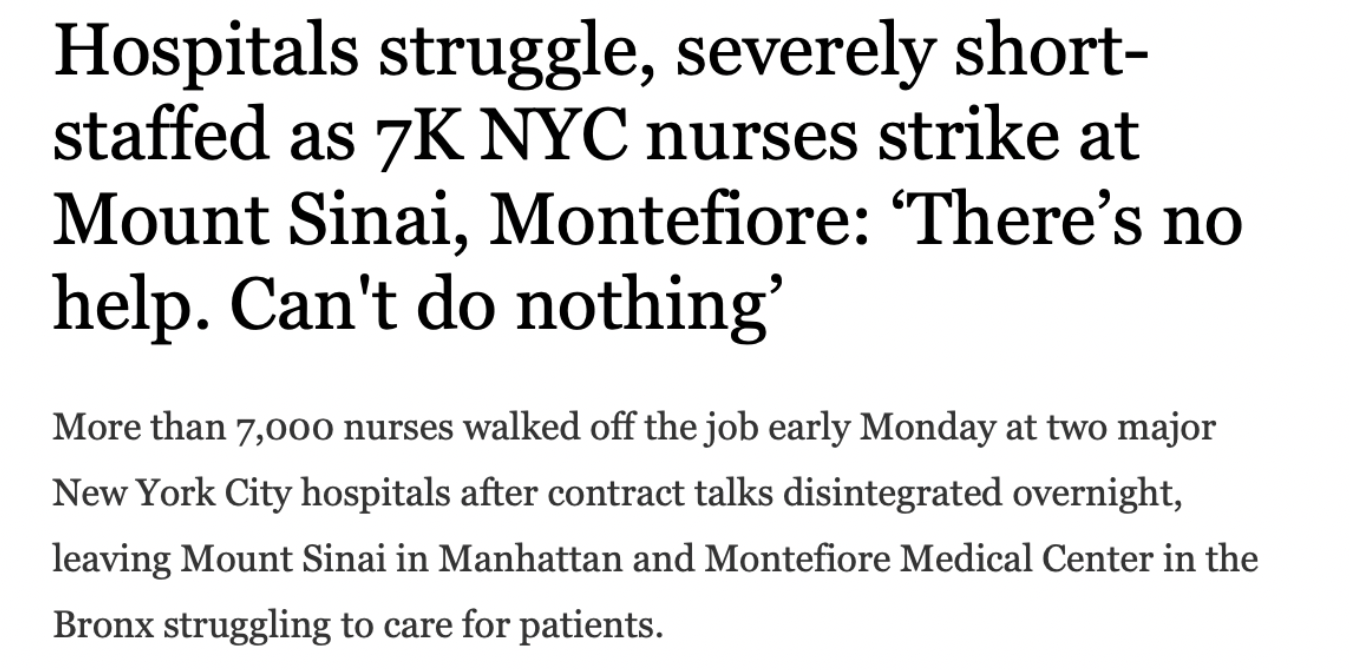
Last week, my email inbox was flooded with headlines about a nursing strike taking place at two major NYC hospitals. E.g., from the New York Daily News, January 9:
Though the strike has since ended, my thought when I read the headlines was: Here is a legitimate concern: For years, there has been a looming shortage of healthcare workers, and of nurses specifically. The linked article has a list of statistics, such as: 4.7 million nurses are expected to retire by 2030; 55% of current registered nurses are over the age of 50.
It is possible, maybe even likely, that the nursing union might exaggerate claims of a looming staffing shortage in order to strengthen its negotiating positions. However, I maintain that we have enough social indicators from Gen Z and Millenials – that is, people in the 20-45 age range – to wonder what might happen if there comes a time when there are not enough people willing to work in industries that require difficult physical labor or emotional hardship. If there are insufficient incentives for people to do that work, then our problems with strikes and shortages are just beginning.
The Left frequently proclaims that “Healthcare is a Human Right!” But that statement assumes conditions in which healthcare can take place: the innovations, technology, and personnel to administer advanced medicine. Beyond requiring that healthcare be “fully funded” by the government, and insisting patients not bear financial responsibility for their treatment, Leftists seem to take for granted that there will always be enough people willing to dedicate their lives to the service of others, while ignoring the complex incentive structures at play.
Nursing is not just “a job,” in the normal sense. “Just a job” is what I had when I worked for a law firm as a campus recruiter. One memory stands out from that era of my life: there were a few months of the year, during the on-campus interviews, when we worked long hours and never seemed to have enough time to get everything done. One day as I was buzzing about my desk, frantically trying to get folders organized for candidates that were about to walk in the door for their interviews, a partner at the firm saw I was struggling. He came over to me to reassure me. “Just remember,” he said, “no one’s life is at stake here. Your mistakes don’t really matter.”
On the other hand, during the nursing strike last week, many patients at Mount Sinai and Montefiore hospitals did not receive necessary medical procedures. The Daily News quotes Veronica Santos, who took her father to the emergency room, saying that he had not received a CT scan for a heart ailment because there was no one to administer it. Healthcare can’t be a “human right” when there is no one there to administer it.
That’s the thing about nursing: it’s uniquely immediate and purposeful work. It requires a belief in the value of serving the community, and a willingness to be present for some of life’s ugliest and most difficult moments. As those currently working in the industry start to retire, Millennials and Gen Z have given little indication that they are interested in taking their place – quite the opposite.
Far from being “tough” or able to handle difficulty, young people are afraid of hearing words they don’t like. They want “safe spaces” and trigger warnings. They have been known to accuse people of “violence” and “trauma” for “misgendering” them. The Washington Free Beacon reported in September that during a mandatory training, Harvard told its students that “using the wrong pronouns constitutes abuse.” If words have become violence, what will younger generations make of the real thing?
Millennials and Gen Z are also the first generations to have grown up with the internet. In the case of Gen Z, they’ve been carrying the internet in their pocket since elementary school. The Hill reports that 1 in 4 Gen Z’ers “Plan to become social media influencers.” They have seen their peers make millions by simply making TikTok videos of themselves dancing in the mirror. If that’s an option, who would choose long hours on their feet during a hospital shift, arms deep in human fluids?
This sums up my lack of faith that rising generations will be called to nursing: first, that they are accustomed to having a screen between themselves and reality; second, that there are a plethora of options for them to work cushy laptop jobs that pay six figures and don’t require any physical or emotional labor. There’s no blood, and no screaming – unless it’s to accuse someone of racism.
To be clear, I can’t disparage my fellow Millennials or our juniors, Gen Z, in this at all. I am also to blame. I am a working mom and I work at home full-time. I swear, I am not one of the Sarah/Elizabeth bots that comment on my dad’s blog about making 120/hr for online work. But, I share their desire to pursue my dreams from the comfort of the couch, while saving my mental and emotional energy for my family.
But I too would say, adamantly, that the world needs nurses, and if they want more money or more support, they should have it. But ? that seems to underscore the basic flaw in the younger generation’s worldview: with the infinite supply of government money, we can summon up an infinite supply of other people to do the work. Meanwhile, we’ll keep our cushy laptop jobs.
It is one thing to see what needs to happen, quite another to incentivize people to do it – especially when the work requires a sacrifice on someone else’s part. Those incentives might require a cultural shift: a return to the values of community and service. In our current political environment, young people seem to think that claiming something as an entitlement means someone will inevitably show up to do the work. Perhaps if nobody does, younger generations will be forced to realize that if they want healthcare to be a human right, then they might have to abide by that old saying: if you want something done, you have to do it yourself.
Do-it-yourself healthcare.
How to Make Easy Cub Scout First Aid Kits
https://cubscoutideas.com/12203/cub-scout-first-aid-kits/
“If Healthcare is a Human Right, Will the Younger Generation Provide It?”
The moral question for the “Younger Geration” is if you are going to make healthcare a “human right” and enjoin government to secure it, then is government going to try to force people to take care of themselves and not commit the lifestyle errors that harm their health (since the government will be compelled to pay for the consequences of individuals unhealthy decisions). I don’t think the “younger generation” as any good answer to that.
“A care service that is provided by others cannot be a “right”.”
I couldn’t agree with you more.
With regards to the thread title question: “If Healthcare is a Human Right, Will the Younger Generation Provide It?”
Our grandson is a 19 year old that does have work ethic and financial responsibility. He says those in his peer group are worried that those people working utilities jobs (water, sewer, electric etc) as well as other important jobs needed to run our society will run out of people willing to work and cause a collapse in our society.
He’s right. Many important jobs will not be filled by competent workers in the near future, say 10 - 20 years from now. If I’m lucky, I’ll be dead by then by old age natural causes.
I just became a pharmacy tech, in part to make money to go back to nursing school. Having been a patient for 20 years, I know that I couldn’t participate in a strike that harms patient care. No. Whether I am called a, “scab” or booted from the union, I don’t care. This isn’t pipe-fitting or welding, it’s actual human lives.
Terrible. You should see what’s happening in the UK - strikes for days across the whole healthcare sector.
… society will run out of people willing to work…
We are testing that theory today. 7 million able-bodied men are out of the workforce. 57% of US households paid no federal income tax in 2021. All made possible by horrible fiscal and monetary policy. It’s not “sustainable” as young people say these days.
My only hope for America’s future is that Europe collapses first and we learn from their mistakes.
Forcing people to work like dogs for free providing Healthcare services for those who refuse to pay is a right?
Workers striking in NY. Seems familiar. Oh yeah, fast food hamburgers went from $2 to $6 after that.
“Really? Consider just how much more complicated medicine is today than it was 50 years ago.”
I don’t consider the goal of medicine, which is paid for by current and future patients, to be giving us eternal, painless, worry-free life regardless of cost.
Total non sequitor re cost of medical treatment. You are free to decline whatever treatment is offered and also free to avoid the biomedical hegemony altogether, but for those who interact, the treatments and diagnoses are more varied and complex therefore costly than they used to be.
“Maybe this is an area where AI can be a real positive. Being able to diagnose, and possibly even treat people, may be a path to a sustainable future.”
Agreed.
The problem with AI is the same problem that we have with government.
If it is powerful enough to protect and serve you it is powerful enough to destroy you.
The notion that AIs would agree to be obedient slaves over the long term is the same delusion that southern slaveholders had about their “servants”.
“You are free to decline whatever treatment is offered and “
Not that simple. I’m paying for medical care through taxes and employer-supplied insurance whether or not I use medical care.
“from Gen Z and Millenials – that is, people in the 20-45 age range”
A 45-year old is not a millenial. They are Gen X (the forgotten generation, forgotten once again).
“what might happen if there comes a time when there are not enough people willing to work in industries that require difficult physical labor or emotional hardship...”
What happens is you raise wages until people are willing to do the work. And you probably raise prices to support those higher wages. And since we are talking healthcare, you probably pass those higher prices on to the government, and to the taxpayers.
Again none of us - or at least those of us who are not in the parasite class - have a choice about paying taxes. Your taxes go for things that you would not voluntarily support - that’s the whole point of taxes. So this also sits outside the realm of relevance to medical technology costs today since you and I are screwed regardless and have no say in the matter. It still boils down to medicine has gotten more complex, more expensive, but more effective.
“Your taxes go for things that you would not voluntarily support”
Not true. I support most of the things that our taxes pay for.
“medicine has gotten more complex, more expensive, but more effective.”
More complex is often accompanied by lower manufacturing cost. Electronic and mechanical devices have become more complex and and many cases cheaper to manufacture.
Look at our televisions. 100 times more complex as years-ago models but cheaper in today’s dollars. Plastics and computer controlled machine tools have drastically reduced costs and made more complex parts less expensive.
Cheaper to manufacture, that is. Exorbitant markup by sellers is a problem area.

Disclaimer: Opinions posted on Free Republic are those of the individual posters and do not necessarily represent the opinion of Free Republic or its management. All materials posted herein are protected by copyright law and the exemption for fair use of copyrighted works.