Posted on 09/16/2022 1:10:25 PM PDT by Red Badger
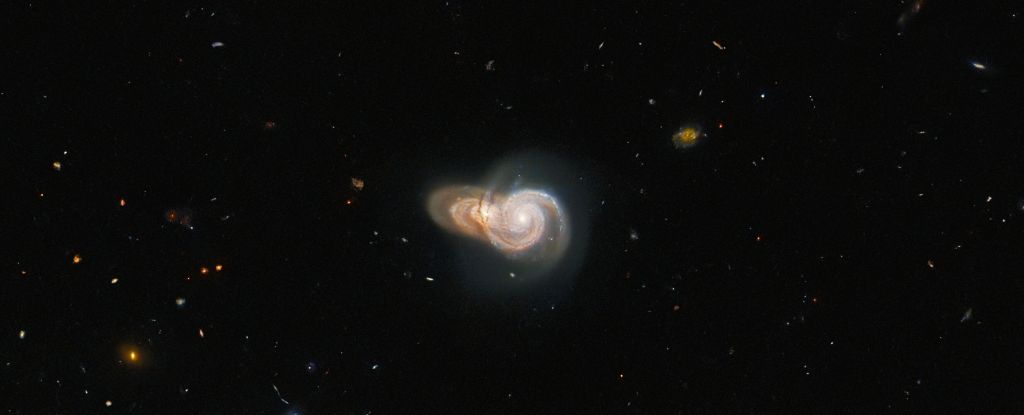
Distant spiral galaxies SDSS J115331 and LEDA 2073461, in a new image from Hubble. (ESA/Hubble & NASA, W. Keel)
A new image from the Hubble Space Telescope beautifully illustrates why astronomers need to be so careful about distance in space.
Over 1 billion light-years away, two galaxies float in the darkness, beautiful golden snail-like spirals seemingly caught in the act of colliding. They're named SDSS J115331 and LEDA 2073461, and in spite of appearances, they're not interacting at all.
Instead, they're separated by quite some distance. Their alignment is an absolutely beautiful line-of-sight coincidence.
Galaxies do collide in space, quite frequently, drawn together along dark matter superhighways to galaxy cluster nodes, where they stream towards a mutual galactic center.
This process is thought to be one way the supermassive black holes at their centers grow to masses billions of times that of the Sun: When galaxies merge, their central black holes do too.
But space is large, and there are a lot of things in it, so scientists must be careful when interpreting two objects that appear to be in the same place. Are they interacting, or are they overlapping with a vast distance in between?
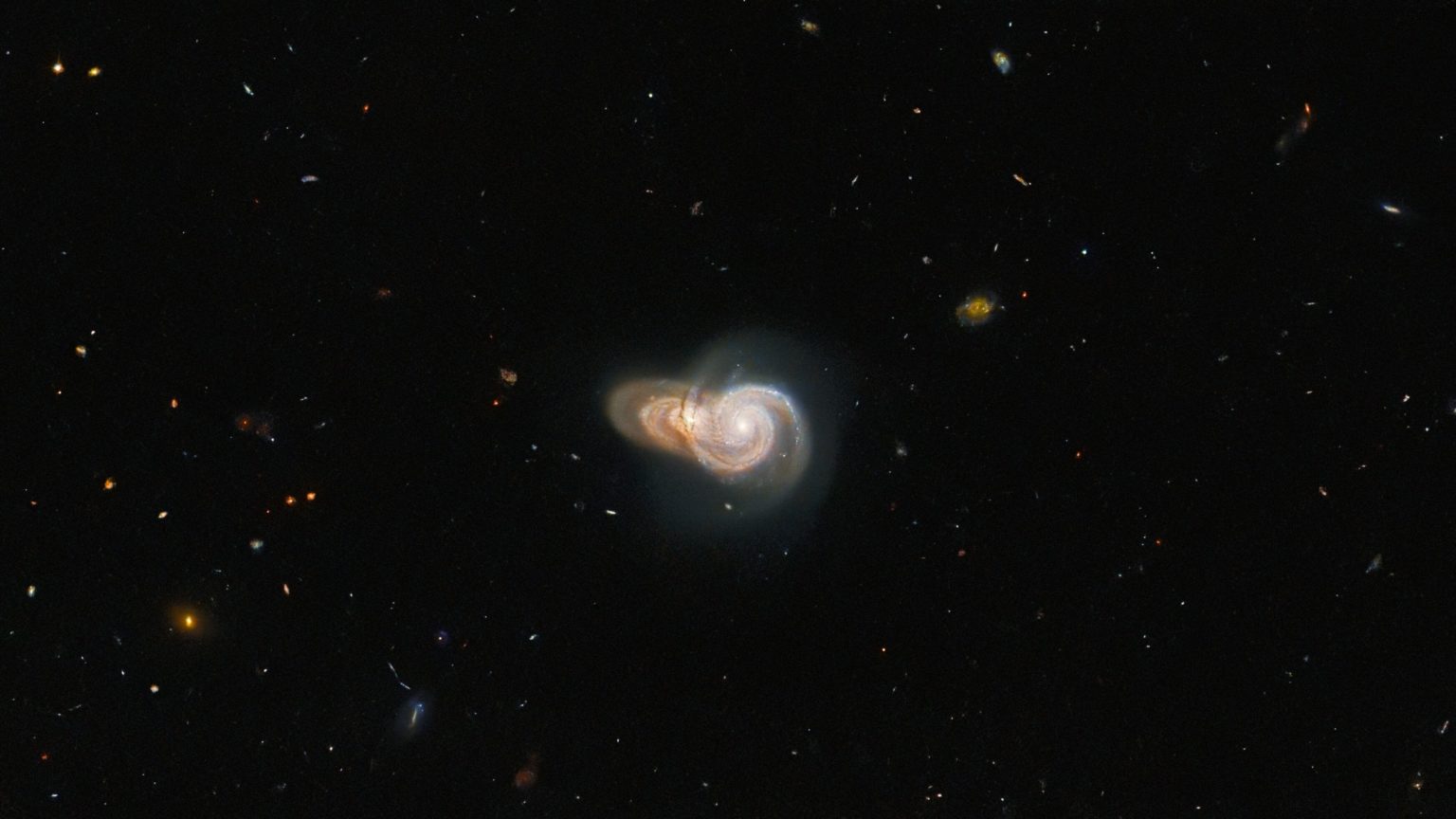
The full Hubble image of overlapping galaxies SDSS J115331 and LEDA 2073461. (ESA/Hubble & NASA, W. Keel)
Distance is one of the most important tools we have for interpreting the Universe around us. Many objects' size, mass, and brightness can't be accurately gauged without an accurate distance measurement.
But distances in space can also be tricky to gauge. You can't tell how far away something is just by looking at it unless you know how much light it emits.
That's why things like Type Ia supernovae, which have a known intrinsic brightness, are a useful tool for gauging distance in space.
For relatively close objects, we can use parallax – the way objects move across the sky in relation to each other.
However, beyond a certain distance, individual objects become harder and harder to see. So scientists rely on other tools, such as the way the expansion of the Universe stretches out light from distant objects.
That's how we know SDSS J115331 and LEDA 2073461 are not in the midst of a giant collision, although there are other clues, too: The two galaxies are far too neat; a collision would mess them up.
Even in the vicinity of the Milky Way, distances can be hard to gauge. Recently, scientists found that a source of gamma radiation was more distant than they had thought. In that case, the shared shape and alignment of the radiation and its source allowed scientists to make the connection.
Although overlapping galaxies may not help scientists better understand galactic collisions and mergers, they can be used to understand spiral galaxies.
When backlit by a more distant galaxy, the interstellar dust in a foreground galaxy can be easier to view. Scientists have used this quirk of alignment to map the distribution of interstellar dust in multiple galaxies.
It's unclear whether Hubble's image of SDSS J115331 and LEDA 2073461 will be used for this purpose. But it's incredibly pretty to look at.
You can download wallpaper-sized versions of this image from the Hubble website.
Hubbel Ping!...............
Awesome!
Galaxies having sex..................
LOL!...................
Well, how far apart are they? And how did you retrieve an article released one day in the future?
It’s from UK.................
That’s so beautiful. I wonder how much the photo has been enhanced and modified.
French chef’s on their way.
Only they know......................and they ain’t talkin’..............
They’re always ahead of us. But I don’t think it’s tomorrow yet, there, either. New Delhi, maybe.
Right click on the 2nd image.
choose OPEN IN NEW TAB or WINDOW
Use CTRL and (+) keys to enhance the view.
use sliders to keep galaxies in center as yo enlarge................
LEDA was photo-bombing before it was cool!
Magnificent - the architect is very talented!
Two overlapping spiral galaxies are pictured in this image from the NASA/ESA Hubble Space Telescope. The two galaxies, which have the uninspiring names SDSS J115331 and LEDA 2073461, lie more than a billion light-years from Earth. Despite appearing to collide in this image, the alignment of the two galaxies is likely just by chance — the two are not actually interacting. While these two galaxies might simply be ships that pass in the night, Hubble has captured a dazzling array of interacting galaxies in the past.There they tell you which filters were used in front of a panchromatic FPA to produce a useful color image.This image is one of many Hubble observations delving into highlights of the Galaxy Zoo project. Originally established in 2007, the Galaxy Zoo project and its successors are massive citizen science projects which crowdsource galaxy classifications from a pool of hundreds of thousands of volunteers. These volunteers classify galaxies imaged by robotic telescopes and are often the first to ever set eyes on an astronomical object.
Over the course of the original Galaxy Zoo project, volunteers discovered a menagerie of weird and wonderful galaxies such as unusual 3-armed spiral galaxies and colliding ring galaxies. The astronomers coordinating the project applied for Hubble time to observe the most unusual inhabitants of the Galaxy Zoo — but true to the project’s crowdsourced roots, the list of targets was chosen by a public vote.
I'm mildly curious as to what you mean by "enhanced" and "modified".
I am grateful that Webb Hubble can give us such great images even if it is offset by giving us Chelsea.
I can’t see the snail.
“drawn together along dark matter superhighways to galaxy cluster nodes, where they stream towards a mutual galactic center”
Wait. They can see these dark matter superhighways?
Conjecture posing as science.
I dated an astrophysicist who had a best friend the drink himself to death because he understood the vastness of space and how insignificant we really are.
I totally get it and force myself not to think about it
Disclaimer: Opinions posted on Free Republic are those of the individual posters and do not necessarily represent the opinion of Free Republic or its management. All materials posted herein are protected by copyright law and the exemption for fair use of copyrighted works.