Posted on 07/13/2022 1:57:25 PM PDT by MtnClimber
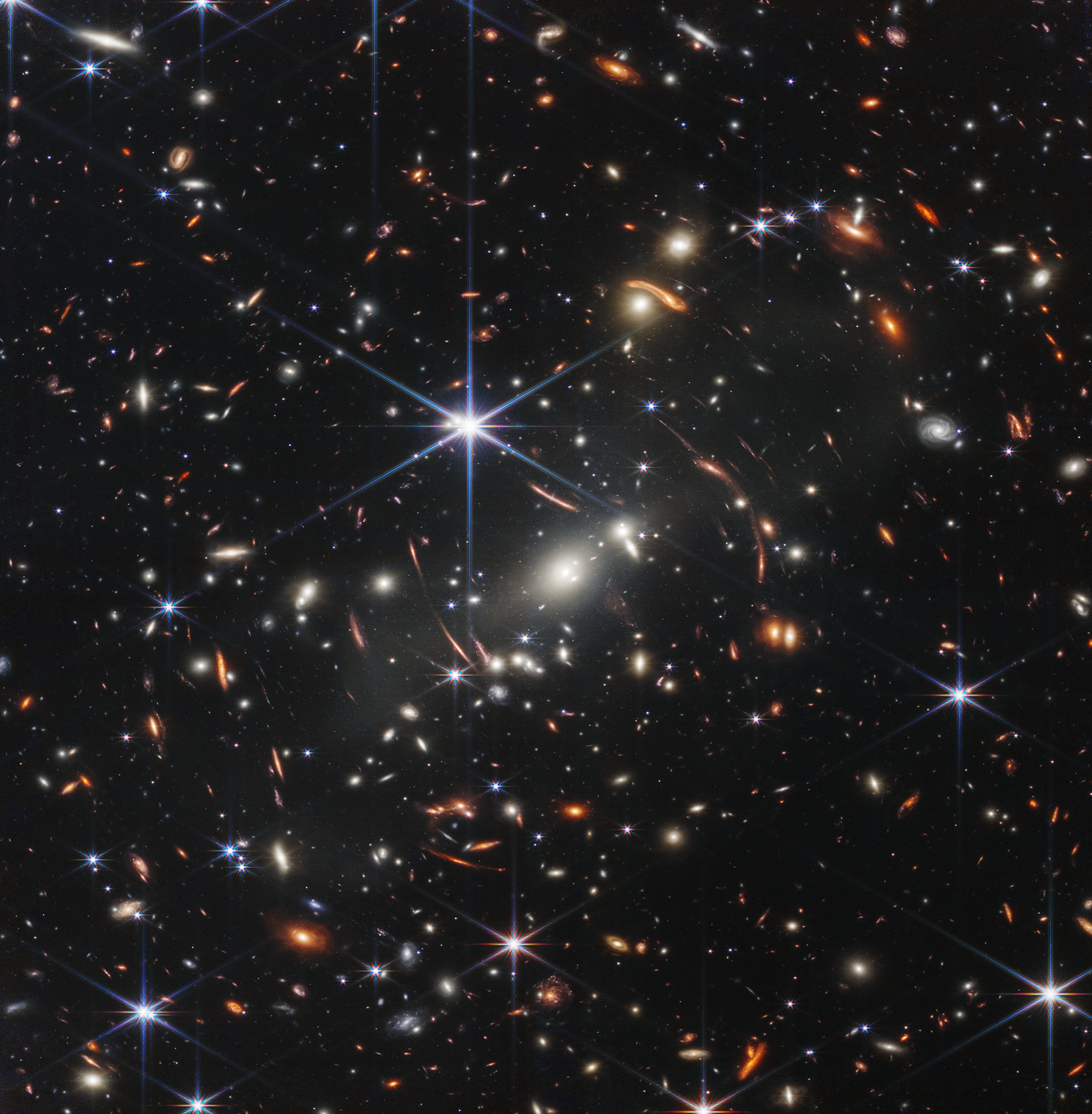
Explanation: This is the deepest, sharpest infrared image of the cosmos so far. The view of the early Universe toward the southern constellation Volans was achieved in 12.5 hours of exposure with the NIRCam instrument on the James Webb Space Telescope. Of course the stars with six visible spikes are well within our own Milky Way. Their diffraction pattern is characteristic of Webb's 18 hexagonal mirror segments operating together as a single 6.5 meter diameter primary mirror. The thousands of galaxies flooding the field of view are members of the distant galaxy cluster SMACS0723-73, some 4.6 billion light-years away. Luminous arcs that seem to infest the deep field are even more distant galaxies though. Their images are distorted and magnified by the dark matter dominated mass of the galaxy cluster, an effect known as gravitational lensing. Analyzing light from two separate arcs below the bright spiky star, Webb's NIRISS instrument indicates the arcs are both images of the same background galaxy. And that galaxy's light took about 9.5 billion years to reach the James Webb Space Telescope.
For more detail go to the link and click on the image for a high definition image. You can then move the magnifying glass cursor then click to zoom in and click again to zoom out. When zoomed in you can scan by moving the side bars on the bottom and right side of the image.
This was done 40 to 50 years ago at Woodstock. Just takes the right mix of drugs and alcohol.
What does this cost the US?
The cost for creating the telescope was $10 billion.
Wow!
Cute!
It’s full of stars!
I want to see if they take a look at Proxima Centauri B. An exo-planet in the goldilocks zone appears to have the right conditions for life. Strange radio waves and talk of artificial light are reported. Not David Icke stuff either.
Just spectacular. I can’t wait to see what else is discovered. Exciting times.
About 100 million in 1960 dollars.
About .39 of one percent of the cost of the Apollo program.
The potential for technological gains are very high.
Note: If you find the brightest nearby star (with distortion spikes) that is near the top of the image, follow the distortion spike that is around 2:30 and just past the end is a white elliptical galaxy that is gravitationally bending the light from the red spiral galaxy behind it to the immediate upper right. Einstein was right.
Color me Luddite
How is this different from Hubble’s Deepfield?
More colored dots, I want to see planets dammit!
Build it bigger!
Wasnt the border wall going to cost 5 billion??
—> The potential for technological gains are very high.
If true, private industry would be investing
Well, it did this shot in a few hours. The Hubble took 6 months.

With Zillion X Zillion X Zillion X Zillion planets out there in universe, what are the odds of a few having right conditions for life to exist? I would venture 99.99999/100.00
I worked ten years at the Kecks in Hawaii as an engineer.
This new telescope is impressive science and great lessons in ancient history.
Let us all keep in mind this is all history.
To bring it more home to you,
the photons from our sun that you enjoy on a daily basis, took over a million years to get to you.
From their initial formation in a fusion reaction, to impacting your body, it took one million years.
Our sun is pretty close.
about 8 minutes at light speed. Some of the entities in the photo are 12 or more billion light years away.
And this is all random and just happened from nothing.
So said the Democrat gods of science.
Disclaimer: Opinions posted on Free Republic are those of the individual posters and do not necessarily represent the opinion of Free Republic or its management. All materials posted herein are protected by copyright law and the exemption for fair use of copyrighted works.