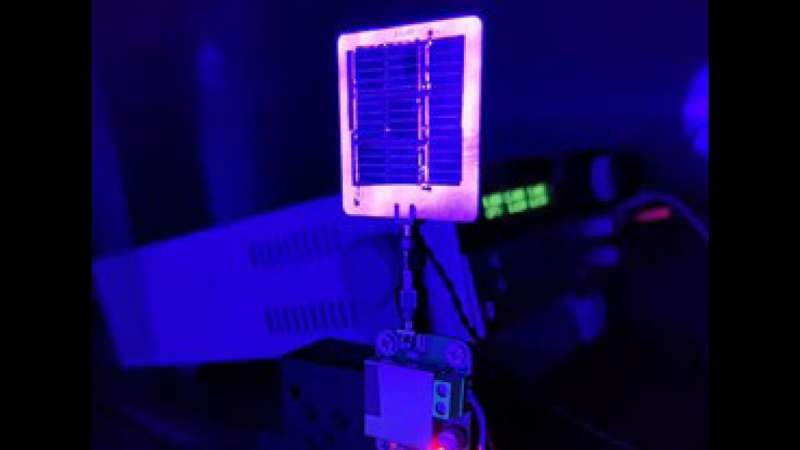
 \ Researchers showed that high data rates can be achieved by using an array of solar cells as the detector in an underwater wireless optical communication system. Credit: Jing Xu, Zhejiang University
 Posted on 02/16/2022 11:10:07 AM PST by Red Badger
\ Researchers showed that high data rates can be achieved by using an array of solar cells as the detector in an underwater wireless optical communication system. Credit: Jing Xu, Zhejiang University
*****************************************************************************************
Although solar cells are typically designed to turn light into power, researchers have shown that they can also be used to achieve underwater wireless optical communication with high data rates. The new approach—which used an array of series-connected solar cells as detectors—could offer a cost-effective, low-energy way to transmit data underwater.
"There is a critical need for efficient underwater communication to meet the increasing demands of underwater data exchange in worldwide ocean protection activities," said research team leader Jing Xu from Zhejiang University in China. For example, in coral reef conservation efforts, data links are necessary to transmit data from divers, manned submarines, underwater sensors and unmanned autonomous underwater vehicles to surface ships supporting their work.
In the journal Optics Letters, Xu and colleagues report on laboratory experiments in which they used an array of commercially available solar cells to create an optimized lens-free system for high-speed optical detection underwater. Solar cells offer a much larger detection area than the photodiodes traditionally used as detectors in wireless optical communication.
"To the best of our knowledge, we demonstrated the highest bandwidth ever achieved for a commercial silicon solar panel-based optical communication system with a large detection area," said Xu. "This type of system could even allow data exchange and power generation with one device."
Optimizing solar cells for communication
Compared to using radio or acoustic waves, light-based underwater wireless communication exhibits higher speed, lower latency and requires less power. However, most long-distance high-speed optical systems are not practical for underwater implementation because they require strict alignment between the transmitter emitting the light and the receiver that detects the incoming light signal.

The researchers tested a detector made from a 3×3 solar array in a 7-meter-long water tank that emulated an underwater channel. Mirrors were used to extend the pathlength of the optical signal. Credit: Jing Xu, Zhejiang University
************************************************************************************
Because solar cells detect light from a large area and convert it to an electrical signal, using them as detectors can ease the transmitter-receiver alignment requirement in an underwater wireless communication system. However, it has been difficult to achieve high bandwidth because solar cells are optimized for energy harvesting rather than communication.
"Until now, achieving high-speed links using off-the-shelf silicon solar cells has required complex modulation schemes and algorithms, which need intense computing resources that use extra power and create a high processing latency," said Xu. "Using modeling and simulation of connected solar cells, we optimized the peripheral circuit, which significantly improved the performance of our solar cell-based detector."
Underwater testing
The researchers tested the new design, which used a 3×3 solar array to create a detection area of 3.4 × 3.4 centimeters, in a 7-meter-long water tank that emulated an underwater channel. Mirrors were used to extend the pathlength of the optical signal, creating a transmission distance of 35 meters. The system showed reliable stability, low power consumption and high performance. As the size of the solar array increases from 1×1 to 3×3, the −20-dB bandwidth increases from 4.4 MHz to 24.2 MHz.
Even though a simple modulation scheme was used, the new system exhibited a much higher detection bandwidth—which leads to a higher data rate—than has been reported in other studies using commercial silicon solar cells with a large detection area as detectors. Applying a reverse bias voltage of 90 V boosted the bandwidth further, allowing them to achieve a −20-dB bandwidth of 63.4 MHz. This bandwidth enabled a 35-m/150-Mbps underwater wireless optical link using the simplest form of amplitude-shift keying modulation.
"Because solar cells are mass produced, the proposed scheme is quite cost effective," said Xu. "Beyond the underwater world, this type of detector could also be used in visible light communication, a type of wireless communication that uses visible light from LEDs and other sources to transmit data across distances."
To optimize the system for real-world applications in underwater communication, the researchers plan to next study its performance with weak optical signals. This will show how well it works in muddy water and with movement. They are also working to make the system more practical by fine tuning key parameters like the number of solar cells in the array and the required reverse bias voltage.
Explore further
Plastic solar cells combine high-speed optical communication with indoor energy harvesting
More information: Zhijian Tong et al, Series-connected solar array for high-speed underwater wireless optical links, Optics Letters (2022). DOI: 10.1364/OL.449466
Journal information: Optics Letters
Provided by The Optical Society
Tech Ping!................
Just like lights at night mess up sea turtles at Palm Beach, FL. LOL
I read years ago that the response time of a photodiode (which is what a solar cell is, more or less) goes up as it’s size does. So a solar cell isn’t going to have the frequency response of a small photodiode.
Light communications in water would seem range limited. Might be good for covert submarine ops between subs and divers or mini-subs in close proximity, but not sure what long range application would be possible. On the bright side, those in close comms would be naturally hidden from anyone listening from more than a few hundred yards, unlike underwater sound comms.
why wouldn’t you just use a CdS Photoresistor or Photoresistor array ?
I am not really impressed by someone using a solar cell to do something like this
Murky water, plus how long before the cells get gunked up as sea life gets drawn to warmer cells. I expect this can't fly in real life.
This was starting out to be an interesting article until it pukes up this typical environmental communism nonsense...
I'll leave it to others to read the rest...
Does it even mention the possible negative impact of solar cell materials on the oceanic environment?
I don’t think CdS can support MHz bandwidths.
Actually I’m surprised solar cells can, although I see they are specifying -20 dB bandwidth, rather than the much more standard -3 dB bandwidth, which will be lower.
Communicating with combat submarines has always been a problem.
“Compared to using radio or acoustic waves, light-based underwater wireless communication exhibits higher speed, lower latency and requires less power. However, most long-distance high-speed optical systems are not practical for underwater implementation because they require strict alignment between the transmitter emitting the light and the receiver that detects the incoming light signal.”
Looks like they are claiming it is like the difference between a directional receive antenna Vs a multi-directional receive antenna. Alignment is the issue?
It’s the ChiComs, liberals will say nothing if they want to keep their funding.
“So a solar cell isn’t going to have the frequency response of a small photodiode.”
Your point?
Next, they’ll have windmills catching birds for us to eat.
” Photoresistor”
Very slow response.
A photo-multiplier tube would give the most range. Of course, there couldn’t be any ambient light.
I used a single solar cell with a 75mW red helium/neon laser to transmit voice in 1970. That experiment used a beam splitter and recombination on the face of the cell. Signal quality was pretty good. We just used a little speaker to vibrate one of the mirrors for modulate. Relative motion between the transmitter and receiver resulted in a signal that represented the velocity. The latter kicked the former’s ass, so it was a terrible way to send voice.
A solar cell is less than optimal for use with high frequency photonic modulation, and in fact may not work at all.
“A solar cell is less than optimal for use with high frequency photonic modulation, and in fact may not work at all.”
Define high frequency.
1MHz or more.
Disclaimer: Opinions posted on Free Republic are those of the individual posters and do not necessarily represent the opinion of Free Republic or its management. All materials posted herein are protected by copyright law and the exemption for fair use of copyrighted works.