Posted on 01/26/2022 5:05:55 AM PST by MtnClimber
At this current crazy moment, most of the “Western” world (Europe, the U.S., Canada, Australia) is hell bent on achieving a “net zero” energy system. As I understand this concept, it means that, within two or three decades, all electricity production will be converted from the current mostly-fossil-fuel generation mix to almost entirely wind, solar and storage. On top of that, all or nearly all energy consumption that is not currently electricity (e.g., transportation, industry, heat, agriculture) must be converted to electricity, so that the energy for these things can also be supplied solely by the wind, sun, and batteries. Since electricity is currently only about a quarter of final energy consumption, that means that we are soon to have an all-electric energy generation and consumption system producing around four times the output of our current electricity system, all from wind and solar, backed up as necessary only by batteries or other storage.
A reasonable question is, has anybody thought to construct a small-to-moderate scale pilot project to demonstrate that this is feasible? Before embarking on “net zero” for a billion people, how about trying it out in a place with, say, 10,000, or 50,000, or 100,000 people. See if it can actually work, and how much it will cost. Then, if it works at reasonable cost, start expanding it.
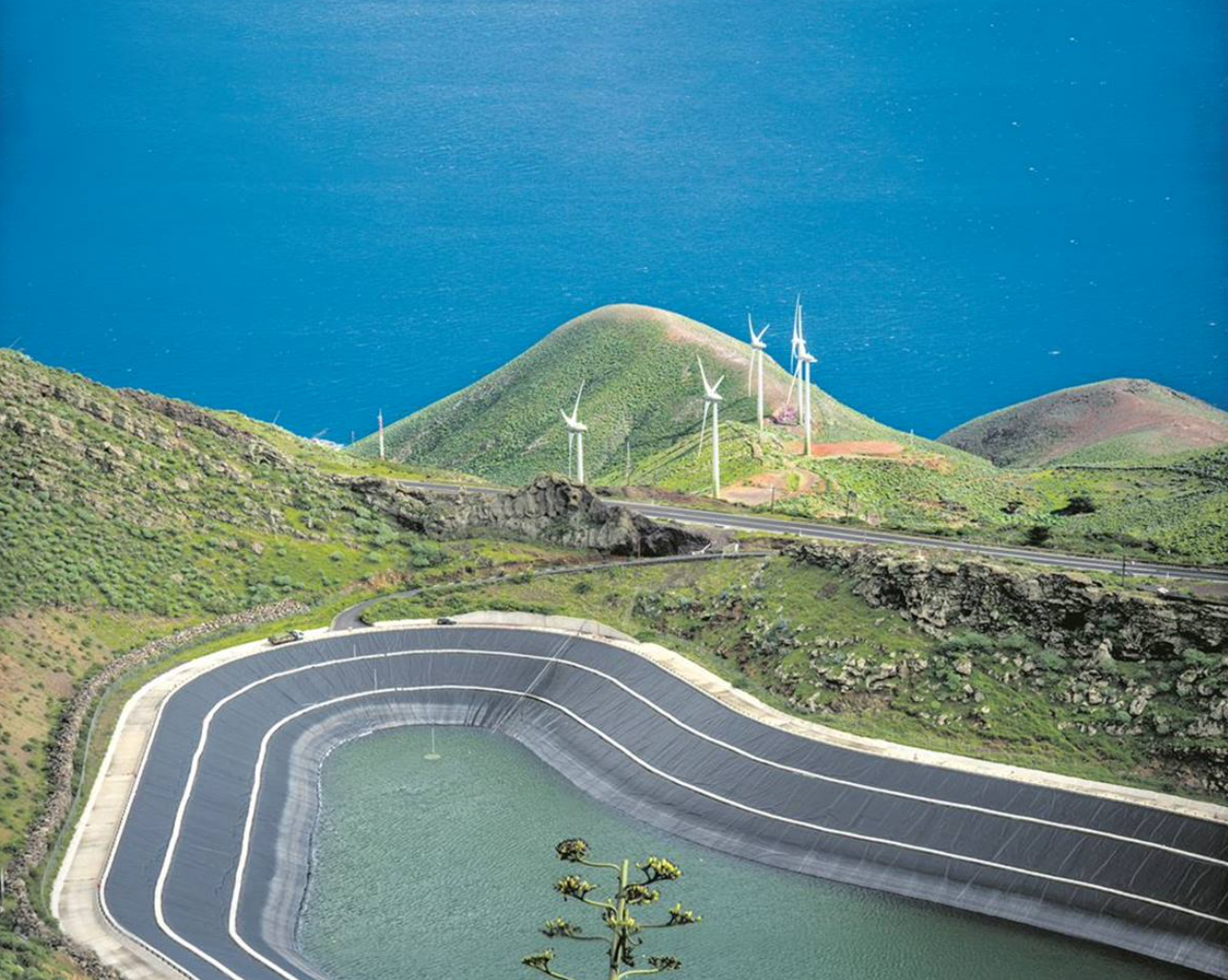
As far as I can determine, that has never been done anywhere. However, there is something somewhat close. An island called El Hierro, which is one of the Canary Islands and is part of Spain, embarked more than a decade ago on constructing an electricity system consisting only of wind turbines and a pumped-storage water reservoir. El Hierro has a population of about 11,000. It is a very mountainous volcanic island, so it provided a fortuitous location for construction of a large pumped-storage hydro project, with an upper reservoir in an old volcanic crater right up a near-cliff from a lower reservoir just above sea level. The difference in elevation of the two reservoirs is about 660 meters, or more than 2000 feet. Here is a picture of the upper reservoir, looking down to the ocean, to give you an idea of just how favorable a location for pumped-storage hydro this is:
The El Hierro wind/storage system began operations in 2015. How has it done? I would say that it is at best a huge disappointment, really bordering on disaster. It has never come close to realizing the dream of 100% wind/storage electricity for El Hierro, instead averaging 50% or less when averaged over a full year (although it has had some substantial periods over 50%). Moreover, since only about one-quarter of El HIerro’s final energy consumption is electricity, the project has replaced barely 10% of El Hierro’s fossil fuel consumption.
Here is the website of the company that runs the wind/hydro system, Gorona del Viento. Get ready for some excited happy talk:
A wind farm produces energy which is directed into the Island’s electricity grid to satisfy the population’s demand for electricity. The surplus energy that is not consumed directly by the Island’s inhabitants is used to pump water between two reservoirs set at different altitudes. During times of wind shortage, the water stored in the Upper Reservoir is discharged into the Lower Reservoir, where the Wind-Pumped Hydro Power Station is, to generate electricity from its turbines. . . . The diesel-engine-powered Power Station only comes into operation in exceptional circumstances when there is neither sufficient wind or water to produce the energy to meet demand.
Over at the page for production statistics, it’s still more excitement about tons of carbon emissions avoided (15,484 in 2020!) and hours of 100% renewable generation (1293 in 2020!). I think that they’re hoping you don’t know that there are 8784 hours in a 366 day year like 2020.
But how about some real information on how much of the island’s electricity, and of its final energy consumption, this system is able to generate? Follow links on that page for production statistics, and you will find that the system produced some 56% of the electricity for El Hierro in 2018, 54% in 2019, and 42% for 2020. No figures are yet provided for 2021. At least for the last three years of reported data, things seem to be going quite rapidly in the wrong direction. I suspect that that’s not what you had in mind when you read that the diesel generators only come into operation in “exceptional circumstances” when wind generation is low. And with electricity constituting only about 25% of El Hierro’s final energy consumption, the reported generation statistics would mean that the percent of final energy consumption from the wind/storage facility ran about 14% in 2018, 13.5% in 2019, and barely 10% in 2020.
So why don’t they just build the system a little bigger? After all, if this system can provide around 50% +/- of El Hierro’s electricity, can’t you just double it in size to get to 100%? The answer is, absolutely not. The 50% can be achieved only with those diesel generators always present to provide full backup when needed. Without that, you need massively more storage to get you through what could be weeks of wind drought, let alone through wind seasonality that means that you likely need 30 days’ or more full storage. Get out your spreadsheet to figure out how much.
Roger Andrews did the calculation for El Hierro in a January 2018 post on the Energy Matters website. His conclusion: El Hierro would need a pumped-storage reservoir some 40 times the size of the one it had built in order to get rid of the diesel backup. Andrews provides plenty of information as to the basis of his calculations and his assumptions, so feel free to take another crack at his calculations with better assumptions. But unfortunately, his main assumption is that the pattern of wind intermittency for any given year will be just as sporadic as it was for 2017.
Then take a look at the picture and see if you can figure out where or how El Hierro is going to build that 40 times bigger reservoir. Time to look into a few billions of dollars worth of lithium ion batteries — for 11,000 people.
And of course, for those of us here in the rest of the world, we don’t have massive volcanic craters sitting 2000 feet right up a cliff from the sea. For us, it’s batteries or nothing. Or maybe just stick with the fossil fuels for now.
So the closest thing we have to a “demonstration project” of the fully wind/storage electricity has come up woefully short, and really has only proved that the whole concept will necessarily fail on the necessity of far more storage than is remotely practical or affordable. The idea that our political betters plow forward toward “net zero” without any demonstration of feasibility I find completely incomprehensible.
#13 You can charge up your cell phone on the go!
Sure. Let’s do a demo at one of the few places on earth where the wind almost always blows and the sun almost always shines.
That is bullshit. Only 10% of the World has these qualities. 90% of the globe does not get adequate wind and sun for electricity.
One solar cell at the equator produces the equivalent of 2 solar cells in South Carolina and 4 solar cells in Vermont.
This test would not extrapolate to 90% of the Globe.
“Our side is missing the opportunity to normalize off-grid power independence.”
I’d go for it if I could find space for 2 reservoirs and associated pump/generators, or roughly 2.0 Megawatt-hours of battery storage (to get through 30 days of crappy weather and still have air conditioning, here in Texas).
Still take me a while to get the permits and financing, though.
Humans contribution to CO2 today is insignificant to what nature produces. Recent major volcano eruption probably produced more CO2 than all human activity in 2021. IOW, human activity generating CO2 is not necessary for our food supply and plants.
Besides ... fields or solar panels and giant windwills are visual pollution ... worse than the billboards (exception - anti-Trump billboards) that the left got all riled up about as “visual pollution”, starting a few decades ago.
“This test would not extrapolate to 90% of the Globe.”
...and it still would collapse, even under best-case conditions.
great! i propose either the island of manhattan, or the entirety of Cape Cod.
it might be easy to isolate either property for the experiment. there would be seaonal weather, and the occasional heavy weather bout, to see if the generation units and the power transmission equipment, would stand.
“What is comprehensible is total government control of its population’s energy consumption”
Aren’t renewables the exact opposite? With rooftop solar and battery back-up a home can be entirely energy independent.
Whether the tech works or not is one question, but if they do work they create a world that is much more self-reliant.
That is my conclusion too. You cannot change the laws of physics. It takes the same amount of energy to accellerate a 3,000 lb car from 0-60mph. Of course there are different efficiencies for gasoline and electric engines, but the electric engine has plenty of losses in the system (electricity generation, electricity distribution, battery charging, battery self discharge when idle, and battery discharge for running). And the electric car has batteries that weigh much more than a gasoline engine and all of the battery weight has to be moved around too.
Australia can go net-zero very easily and cheaply: simply fertilize the open ocean with iron and other trace elements and let saltwater algae do its thing. It might trigger a new ice age, but they'd be net-zero on the carbon.
Well said. The problem is the zero willingness to compromise. Diesel/electric hybrids with no batteries needed are a win win for both sides of the argument. But both sides refuse to discuss this efficient compromise at all.
Yeh, they’re kinda protective of the Great Barrier Reef. So, that could be an issue 😉
Those who whine most loudly and often about it should be made to be the crash-test dummies for it. Require them to live with it and report the results.
Where sun and wind are a given they can be an additional asset but will seldom meet all the energy needs for modern lifestyles.
<> It seems collapse of our energy economy is the planned result.<>
Exactly. Destroy the middleclass and build the new marxist man on the rubble.
Disclaimer: Opinions posted on Free Republic are those of the individual posters and do not necessarily represent the opinion of Free Republic or its management. All materials posted herein are protected by copyright law and the exemption for fair use of copyrighted works.