Posted on 01/11/2022 9:02:19 AM PST by Red Badger
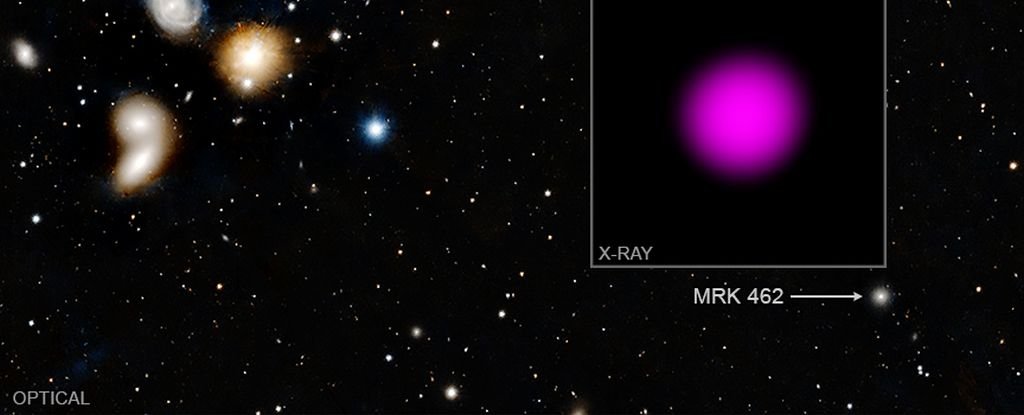
(X-ray: NASA/CXC/Dartmouth Coll./J. Parker & R. Hickox; Optical/IR: Pan-STARRS)
==========================================================================
Because they emit nothing we can detect, there are many things about black holes we simply do not know.
Amongst the most perplexing are supermassive black holes, millions to billions of times the mass of our Sun. Since black holes form from the cores of massive dead individual stars, how do supermassive behemoths grow so danged huge? A new discovery could help us find some much-sought answers.
In a tiny dwarf galaxy 110 million light-years away, astronomers have just found one of the smallest supermassive black holes ever seen. The 'monster' at the heart of galaxy Mrk 462 is just 200,000 times the mass of the Sun.
The findings were presented at the virtual 239th meeting of the American Astronomical Society.
"This black hole in Mrk 462 is among the smallest of the supermassive, or monster, black holes," said astronomer Jack Parker of Dartmouth College. "Black holes like this are notoriously hard to find."
Its discovery suggests that supermassive black holes – some of them, at least – grow from stellar-mass seeds less than 100 times the mass of the Sun, rather than forming already large and growing larger.
One of the thorns that has lodged firmly in the side of the stellar-mass model is the discovery of many supermassive black holes in the early Universe. It's hard to reconcile the growth of a tiny seed of a stellar core to a gargantuan supermassive black hole in the short timeframe in which these objects appeared after the Big Bang.
Another possibility is that, in the early Universe, huge, dense clouds of gas and dust directly collapsed down into larger black holes tens of thousands of times the mass of the Sun, creating a larger starting point from which supermassive black holes can grow.
And this gives us a method to tease out the likelihoods of each scenario, because the direct collapse model is a rare process. This means we could expect relatively few dwarf galaxies to contain supermassive black holes, compared to the stellar seed model.
There's a catch, though. It's really hard to see core black holes in dwarf galaxies. In larger galaxies, astronomers can use the orbit of the stars in the center to infer the central black hole, but dwarf galaxies are too small and dim for this.
The other method is to look for extremely bright, high-energy radiation, such as X-rays. This suggests a black hole that is actively accreting material, heating it to such insane temperatures that it blasts out high-energy light.
The researchers did exactly this, using the Chandra X-ray observatory to study eight dwarf galaxies that optical data suggested might be harboring an active supermassive black hole. Only Mrk 462 showed the X-ray signature of a feeding supermassive black hole, with a mass around 200,000 times that of the Sun.
But there was something peculiar, too. The ratio of high-energy X-rays to low-energy X-rays suggested that the black hole was heavily obscured, or "buried", by a thick cloud of dust.
This could tip the scales towards the stellar seed scenario.
"Because buried black holes are even harder to detect than exposed ones, finding this example might mean there are a lot more dwarf galaxies out there with similar black holes," said astronomer Ryan Hickox of Dartmouth College.
Recent studies suggest that this might be the case. In the last few years, astronomers have been finding elusive, middleweight black holes in dwarf galaxies and the remnants of dwarf galaxies. These could also support the idea that supermassive black holes might be able to grow rather rapidly from stellar-mass seeds.
As our technology and techniques improve, perhaps we can expect to find more black hole baby chonks that had previously eluded detection.
"We can't make strong conclusions from one example, but this result should encourage much more extensive searches for buried black holes in dwarf galaxies," Parker said. "We're excited about what we might learn."
The research was presented virtually at the 239th meeting of the American Astronomical Society.
They occur naturally in clothes dryers and are the reason for missing socks.

It’s a good thing they’re called minisuper instead of supermini. That could lead to a complete misunderstanding.
.

“Mini” and “supermassive” in the same sentence.
Cute little thing, I wonder what it eats?
“I wonder what it eats?”
Planets?
5.56mm
Because they emit nothing we can detect, there are many things about black holes we simply do not know.
….so we’ll take a picture of a blurry purple dot and say it’s a black hole, because if your stupid enough to fall for the Scamdemic and cloth masks, you’ll believe anything we “scientists” say….without real proof. Trust the science! Trust the people that graduated with ‘D’s in science and yet call themselves scientists!
Whew!
For a minute I thought that they had located Moochell’s long-lost twin...
JSW will be changing everything...
Like opening our eyes in the morning...
Disclaimer: Opinions posted on Free Republic are those of the individual posters and do not necessarily represent the opinion of Free Republic or its management. All materials posted herein are protected by copyright law and the exemption for fair use of copyrighted works.