Posted on 12/13/2021 6:00:46 AM PST by Red Badger
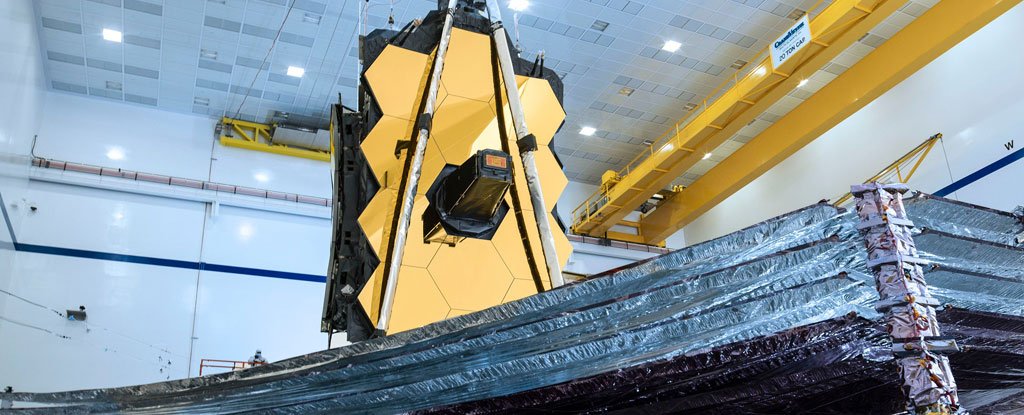
(NASA/Chris Gunn)
VIDEO AT LINK.............................
The James Webb Space Telescope, the most powerful space observatory ever built, is finally set for launch in late December after decades of waiting.
An engineering marvel, it will help answer fundamental questions about the Universe, peering back in time 13 billion years. Here are five things to know.
1. Giant gold mirror
The telescope's centerpiece is its enormous primary mirror, a concave structure 21.5 feet (6.5 meters) wide and made up of 18 smaller hexagonal mirrors. They're made from beryllium coated with gold, optimized for reflecting infrared light from the far reaches of the universe.
The observatory also has four scientific instruments, which together fulfill two main purposes: imaging cosmic objects, and spectroscopy – breaking down light into separate wavelengths to study the physical and chemical properties of cosmic matter.
The mirror and instruments are protected by a five-layer sunshield, which is shaped like a kite and built to unfurl to the size of a tennis court.
Its membranes are composed of kapton, a material known for its high heat resistance and stability under a wide temperature range – both vital, since the Sun-facing side of the shield will get as hot as 230 degrees Fahrenheit (110 degrees Celsius), while the other side will reach lows of -394F.
The telescope also has a "spacecraft bus" containing its subsystems for electrical power, propulsion, communications, orientation, heating, and data handling; all told, Webb weighs around as much as a school bus.
2. Million-mile journey
The telescope will be placed in orbit about a million miles from Earth, roughly four times the distance of our planet from the Moon.
Unlike Hubble, the current premier space telescope that revolves around the planet, Webb will orbit the Sun.
It will remain directly behind Earth, from the point of view of the Sun, allowing it to remain on our planet's night side. Webb's sunshield will always be between the mirror and our star.
It will take about a month to reach this region in space, known as the second Lagrange point, or L2. While astronauts have been sent to repair Hubble, no humans have ever traveled as far as Webb's planned orbit.
3. High-tech origami
Because the telescope is too large to fit into a rocket's nose cone in its operational configuration, it has to be transported folded, origami-style. Unfurling is a complex and challenging task, the most daunting deployment NASA has ever attempted.
About 30 minutes after take-off, the communications antenna and solar panels supplying it with energy will be deployed.
Then comes the unfurling of the sunshield, hitherto folded like an accordion, beginning on the sixth day, well after having passed the Moon. Its thin membranes will be guided by a complex mechanism involving 400 pulleys and 1,312 feet of cable.
During the second week will finally come the mirror's turn to open. Once in its final configuration, the instruments will need to cool and be calibrated, and the mirrors very precisely adjusted.
After six months the telescope will be ready to go.
4. Life, the universe, and everything
Webb has two primary scientific missions, which together will account for more than 50 percent of its observation time. First, explore the early phases of cosmic history, looking back in time to only a few hundred million years after the Big Bang.
Astronomers want to see how the very first stars and galaxies formed, and how they evolve over time.
Its second major goal is the discovery of exoplanets, meaning planets outside the solar system. It will also investigate the potential for life on those worlds by studying their atmospheres.
The great promise of Webb lies in its infrared capacity.
Unlike the ultraviolet and visible light Hubble mostly operates in, the longer wavelengths of infrared penetrate dust more easily, allowing the early universe shrouded in clouds to come more clearly into view.
Infrared also lets scientists go further back in time because of a phenomenon called redshifting. Light from objects farther away is stretched as the universe expands, towards the infrared end of the spectrum.
Also planned are closer observations, in our solar system, of Mars and of Europa, Jupiter's icy moon.
5. Decades in the making
Astronomers began debating the telescope that should succeed Hubble in the 1990s, with Webb's construction beginning in 2004.
Launch has been pushed back several times, initially penciled for 2007, then 2018...mainly because of the complexities associated with development.
The observatory is the result of an immense international collaboration and integrates Canadian and European instruments.
More than 10,000 people worked on the project, with the budget eventually snowballing to around $10 billion.
The mission is set to last for at least five years, but hopefully 10 or more.
My best friend’s dad worked at Itek back in the Sixties when they were developing optical systems, and the publicly distributed cover story was that they were being developed to optically track spacecraft as they were being launched to orbit, but in realty, were the optics placed on the ultra high performance optical surveillance satellites we were to launch in the late Sixties/early Seventies (I think)
I can’t wait for the Webb to launch and start sending us data.
It will be a treasure-trove of information that will lead us to actual treasures worth more than all the wealth currently on Earth. The propagation of Mankind into the Heavens!
But that’s just the optimist in me speaking.
The old saying I've herd is that if a dime was on the ground it can tell you the mint year, that's damn good.
Not to be pessimistic but something that complex with so many fingers on it is bound to get screwed up. Nasa is too woke to pull it off...wrong priorities.
.
Special Relativity.
Psst, check the mirrors this time.
The French have a pretty good track record.
Military satellites could count the hairs on your head in the late 60s
The speed of light. Light is shifted to the red as it travels-stretching through space. Since light particles-or photons are the only thing that can travel that fast because it has no mass.
As you travel towards the speed of light time slows to zero. Therefore light does not feel the effects of time.
I saw that last night, too.
One of the men being interviewed worked on Hubble. Uh oh……
IF it isn’t messed up by the launch, IF it opens up without a hitch, IF THE MIRRORS WERE GROUND, POLISHED, AND DEPLOYED CORRECTLY, if everything works like it’s supposed to, it’s gonna do some great science.
I an cautiously, cautiously, optimistic.
🔭🔭🔭
Lets hope that NASA built this telescope well so that it works right from the launch and parking positioon because if it fails to work right there will be No way to service it.
We don’t need another issue where Nasa Built the Hubble Telescope and upon activation the the telescopes mirror was found to be ground incorrectly. So the telescope couldn’t see anything clearly.
Time, as interpreted by the observation of light, is relative. Why do we speak of it in absolute terms? The question science ought to be concerned with is “How old is matter?” Everything else is just a subjective report of its form at a given time.
“Sure. Believe what you want.”
The telescope can only see red shifted light, as that is what we get from the deep cosmos. It also is so sensitive that pointing it at something as bright as the Earth would blow out its optics.
But as fun as that would be, we need you here! How else will our oversupply of periods get equalized? Please reconsider...........................
IIRC, It’s launching from Guyana.....................
Amen.
We laughed when the lady scientist said each and every one of the hundreds of gizmos must open just right.
It can’t focus on earth. It would be like you looking at your feet through high-powered binoculars. Also, it is viewing infrared.
NASA doesn’t build anything. Contractor companies make everything.
Disclaimer: Opinions posted on Free Republic are those of the individual posters and do not necessarily represent the opinion of Free Republic or its management. All materials posted herein are protected by copyright law and the exemption for fair use of copyrighted works.