Posted on 12/07/2021 12:30:54 PM PST by Red Badger
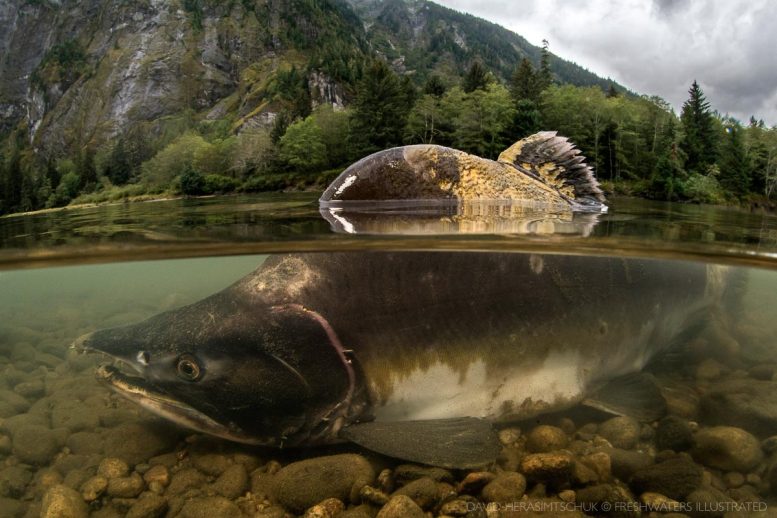
Salmon can colonize newly created streams, but face many other challenges from climate change. Credit: Freshwaters Illustrated
Retreating glaciers in the Pacific mountains of western North America could produce around 6,150 kilometers (3,820 miles) of new Pacific salmon habitat by the year 2100, according to a new study.
Scientists have ‘peeled back the ice’ from 46,000 glaciers between southern British Columbia and south-central Alaska to look at how much potential salmon habitat would be created when underlying bedrock is exposed and new streams flow over the landscape.
Modeling glacier retreat under different climate change scenarios, researchers discovered that, under a moderate temperature increase, the glaciers could reveal potential new Pacific salmon habitat nearly equal to the length of the Mississippi River (6,275 km).
Desirable for salmon, in this case, means low-gradient streams (less than 10% incline) connected to the ocean with retreating glaciers at their headwaters. The team discovered that 315 of the glaciers examined met these criteria.
The international team, led by researchers at Simon Fraser University (Canada) with University of Birmingham (UK), and other organizations, published their findings today (December 7, 2021) in Nature Communications.
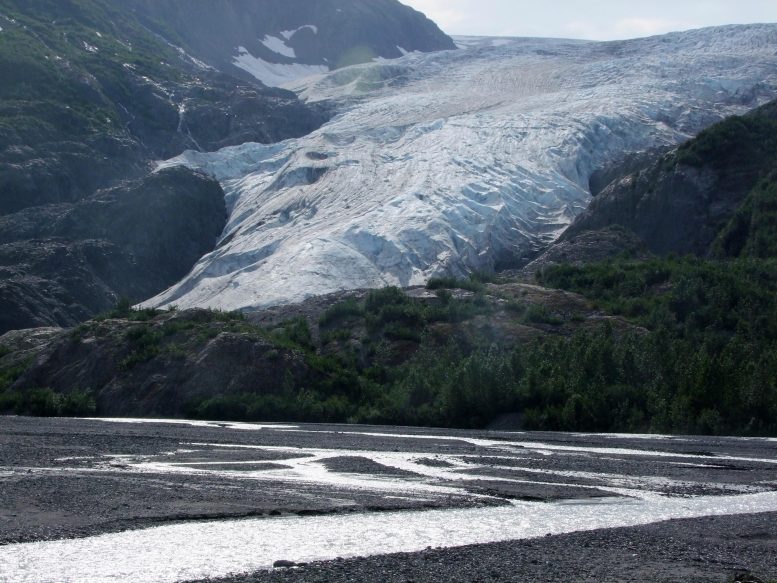
Exit Glacier, in Alaska, is one of hundreds of glaciers that are melting and retreating creating new salmon habitat. Credit: Alexander Milner
Lead author, Simon Fraser University spatial analyst Dr. Kara Pitman comments: “We predict that most of the emerging salmon habitat will occur in Alaska and the transboundary region, at the British Columbia-Alaska border, where large coastal glaciers still exist. The Gulf of Alaska sub-region is predicted to see the most gains—a 27% increase in salmon-accessible habitat by 2100.
“Once conditions stabilize in the newly-formed streams, salmon can colonize these areas quite quickly. It’s a common misconception that all salmon return home to the streams they were born in. Most do, but some individuals will stray—migrating into new streams to spawn and, if conditions are favorable, the population can increase rapidly.”
Co-author Professor Alexander Milner from the University of Birmingham has researched glacial retreat and salmon populations in southeast Alaska for over three decades. His team has worked on Stonefly Creek in Glacier Bay where glacier retreat revealed a new stream in the late 1970s and he comments:
“Colonization by salmon can occur relatively quickly after glacial retreat creates favorable spawning habitat in the new stream. For example, Stonefly Creek was colonized within 10 years by pink salmon that grew rapidly to more than 5,000 spawners. Other species also colonized including Coho and Sockeye salmon, especially where a lake is associated with the stream.”
The researchers caution that while the newly created habitat is a positive for salmon in some locations; overall, climate change still poses grave challenges for some salmon populations.
“On one hand, this amount of new salmon habitat will provide local opportunities for some salmon populations,” says Dr. Pitman. “On the other hand, climate change and other human impacts continue to threaten salmon survival—via warming rivers, changes in stream flows, and poor ocean conditions.
“Climate change means we increasingly need to look to the future. We can’t just protect current-day habitat for species but need to consider what habitats they might rely on in the future.”
Reference: “Glacier retreat creating new Pacific salmon habitat in western North America” 7 December 2021, Nature Communications. DOI: 10.1038/s41467-021-26897-2
We’ll, at least there is some good news I guess. I’m still depressed about Climate Change causing the skyrocketing divorce rate among albatrosses in the Falkland Islands...very depressing...
Butter... lemon... a little Old Bay...
Yeah... I’m SOOOOOO there!!!!
Or it may not.
No butter for me, doctor’s orders...................

Don’t blame the butter for what the bread did.
Little dry rub and in the smoker they go. Nothing more to do but eat.
Let's drive our cars more and increase the supply of highly nutritious salmon.
I hear you brother... but a little teensy weentsy slice o’ Land O’ Lakes now and then maybe??? Not even that?
Can’t have bread either.........................
climates change, and God’s creation functions as He intended...things adapt, change, morph....and it is good.
I use olive oil instead. Not bad....................
Yeah, that’s some fine chow, too...
Damn... hungry now!!!!!! Lol
You beat me to it...I just started to type “Or not...”
Yes, I like olive oil too. Very tasty!!!
I like swordfish “steaks” too. Also good eating...
Why leftists are so in love with dead, sterile ice in glaciers is beyond me. I would rather have valleys full of forests, fields, streams, and wildlife than a dirty river of ice.
By 2100. As usual, too long even to be taken seriously.
I'm sorry, but we can lo longer tolerate any kind of "colonization" on the planet, it violates too many "Rights".
These Salmon must be stopped, even if we have to kill them.
... and eat them.
Rotten for beautiful Polar Bears, great for salmon.
But bears eat salmon, so they may just shed a lot and acclimate.
Disclaimer: Opinions posted on Free Republic are those of the individual posters and do not necessarily represent the opinion of Free Republic or its management. All materials posted herein are protected by copyright law and the exemption for fair use of copyrighted works.