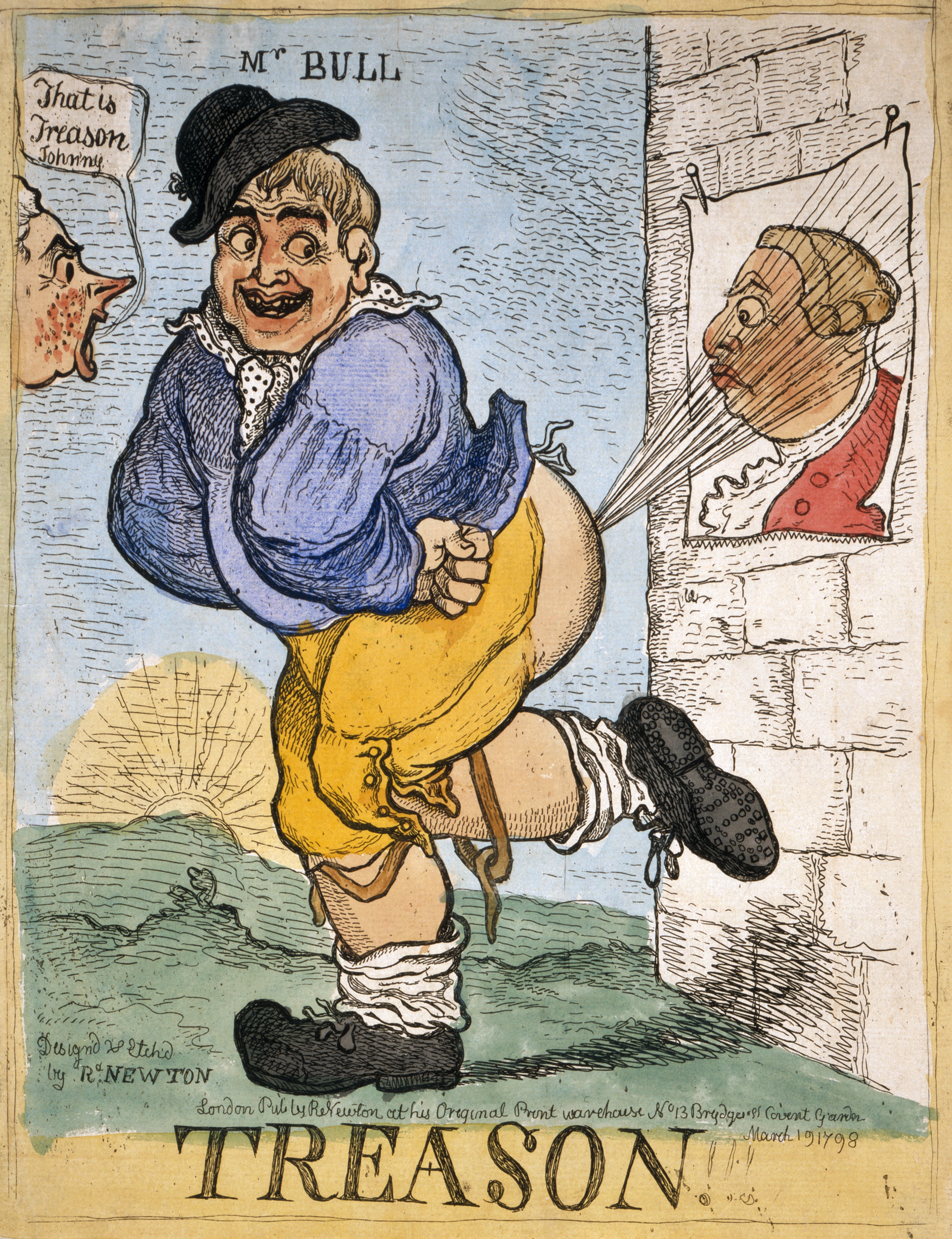
Even the English were not all that enamored of him.
Posted on 11/12/2021 7:42:48 AM PST by ProgressingAmerica
As a citizen historian, I find it both "funny" and annoying how skewed history is and how few treat leftist historians compared to their leftist journalist counterparts. Its a huge problem for us.
Pimping a new book that he will hope you will buy, Andrew Roberts (the Book's author) writes this glowing piece for The Smithsonian about you know, George III, he wasn't all that bad of a guy!
Hey I have an idea. Maybe we should've stayed under monarchism. That whole "liberty thing"? Perhaps that's overrated. Sarcasm aside, take a look at paragraph number 2:
We can now see, for example, George’s fervent denunciation of slavery in an essay he wrote as Prince of Wales in the late 1750s, after reading Charles de Montesquieu’s classic enlightenment text, The Spirit of the Laws (1748).
This is historical malpractice. So George wrote some paper some time for some people to read, so what. When the pedal was down against the metal, what did King George actually do? Actions speak louder than words. When King George III had the opportunity, he sided with slave traders over abolitionists. Here's the actual text of the King's veto:
it hath been represented to us that so considerable an increase upon the duties of slaves imported into our colony of Virginia will have the effect to prejudice and obstruct as well the commerce of this kingdom as the cultivation and improvement of the said colony; whereupon we have thought fit to disallow the first mentioned of the laws, leaving the other, which is of short duration, to expire by its own limitation. It is therefore our will and pleasure that you do not upon pain of our highest displeasure give your assent for the future, without our royal permission first obtained, to any law or laws by which the additional duty of five per cent upon slaves imported, imposed by the last mentioned law, shall be further continued or to any laws whatever by which the duties of ten per cent upon slaves imported into our said colony, payable by laws passed antecedent to the seventh day of November, 1769, shall upon any pretense be increased or by which the importation of slaves shall be in any respect prohibited or obstructed.
The text of this is quite clear. Increasing the duties are going to reduce slave imports, and that's going to hurt the empire. Oh woe is me, we can't have that!
How different would this Smithsonian article look if it had included the fact that the King actively stood against abolitionism? Laws such as the one which was vetoed, referenced above, this was happening all over the colonies in the 1770s. This wasn't a one time thing.
I can see I'm going to have to record this veto into audio that everybody can listen to and throw it up on YouTube, since so many historians can't find the time to write the truth. What a bunch of flagrant liars. It isn't just this one guy, the Smithsonian is in on it. What a disgrace. What a historical disgrace this whole thing is. But that's where we are with the state of the "historical profession" in America these days. The article concludes this way:
The time has therefore come for objective Americans to take a fresh look at their last king. It was right for the colonies to break away from the British Empire in 1776 because they were ready by then to found their own nation-state, but despite the rhetoric of their founding document, they were not escaping tyranny, so much as bravely grasping their sovereign independence from a good-natured, cultured, enlightened and benevolent monarch.
Historians will always side against the American Revolution and cling to any whataboutism they can in order to make America look bad, meanwhile anything else must be preferred. "Rhetoric", "rhetoric"??? That's all the declaration is? It's no big deal? Reading the Declaration makes it quite clear that it is just as applicable today as it was back then.
We need new historians just as badly as we need new journalists. None of them are interested in being honest. None of them.
Maybe Roberts is just trying to say that George III wasn’t Hitler. That the US and the UK were able to get along so well later supports that view.
ping
Some Commonwealth countries in Africa continued to allow chattel slavery until the turn of the 20th Century. And British Hong Kong had its own peculiar form of indentured servitude (called mui tsai) that wasn't banned until the 1920s that allowed the buying of young Chinese girls to be kept as household slaves/servants until they were emancipated through marriage .
So Huzzah! for 'Ol Blighty!
The Declaration of Independence is about the right of a collective people to declare independence from a government they see as no longer representing their interests.I have a similar beef with misunderstandings about "all men are created equal" -- the point wasn't that every man (and, yes, Howiedoody Zinn, that includes women) is equal (key word leftists miss is "created") but that a king, too, is created equal (key word "all"). It justified separation from the King by denying divine rule, something that the great John Milton had affirmed a hundred years earlier in his argument that kings serve only at the consent of the people.
Sure, the Virginia laws were not “abolitionist” but even so, had those laws gone into effect, they would have set a standard and an outcome that would have diminished the impact of slavery on the rest of American history.
The number of imported slaves into the U.S. between 1770 and 1809 was about 160,000 (with 64,000 coming between 1801-1810), without which the overall number of slaves by 1860 would have been significantly less than the actual 3.5mm (I’m guessing those 160,000 led to an additional 500,000 slaves born by 1860)
More importantly, the proposed taxes and any subsequent, quotas or outright bans by Virginia on the slave trade would have justified more of the same; instead, by vetoing it, the King did the opposite and justified the expansion of slavery instead.
Your post is very encouraging! Mainly, because I greatly appreciate those who take the time to go out and secure the facts independently that way you can speak to these things directly and not just “I heard that thing from that person that time”. This is important.
Secondarily, you and I converged in however way. The end result was the same book by Owens. See this for what I did with it:
New audiobook release: “The Wrong of Slavery”, by Robert Dale Owen
https://freerepublic.com/focus/f-chat/3974335/posts
Eras is probably a better word but regardless, American history does have readily identifiable ebbs and flows that allow for compartmentalization in discussions.
"I actually don't think I said a thing about the civil war in this discussion."
You didn't use that specific phrase; however, you did say in post 9: "Subsequent generations have reinterpreted it to be a condemnation of slavery" Your posting history in general and yours/my past discussions in particular have trended into CW talk even in non-CW topics. It is the most obvious and likely subsequent generation coming from you. - likewise, a comment like that would be most likely coming from me to be in the context of the early 20th century progressive era.
"Do you know of a more significant example of "historical malpractice" than that of people trying to make the Declaration of Independence about slavery?"
The way the question sits regarding the Declaration is unanswerable. Need clarity. Do you mean:
Do you know of a more significant example of "historical malpractice" than that of people trying to make the Declaration of Independence wholly and solely about slavery?
or:
Do you know of a more significant example of "historical malpractice" than that of people trying to make the Declaration of Independence in part about slavery?
The omitted items make a world of difference. Which question did you want me to answer?
"I welcome anyone suggesting another example of historical malpractice"
I think the entire body of work in regard to the Progressive Era takes the cake. The whole thing is a massive and flagrant coverup. Hence my username, and hence my main-target open source audiobooks.
What is your opinion of when Anthony Benezet took “what seems to us to be the moral high road”? - With Benjamin Franklin’s blessing?
Even the English were not all that enamored of him.
The war of American Independence, that was enjoyable by and large
Watching England's free descendants busy defeating German Jarge
-Flanders & Swann - The War Of 14-18
I was actually thinking of the generation shortly after the Declaration of independence. They immediately started using the "all men are created equal" statement as justification for abolishing slavery, starting with Massachusetts adopting it into their 1780 Constitution. Liberal courts decided that this phrase in the Massachusetts constitutions meant that Massachusetts had abolished slavery by the adoption of this statement.
This is the exact sort of liberal lying that we have seen over and over again with liberal courts "interpreting" the US Constitution to mean things it was never intended to mean, such as the 14th Amendment creating a right to abortion.
It was this era that initiated the deliberate misinterpretation, and this misinterpretation simply got stronger from that point forward.
Do you know of a more significant example of "historical malpractice" than that of people trying to make the Declaration of Independence wholly and solely about slavery?
or:
Do you know of a more significant example of "historical malpractice" than that of people trying to make the Declaration of Independence in part about slavery?
I think either is correct depending on the people doing it and the time in which they were doing it. I think nowadays the Declaration of Independence has become entirely about slavery, and the only words modern people remember from it are "all men are created equal", but I think in the earlier part of the 19th century, they remembered what the Declaration was about, but they made conscious efforts to make it about slavery in an effort to further Abolition.
I think the entire body of work in regard to the Progressive Era takes the cake. The whole thing is a massive and flagrant coverup. Hence my username, and hence my main-target open source audiobooks.
To what specific thing in the progressive era do you refer? For myself, the only thing that comes to mind is Margaret Sanger's effort to control the population of "human weeds" through her reproductive planning and abortion efforts. Nowadays this behavior is ignored through a historical "omerta" or explained away as her being a "product of her time."
People nowadays try to cover up the reality of her efforts because it is too uncomfortable for them to face up to the truth of what she was doing and why.
I'm trying to think of another example of historical malpractice related to the progressive era, but nothing is coming to mind at the moment.
For another example of British hypocrisy don't forget about their shipping many tons of opium into Chinese cities and destroying the social and economic fabric of that nation. The Chinese wrote to Queen Victoria begging her to stop the shipments of opium into China, but these letters were intercepted and she didn't see them.
Opium was making them too much money. Much of the wealth of the Victorian era came from Chinese drug addicts selling everything they could to pay for their addictions.
China was the "sick man of Asia" for a reason, and that reason was British men wrecking them with drugs.
Appeals to morality don't work. Threats to money streams elicit instant reactions as the Opium wars illustrate.
All very good reasons why 19th century Americans didn’t trust Britain or the disunionists who wanted to be dependent on the UK.
This is an interpretation which I had never before considered. I can see the point philosophically, but I find it difficult to believe that the people of that time period would have embraced it. In their culture, the King was effectively put into power by God, and I think it would probably take a generation or two not living under the "divine right of kings" to began to see the King as an "equal" to an ordinary man. Even today people don't see a King as equal, because so many are infatuated with Royalty and look on it admiringly.
Still, I get that "All men are created equal" is a core statement of a free and democratic people, so its meaning far exceeds its logical purpose in the Declaration.
It came to mean such, but at the time they sent it to England, so far as they were concerned it only meant that *they* were equal. Like a selfish child, their primary concern was for themselves, even though they were hypocritically denying this equality for others.
Not trusting the British is probably a good idea, but so is not trusting anyone else. The people most interested in a people's welfare is that people themselves.
Speaking of disunionists, Massachusetts and Connecticut seriously considered rejoining the United Kingdom during the war of 1812. I guess they were willing to sell everybody else out. Would Britain have been able to retake the other states with the help of these two? They probably would have made a conscious decision not to attempt it.
👍🏻
They do deserve credit for it, it's just that we have to keep in mind that it was after all six decades after the separation of Independence. And the rest of what you stated.
We Americans were abolitionist before they were. - This fact right here would be a huge problem for progressives if we weaponized it. They've geared their false historical narratives in the exact opposite direction and in such a way that they cannot reverse it. It's a one-way road for them and it is such a weakness. Such a weakness.
I regard this as low-hanging fruit, ripe for the picking.
I can see the point philosophically, but I find it difficult to believe that the people of that time period would have embraced it.Let's just say that Jefferson wasn't dumb. He deliberately built the logic. He knew Milton, Hobbes, Locke, and Hume (and the rest of the canon, especially Machiavelli and Montesquieu), and he knew that the logic of independence required denial of divine rule.
Even today people don't see a King as equal, because so many are infatuated with Royalty and look on it admiringly.Certainly, and it was visceral back in the day, but more for the religious than civil implications. Killing Charles I was wrong not for its act of regicide but for the deicide, as Chuckie was head of the church. (Under a pope, kings were expendable, but if the king represented God, uh oh.)
Even the English were not all that enamored of him.
This is a decent clarification, thank you for providing it. It probably is fair to say that the courts were improper for manufacturing new law - on the surface at least - I do not know the details of the case. Given that less than a decade prior the legislature (that is the duly elected representatives of the people) passed an abolitionist law and was only prevented from clearance(was vetoed) by essentially a foreign power, this does not necessarily fit with the usual mold of judicial activism.
I think the most important question I have about the case is, when deciding the case did they reference the Original Rough Draught of the Declaration? Just because Jefferson's philippic was only removed because of two colonies that doesn't change much. Remember that. It was only two, not thirteen. The philippic makes it at least part about African slavery. I know we'll disagree so we will have to agree to disagree on this. The original draft makes it impossible to make the Declaration slavery-agnostic, as do the king's vetos. It's impossible. This was a big deal for people at the time. It was a big problem.
I am not sure you are aware of this, but even Virginia's State Constitution condemns King George for promoting the slave trade. I know its convenient for some to try to diminish Jefferson as just propagandizing or etc, but this was a common discussion point in many writings in that era and it was on both sides of the Atlantic. But to step back one step and focus on the Virginia Constitution, it probably was written with much Jefferson input but they all agreed to it. That's at least a dozen if not dozens of people who looked and they said "yeah, can't argue with that one. That is in fact what the king did."
"I think nowadays the Declaration of Independence has become entirely about slavery"
Agreed. In-whole is malpractice.
"To what specific thing in the progressive era do you refer?"
All of it. Sanger, the wider eugenics quagmire, the role of bureaucracy, Wilson's legacy, TR's legacy, the hoax that the era even ended, that progressivism has anything to do with progress, the similarity between progressivism "progress" and Evolutionary Socialism.(there is no Darwin here.) Everything. Progressive era IRR. Journalism is a hoax. Universities are a hoax. The beginnings of progressivism with Henry George and Edward Bellamy. The domestic effects of WWI. I couldn't possibly list it all. Pretty much anything you can go see in a history book about the progressive era, it's not wholly truthful enough to be called the truth. It's all lies. The only wholly honest thing contained are people's names. They have a massive incentive to make sure nobody sees the era for what it is.
Disclaimer: Opinions posted on Free Republic are those of the individual posters and do not necessarily represent the opinion of Free Republic or its management. All materials posted herein are protected by copyright law and the exemption for fair use of copyrighted works.