Posted on 08/27/2021 9:53:38 AM PDT by Red Badger
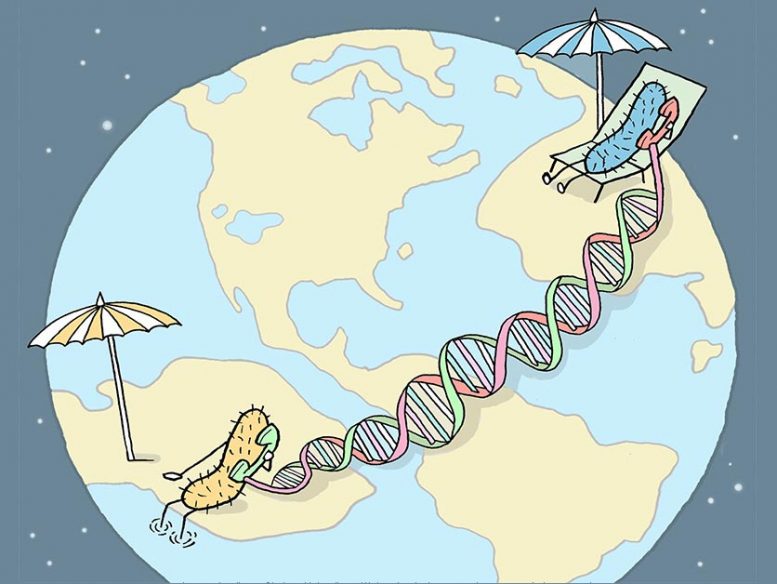
Proteins communicating through the DNA molecule constitute a newly discovered genetic “switch.”
Proteins can communicate through DNA, conducting a long-distance dialogue that serves as a kind of genetic “switch,” according to Weizmann Institute of Science researchers. They found that the binding of proteins to one site of a DNA molecule can physically affect another binding site at a distant location, and that this “peer effect” activates certain genes. This effect had previously been observed in artificial systems, but the Weizmann study is the first to show it takes place in the DNA of living organisms.
A team headed by Dr. Hagen Hofmann of the Chemical and Structural Biology Department made this discovery while studying a peculiar phenomenon in the soil bacteria Bacillus subtilis. A small minority of these bacteria demonstrate a unique skill: an ability to enrich their genomes by taking up bacterial gene segments scattered in the soil around them. This ability depends on a protein called ComK, a transcription factor, which binds to the DNA to activate the genes that make the scavenging possible. However, it was unknown how exactly this activation works.
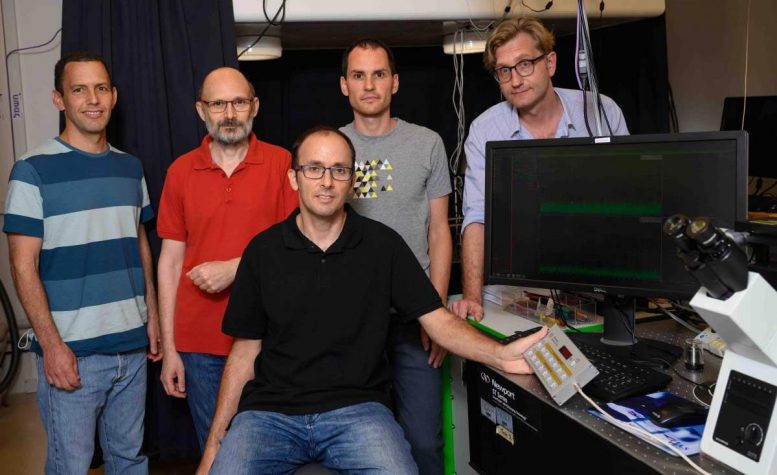
(l-r) Dr. Nadav Elad, Dr. Haim Rozenberg, Dr. Gabriel Rosenblum, Jakub Jungwirth and Dr. Hagen Hofmann. Twisting a rope from one end. Credit: Weizmann Institute of Science
Staff Scientist Dr. Gabriel Rosenblum led this study, in which the researchers explored the bacterial DNA using advanced biophysical tools – single-molecule FRET and cryogenic electron microscopy. In particular, they focused on the two sites on the DNA molecule to which ComK proteins bind.
They found that when two ComK molecules bind to one of the sites, it sets off a signal that facilitates the binding of two additional ComK molecules at the second site. The signal can travel between the sites because physical changes triggered by the original proteins’ binding create tension that is transmitted along the DNA, something like twisting a rope from one end. Once all four molecules are bound to the DNA, a threshold is passed, switching on the bacterium’s gene scavenging ability.
“We were surprised to discover that DNA, in addition to containing the genetic code, acts like a communication cable, transmitting information over a relatively long distance from one protein binding site to another,” Rosenblum says.
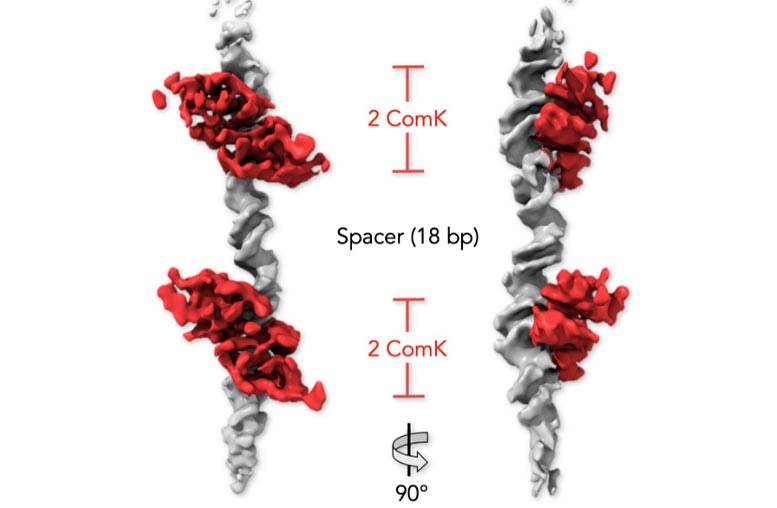
A 3D reconstruction from single particles of bacterial DNA (gray) and ComK proteins (red), imaged by cryogenic electron microscopy, viewed from the front (left) and at a 90 degrees rotation. ComK molecules bound to two sites communicate through the DNA segment between them. Credit: Weizmann Institute of Science
By manipulating the bacterial DNA and monitoring the effects of these manipulations, the scientists clarified the details of the long-distance communication within the DNA. They found that for communication – or cooperation – between two sites to occur, these sites must be located at a particular distance from one another, and they must face the same direction on the DNA helix. Any deviation from these two conditions – for example, increasing the distance – weakened the communication. The sequence of genetic letters running between the two sites was found to have little effect on this communication, whereas a break in the DNA interrupted it completely, providing further evidence that this communication occurs through a physical connection.
Knowing these details may help design molecular switches of desired strengths for a variety of applications. The latter may include genetically engineering bacteria to clean up environmental pollution or synthesizing enzymes to be used as drugs.
“Long-distance communication within a DNA molecule is a new type of regulatory mechanism – one that opens up previously unavailable methods for designing the genetic circuits of the future,” Hofmann says.
Reference: “Allostery through DNA drives phenotype switching” by Gabriel Rosenblum, Nadav Elad, Haim Rozenberg, Felix Wiggers, Jakub Jungwirth and Hagen Hofmann, 20 May 2021, Nature Communications. DOI: 10.1038/s41467-021-23148-2
The research team included Dr. Nadav Elad of Weizmann’s Chemical Research Support Department; Dr. Haim Rozenberg and Dr. Felix Wiggers of the Chemical and Structural Biology Department; and Jakub Jungwirth of the Chemical and Biological Physics Department.
Dr. Hagen Hofmann is the incumbent of the Corinne S. Koshland Career Development Chair in Perpetuity.
😯
Whether looking internally into G-d’s creations or outwardly at His universe, our scientific searches open windows with vistas that beforehand we did not know existed. The science of observing how LIFE works and of observing the universe and its atomic structure is like peeling an infinitely layered onion.
Yet the Darwinists will tell us it is all an accident....................
A Darwinist would argue that natural selection is opportunistic.
No, I’m not a Darwinist. Maybe a Hemidemisemidarwinist. Natural selection is a thing, observable in human timescales. But spontaneous emergence of self-replicating cells from lifeless matter, that’s something else.
This discovery is one of many that is revolutionizing our understanding of biology. The logic of it seems simple in hindsight, that binding proteins at one point on the DNA molecule create mechanical changes to the molecule that make other bindings possible. Unlike the neat pictures of the double helix in textbooks, DNA spends most of its time balled up like yarn. Many epigenetic changes relax or tighten this ball to hide or expose instructions that activate or suppress gene expression. These changes react to environmental, dietary, and even emotional processes in our body. This is another epigenetic mechanism path that is now under investigation.
A very good book on this whole area is “The Secret Language of Cells” by Jon Liefe, MD. All our body cells use chemical and electrical signals to coordinate our growth, healing, and even time of our death during our entire lifetimes. Understanding their messages may lead to eliminating cancer tumors and even replacing organs or limbs lost to disease or accident.
Interesting. Our Lord is quite the programmer. DNA is one of the most information dense things we have ever discovered. It is astounding how much information is encoded, and how it performs its functions.
Is DNA Hardware or Software?.........................
Thank you, for the information. My concern is I do not want anything the pharmaceutical companies or government agencies ‘protein’ wants to say to my cells!
Firmware
Software
Microevolution makes sense to me, but macro does not.
That, of course, doesn’t even touch life from nothing.
## Is DNA Hardware or Software?.........................
I’d say it’s software. The chemical and physical laws of the universe itself is the hardware.
## Firmware
An interesting answer.
In before “this can’t be true because the photo shows five (5) white men”.
Thnx
It wasn’t a jest.
# It wasn’t a jest.
I figured as much. That’s why I said it was an interesting answer. I could easily make a case for it.
Disclaimer: Opinions posted on Free Republic are those of the individual posters and do not necessarily represent the opinion of Free Republic or its management. All materials posted herein are protected by copyright law and the exemption for fair use of copyrighted works.