Posted on 08/06/2021 4:26:02 PM PDT by MtnClimber
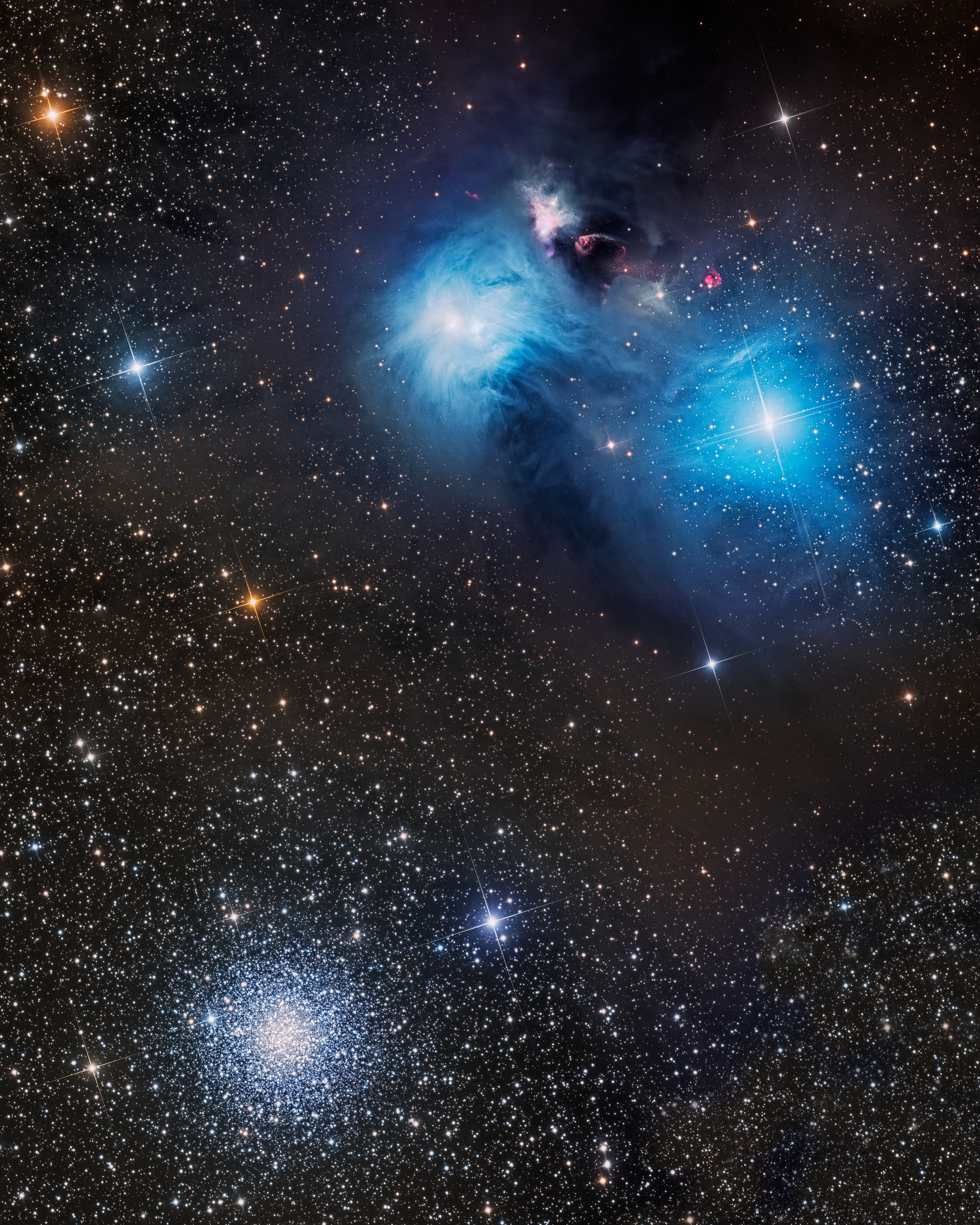
Explanation: Cosmic dust clouds cross a rich field of stars in this telescopic vista near the northern boundary of Corona Australis, the Southern Crown. Less than 500 light-years away the dust clouds effectively block light from more distant background stars in the Milky Way. Top to bottom the frame spans about 2 degrees or over 15 light-years at the clouds' estimated distance. At top right is a group of lovely reflection nebulae cataloged as NGC 6726, 6727, 6729, and IC 4812. A characteristic blue color is produced as light from hot stars is reflected by the cosmic dust. The dust also obscures from view stars in the region still in the process of formation. Just above the bluish reflection nebulae a smaller NGC 6729 surrounds young variable star R Coronae Australis. To its right are telltale reddish arcs and loops identified as Herbig Haro objects associated with energetic newborn stars. Magnificent globular star cluster NGC 6723 is at bottom left in the frame. Though NGC 6723 appears to be part of the group, its ancient stars actually lie nearly 30,000 light-years away, far beyond the young stars of the Corona Australis dust clouds.
For more detail go to the link and click on the image for a high definition image. You can then move the magnifying glass cursor then click to zoom in and click again to zoom out. When zoomed in you can scan by moving the side bars on the bottom and right side of the image.
aaaaaaaaand... ...another fake...
aloud. A fine phone background
Fake??!!??
The baby chest-burster from “Alien” is about 1/3 down from the top!
These astrophotos aren’t fake, but they are greatly enhanced by using sophisticated software. We wouldn’t be able to study, to appreciate what is out there without doing this.
Real science is done by studying photos taken in this manner.
PLUS, they are beautiful to look at. There is a certain amount of manipulation of the photo using the software that brings out the detail.
One of my more favorite parts of the sky! The globular is quite spectacular, and, the gas cloud, while not quite like that, is still interesting to study.
Only issue, the picture is upside down. The Globular should be at the top of the picture and the gas cloud should stretch off to the left.
Other than being upside down, it hasn’t been processed that much. The colors are the most striking. In my scope the globular is quite nice, but, the gas is standard telescope gray green.
Or, take your freaking complaint to NASA since its a post linked from their site. MtnClimber, the Free Republic poster is simply passing on what NASA posts!
What, is MtnClimber supposed to learn what sit-erp and each of a half a dozen other complainers regard as "real photos" and screen NASAs choices for their markers of fakeness then exclude them from his post and then search the internet to find you suitable alternatives? Freaking utterly selfish! Go do it yourself!
Mtn Climber, thanks! Ignore these "Waah! its Fake! luddites! Please post APOD exactly as NASA Presents it.
Disclaimer: Opinions posted on Free Republic are those of the individual posters and do not necessarily represent the opinion of Free Republic or its management. All materials posted herein are protected by copyright law and the exemption for fair use of copyrighted works.