Posted on 07/02/2021 11:11:39 AM PDT by Red Badger
Gravitational wave astronomy has just given us another amazing gift: the first observational confirmation of one of Stephen Hawking's predictions about black holes.
An analysis of the very first gravitational wave detection made back in 2015, GW150914, has confirmed Hawking's area theorem. It states that, under classical physics, the area of the event horizon of a black hole can only grow larger - never smaller.
The work gives us a new tool for probing these mysterious objects, and testing the limits of our understanding of the Universe.
"It is possible that there's a zoo of different compact objects, and while some of them are the black holes that follow Einstein and Hawking's laws, others may be slightly different beasts," said astrophysicist Maximiliano Isi of MIT's Kavli Institute for Astrophysics and Space Research.
"So, it's not like you do this test once and it's over. You do this once, and it's the beginning."
Hawking first proposed his theorem back in 1971. It predicted that the surface area of the event horizon of a black hole should never decrease, but only increase.
The event horizon is not the black hole itself, but the radius at which even light speed in a vacuum is insufficient to achieve escape velocity from the gravitational field generated by the black hole singularity. It's proportional to the mass of the black hole; since black holes can only gain mass, under general relativity, the event horizon should only be able to grow.
(This increase-only model is also curiously similar to another theory, the second law of thermodynamics. It states that entropy - the progression from order to disorder in the Universe - can only increase. Black holes also have entropy ascribed to them, and it's directly proportional to their event horizon surface area.)
Mathematically, the area theorem checks out, but it's been observationally difficult to confirm - mainly because black holes are extremely difficult to observe directly, since they emit no detectable radiation. But then, we detected the gravitational ripples propagating through space-time of a collision between two of these enigmatic objects.
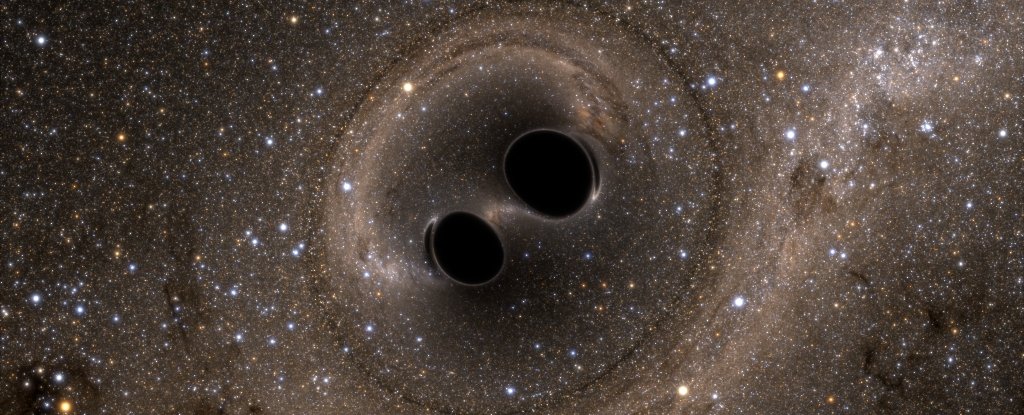
This was GW150914, and the brief bloop of the collision recorded by the LIGO interferometer changed everything. It was the first direct detection of not one black hole, but two. They came together and formed one larger black hole.
This black hole then faintly rung, like a struck bell. In 2019, Isi and his colleagues worked out how to detect the signal of this ringdown. Now they've decoded it, breaking it down to calculate the mass and spin of the final black hole.
They also performed a new analysis of the merger signal to calculate the mass and spin of the two pre-merger black holes. Since mass and spin are related to the area of the event horizon, this allowed them to calculate the event horizons of all three objects.
If the event horizon could shrink in size, then the event horizon of the final merged black hole should be smaller than those of the two black holes that created it. According to their calculations, the two smaller black holes had a total event horizon area of 235,000 square kilometers (91,000 square miles). The final black hole had an area of 367,000 square kilometers.
"The data show with overwhelming confidence that the horizon area increased after the merger, and that the area law is satisfied with very high probability," Isi said.
"It was a relief that our result does agree with the paradigm that we expect, and does confirm our understanding of these complicated black hole mergers."
At least in the short term. Under quantum mechanics - which does not play nicely with classical physics - Hawking later predicted that, over very long timescales, black holes should lose mass in the form of a type of black-body radiation we now call Hawking radiation. So it's still possible that the event horizon of a black hole could decrease in area, eventually.
That will obviously need to be examined more closely in the future. In the meantime, the work of Isi and his team have given us a new toolset for probing other gravitational wave observations, in the hope of gaining even more insights into black holes and the physics of the Universe.
"It's encouraging that we can think in new, creative ways about gravitational-wave data, and reach questions we thought we couldn't before," Isi said.
"We can keep teasing out pieces of information that speak directly to the pillars of what we think we understand. One day, this data may reveal something we didn't expect."
The research has been published in Physical Review Letters.
“(This increase-only model is also curiously similar to another theory, the second law of thermodynamics. It states that entropy - the progression from order to disorder in the Universe - can only increase. Black holes also have entropy ascribed to them, and it’s directly proportional to their event horizon surface area.)”
Black holes are not the Universe. Entropy can obviously decrease locally and temporarily, if energy pours into it. Consider the Earth and life on it.
Beyond that, I wonder what would happen to a positively charged black hole, if you started pouring electrons into it. Would the event horizon still grow?
what about Hawking radiation?
If a black hole didn’t receive anything new, but emitted Hawking radiation, then it would eventually shrink in mass and the event horizon would shrink.
Unless Hawking radiation is only emitted when the black hole is feeding and is always less than the amount of food.
I hate getting sucked into a black hole. Crossing that event horizon seems to take forever.
If Marianne Williamson astrally projects into a black hole will she be able to come back?
Never heard of her........................
The addition of electrons (which have a negative charge) to a positively-charged Black Hole would merely result in a gradual neutralization of the Black Hole's positive charge, while its total mass (and thus the area of its event horizon) would increase.
It has been established that a Black Hole can have only three different measurable (by an outside observer) properties: mass (measured by its gravitational field and size of event horizon); spin (measured by its oblateness); and electrical charge (which could be measured by bringing another charged body near it and measuring the repulsion / attraction).
But is there a limit to the amount of charge that a Black Hole could accumulate? Would the "internal pressure" that would build up if one were to continually add, say, only protons eventually elicit any unusual effect measurable by outside observers?
That's what I'd like to know.
Regards,
The article discusses Hawking Radiation and explains that, in the long term, and if the Black Hole did not absorb any new matter, it would slowly decrease in mass, while its Event Horizon would correspondingly decrease in area.
Though I don't understand why the author felt it pertinent to distinguish between long-term and short-term increases in entropy.
Regards,
Only to your friends on the outside, who are observing you being sucked in.
For who, who is being sucked in, the subjective amount of time would not be all that long - perhaps a few days or weeks, in the case of a solar system-sized Black Hole.
But for you, looking out - you'd see the Universe age trillions of years in what seemed to you mere weeks.
Regards,
I’d like to know, too.
What I was alluding to in that thought experiment was that the electrical repulsive force in the positively charged black hole could be significant compared to the gravitational force. I would think that would enlarge the event horizon, at least for some outside positively charged particle that happened to stray nearby. Electrons would neutralize that black hole, but increase its mass relatively modestly, making me think that would tend to shrink the event horizon.
But I’m not a cosmologist. I think of “event horizon” as “point of no return”. Maybe that’s wrong, or maybe I’m missing something.
“Beyond that, I wonder what would happen to a positively charged black hole, if you started pouring electrons into it. Would the event horizon still grow?”
It should since it’s proportional to the mass and by adding electrons you’re increasing the mass.
I’m surprised the term “black hole” is still allowed to be used.
Example: California’s power grid.
At this point, I’ll resort to argumentum ad verecundiam, based on an article that I just read:
“Together, the black hole’s mass and charge determine its size — the radius of the event horizon.”
There’s also some other interesting discussion about shrinking, charged black holes.
Summary: You are wondering whether the Black Hole's electrical charge (apart from the mass of those charged particles) might somehow contribute to the area of its Event Horizon, right?
Don't think so.
But in my thought experiment, a spaceship is given a significant electrical charge, and then carefully guided towards a Black Hole with a like charge until it is effectively "floating" almost motionlessly just over the Event Horizon. The spaceship could then rid itself (in a controlled fashion) of some of its electrical charge, and thus sink slowly towards the Event Horizon, and perhaps partially immerse into it. The spaceship could then dispose of some of the opposite charge (by jettisoning opposite-charged particles), thus increasing the repulsive force. QUESTION: Could this be used to essentially "re-emerge" from the Event Horizon? The beauty of this hypothetical method is that it wouldn't require incredible expenditures of energy (rocket fuel) and/or high speeds in order to "play around" in the immediate vicinity of the Event Horizon.
Regards,
In other words: Not only mass, but also charge "bends" space - Is that what you are saying?
But would positively-charged particles "warp" space in a different direction than negatively-charged particles? They'd have to, wouldn't they!
Regards,
You might enjoy the article that I just referenced above.
I like your thought experiment. You’ll have to work out some way for the spaceship not to be torn apart by tidal forces. Maybe if the black hole were particularly huge, or if the craft were particularly devious in its design.
Disclaimer: Opinions posted on Free Republic are those of the individual posters and do not necessarily represent the opinion of Free Republic or its management. All materials posted herein are protected by copyright law and the exemption for fair use of copyrighted works.
