Posted on 06/22/2021 7:55:33 AM PDT by Red Badger
Heavy-duty trucks, or semi-trucks with a gross vehicle weight greater than 26,000 pounds, are responsible for around 15% of total U.S. transportation energy use and greenhouse gas emissions. Electrifying these vehicles would be a significant step toward transportation decarbonization in the United States. However, the opportunity for battery electric vehicles (BEVs) in heavy-duty trucking is highly debated due to concerns about vehicle range, charging requirements, and battery weights.
Researchers from the National Renewable Energy Laboratory (NREL), in collaboration with two electric utilities, recently studied a promising opportunity for near-term electrification within this segment through depot charging. This research, which examines multiple short-haul trucking operations, is detailed in a recent Nature Energy article. The team also explored the impact of these vehicles on the grid, showing that in most cases the existing technology can accommodate truck charging at depots.
"For years, the trucking industry has been skeptical of heavy-duty electric vehicles," said NREL's Brennan Borlaug, a research analyst and lead author of the study. "That perception is shifting, and our research suggests that certain short-haul operations can be electrified today with relatively low-power depot charging that won't overwhelm the grid."
Short-Haul Trucks Represent Significant Share of the Total Truck Population
While most people picture semi-trucks carrying heavy loads over long highways, data collected by the U.S. Census Bureau suggests that nearly 80% of heavy-duty trucks operate primarily within a 200-mile range. These trucks account for around 50% of total heavy-duty vehicle energy use and are typically responsible for distributing goods between warehouses and nearby retail establishments. As a result, the vehicles are often characterized by short, predictable routes and off-shift periods at central locations such as a vehicle depot, making them prime candidates for electrification. Ideally, fleets could perform all charging at their depots, where it is convenient, inexpensive, and fully controllable.
Commercial heavy-duty trucking operations are motivated to reduce operating costs. A 2020 BloombergNEF report shows that fuel costs for trucks make up more than half their total cost of ownership. The switch to BEV fleets would offer a significant reduction in fuel costs and require less routine maintenance, another key advantage for fleets.
Simulating EV Charging for Real-World Fleet Operations
NREL researchers leveraged real-world operating data from NREL's Fleet DNA clearinghouse to simulate EV charging at fleet depots and made the charging loads results publicly available for other researchers to use. The Fleet DNA tool offers composite data summaries and visualizations for real-world medium- and heavy-duty fleet operations, useful for understanding the operating range of commercial vehicles across vocations and weight classes. NREL researchers simulated multiple charging strategies, including "smart" charging, where BEVs take full advantage of the time spent parked at the depot to charge at slower rates and reduce peak energy demand. This study shows that charging requirements could be met at power levels in line with current light-duty charging technology (≤100 kW/vehicle) for the fleets studied.
Integrating Heavy-Duty EV Charging on the Grid
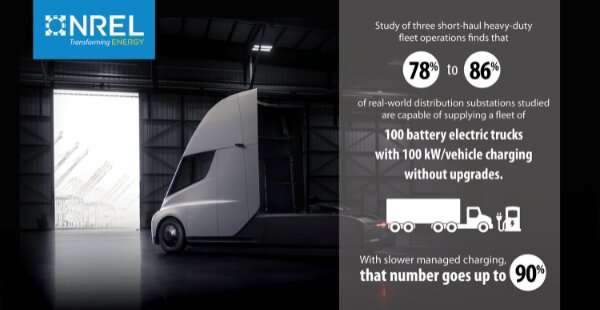
A final focus of the research was to assess whether today's electricity distribution grid could adequately support heavy-duty depot charging. NREL collaborated with two utilities—Southern Company and Texas-based Oncor Electric Delivery Company—to perform a load integration study for 36 substations and summarize the costs and timelines required for anticipated grid upgrades. The team found that most (~80%) of the substations studied could supply the time-varying loads of 100 trucks charged at 100 kW/vehicle without any upgrades, and an additional 10% of substations could avoid upgrades if fleets used "smart" charging.
"This research is unique in that it paints a more complete picture of what it would look like to electrify these fleets," said David Woody, a senior manager in Distribution Planning with Oncor and a coauthor of the study. "As technologies that enable heavy-duty fleet electrification become available, studies like this can help anticipate and prepare for the effects of this transition. Customer engagement with utilities to review load profiles, current and future business and operational needs, and deployment timelines will be key in the transition to electrification."
Moving forward, NREL researchers are interested in studying how other commercial vehicle operating segments—such as last-mile delivery vans or long-haul trucking—may be electrified and integrated with the evolving grid.
Explore further
Commercial truck electrification is within reach
More information: Brennan Borlaug et al, Heavy-duty truck electrification and the impacts of depot charging on electricity distribution systems, Nature Energy (2021). DOI: 10.1038/s41560-021-00855-0
Journal information: Nature Energy
Provided by National Renewable Energy Laboratory
Of course they're numbered. The question is how many digits are used to number them.
Tesla debuted their Tesla Semi in 2017. Have you seen it on the road yet?
BS
Why are you saying “DC” fast charging? Is there some other kind of battery charging technology? Or do you just mean to say that “fast” charging is damaging to a battery?
They are still charging the battery.....................
Disclaimer: Opinions posted on Free Republic are those of the individual posters and do not necessarily represent the opinion of Free Republic or its management. All materials posted herein are protected by copyright law and the exemption for fair use of copyrighted works.