Posted on 06/09/2021 12:29:28 PM PDT by Red Badger
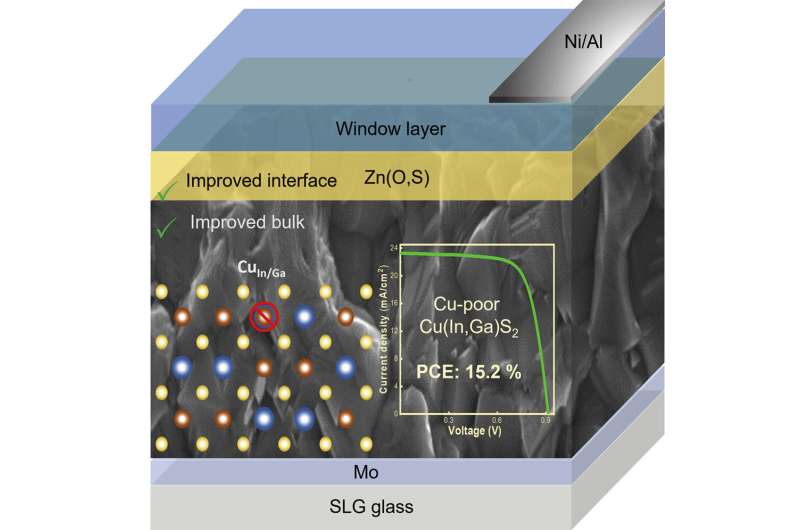
Graphical abstract. Credit: https://doi.org/10.1016/j.joule.2021.05.004
A solar cell developed by physicists from the University of Luxembourg and Uppsala University has recently been certified with an efficiency of 14%, which comes close to the world record of 15.5%. These new findings have been recently accepted for publication in the international journal of energy research Joule.
Solar cells technology has seen significant progress over the last decades, putting solar cells among the lowest cost sources of electricity in central Europe. Solar cells have fundamental physical limitations, and they can never be 100% efficient.
Promising new technologies
Materials for solar cells are always a compromise between losing less light and losing less of the energy. This balance can be improved considerably by using two different materials and making a tandem solar cell—solar cells which combine two individual cells and make better use of the solar spectrum. Their efficiency can be larger than 30%. Current solar cells technologies that are based on a single solar cell are limited to efficiencies below this value. Cu(In,Ga)S2 is a semiconductor material composed of the elements copper, indium, gallium and sulfur, that is used in tandem solar cells.
Sudhanshu Shukla and Mohit Sood from the Department of Physics and Materials Science (DPhyMS) at the University of Luxembourg have investigated the loss mechanisms in Cu(In,Ga)S2 solar cells and improved the material quality. In an effort to also improve the contact materials, they teamed up with Tobias Törndahl of the Uppsala University who has many years of experience with contact materials. The result of this collaboration was a solar cell with a 14% efficiency, which can be considered to be only the beginning of further developments.
The 14% solar cell has been certified by the calibration laboratory at the Fraunhofer Institute for Solar Energy Systems.
"When we develop solar cells in our laboratory, we measure their efficiency under well-defined conditions. However, there can always be small fluctuations between different labs. Therefore, a few labs around the world have specialized in the certification of solar cell efficiencies. Their results are truly comparable and are therefore the only ones that are accepted for any claims of record efficiencies," explains Prof. Susanne Siebentritt, head of the laboratory for photovoltaics at the University of Luxembourg.
Explore further
Scientists develop transparent electrode that boosts solar cell efficiency
More information:
Sudhanshu Shukla et al, Over 15% efficient wide-band-gap Cu(In,Ga)S2 solar cell: Suppressing bulk and interface recombination through composition engineering, Joule (2021). DOI: 10.1016/j.joule.2021.05.004
Journal information: Joule
Now, we're celebrating 50 years of failure?
14% efficiency. That sounds like 86% of materials and promised capability (or promotional hype) is 1. Wasted; 2. Fraudulent on it being a useable source of electricity.
Yes, and the libs want us to use SOLAR and Wind to replace nuclear, Natgas and coal................
To be fair. They only want us to use renewables. They elites will still find a way to provide reliable yet dirty energy for their vehicles homes and airplanes
in other words - burning fossil fuels is still dramatically more efficient... nice
Dr. Roger Burke
Who?
I think that’s where we are headed.
Only government officials will be privy to many of things we now take for granted.
Possibly even large swaths of the internet.
Whereas we will be limited what we can do online.
Rd later.
That is actually really good.
And a great example of why solar as main generating capacity is a long ways away.
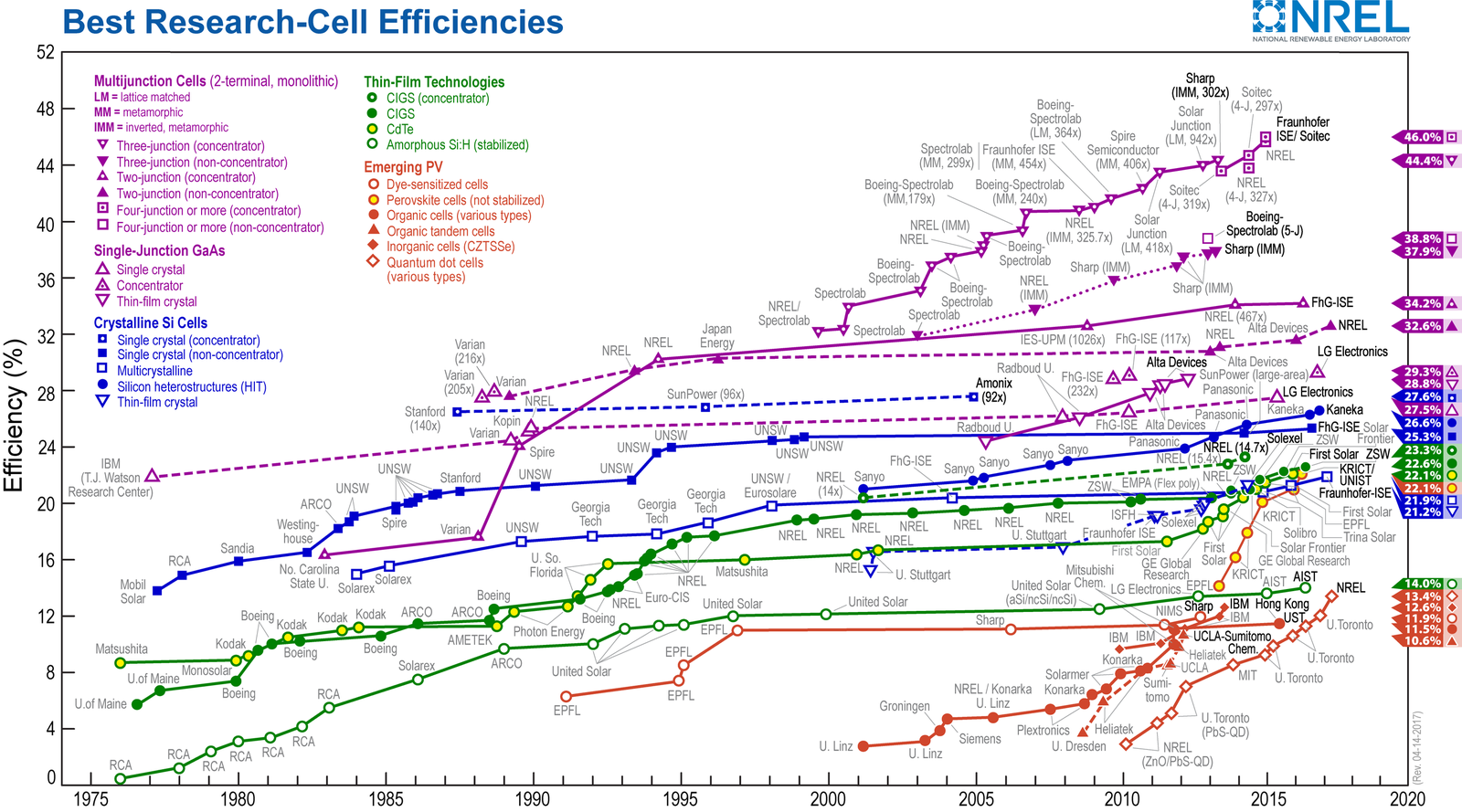
It must be a pretty small cell to get only 33% of a person into it. ;)
The only problem is that you can't just get a hunk of silicon, you have to actually fabricate circuits.
But still, Intel pumps out billions or trillions of circuits every year so why aren't we doing more work in that area?
0% Efficiency at night, makes for about a 7% efficiency total.
I guess I’m supposed to be impressed.
But not really.
Eco power simply cannot meet the demand.
Even if you want to say all non-fossil can support 20% of the grid, that’d mean, without fossil fuels, you would effectively have no power for 24 days of every month.
That means no power anywhere, not just your home.
Nothingburger! Solar cells are failure, they will never deliver any real power, they rarely return even power needed to make them!
In this particular case, the cell contains Indium (In). The problem - indium is very rare! It is not too expensive, because there is little use for it, but the moment they would need a lot of it, the price would invariably skyrocket!
Basically useless discovery.
Last I knew he was retired and living in a Utah ski resort.
From marsjournal.org
Roger D. Bourke
Aerospace Consultant Alta, Utah and La Cañada, California
Areas of Expertise: Planetary mission analysis and design, program planning
Roger Bourke spent the majority of his professional life at the Jet Propulsion Laboratory engaged in various aspects of planetary exploration. He participated in and later led mission planning activities for Mariner Mars 1971, Mariner Venus-Mercury 1973, early phases of Viking, Voyager and the series of Mars missions beginning in the 1990's. In the 1980's, he worked as the mission design and operations manager of the then-Mars Rover Sample Return pre-project and subsequently represented the robotic exploration element in various NASA Mars initiatives. Prior to his retirement from JPL in 2000, he was responsible for coordinating the international connections in the worldwide efforts to explore the Red Planet. NASA awarded him an Exceptional Service Medal and he has been elected to the International Academy of Astronautics. He is now a part-time consultant and full-time skier. Recent publications: W. Huntress, D. Stetson, R. Farquhar, J. Zimmerman, B. Clark, W. O'Neil, R. Bourke, and B. Foing, The next steps in exploring deep space-A cosmic study by the IAA. Acta Astronautica, Vol 58, Issues 6-7, March-April 2006, p302-377.
Disclaimer: Opinions posted on Free Republic are those of the individual posters and do not necessarily represent the opinion of Free Republic or its management. All materials posted herein are protected by copyright law and the exemption for fair use of copyrighted works.