Posted on 05/26/2021 8:44:15 AM PDT by Red Badger
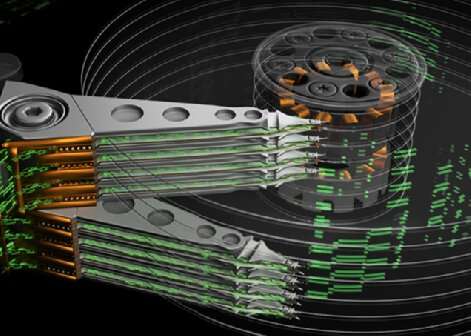
Seagate Mach.2 drive. Credit: Seagate
Seagate has been working toward developing a dual-actuator hard drive, meaning that the drive will contain two sets of independently controlled read/write heads. Now, after several years, the company has released its first functional dual-actuator hard drive, the Mach.2. Currently, only enterprises can purchase and use this product, meaning that at least for now, end users will have to wait their turn.
So far, Seagate has reported the Mach.2's sequential, sustained transfer rate as up to 524MBps—over double the rate of a fast but generic rust disk, closer to the capacity seen in SATA SSD. In fact, this increased transfer rate carries over into input/output as well, featuring 304 IOPS read / 384 IOPS write and only 4.16 ms average latency. By contrast, normal hard drives usually run at 100/150 IOPS with about the same average latency.
Of course, all of that extra capacity requires additional power. Even while idle, the Mach.2 runs at 7.2 W, while Seagate's standard Ironwolf line runs at 5 W while idle. That said, it is a bit easier to measure the power specs of Mach.2 than Ironwolf, as the former's power use can be determined using several random input/output scenarios, as opposed to Ironwolf, whose power is gauged from its "average operating power," a metric undefined by the Seagate data sheet reference.
VIDEO AT LINK....................
Nonetheless, Mach.2 has still been assessed to contain about 200 percent of the operating power of generic hard drives at about 144 percent of the power budget. Moreover, users wanting to conserve even more power can utilize the new product's PowerBalance mode. Despite this advantage, however, such users should be aware that the PowerBalance mode feature decreases sequential performance by 50 percent and random performance by 10 percent.
Explore further
Samsung Electronics doubling current smartphone storage speed More information: MACH.2: Seagate: www.seagate.com/our-story/introducing-mach2/
Fast Pingy!...................
This unit's claim to fame is the throughput approaching those of SSDs, with vastly higher storage densities.
These drives are for data centers, not your home machine.
You are right, they are probably targeting data centers. However:
“Even while idle, the Mach.2 runs at 7.2 W”
The size, generated heat and power consumption are big negatives regarding data centers. SSDs draw practically no power while idle and ~3 W during R/W. Longevity is about even, and the cost difference is closing in.
One of the oldest hard drive techs is to have a read/write head for each track. This would allow a great reduction in moving parts ... and not even Lois Lerner could crash one because the heads do not move.
These were commonly used when platter rotation rates and data density were both utterly anemic (these combined to yield doubly anemic data transfer rates in conventional designs) but they still managed decent performance, especially for the day.
Now that we’ve got thin film construction down to such a high degree I’m wondering why the technology isn’t revamped and doesn’t make a comeback?
The data transfer rates and seek times would be astounding. They would be quieter and more reliable, having fewer moving parts, especially since they would lack the moving part that causes crashes. Might also consume less power.
Hi-Tech buggy whip.
If you just want a fast drive, nothing beats an SSD.
~~~
That’s what I was going to say.
Why invest all this energy (no pun intended) in a dual acting drive that uses more electricity, creates more heat, and is more prone to long term (mechanical) failure than an SSD?
Until you get to 2 to, then the cost difference is pretty huge
Do you know how many tracks are on a modern disk platter? And can you see the difficulties of having a head-per-track on both sides?
I used to have a cassette player that ran my Commodore VIC-20.
Why have moving discs at all?.........................
If placed in a line for each track as in the old days the problem would be insurmountable.
But it could be ameliorated by placing them in a staggered spiral formation with multiple offset spirals scattered around the fixed head to catch different groups of tracks ... which would be working with the strengths of thin film construction rather than ignoring them.
As for the manufacturing costs those have been at least partly addressed by the tech and physical plants already developed by which we now produce these huge TVs with. Make lots of heads at once and then cut them up to test and then mount in a drive.
I would think that by now ALL HDs would be SS....................
I cheated before I posted by reading this related PC Gamer article that said:
As the 14TB capacity might have hinted at, the new hard drive is aimed squarely at the datacentre crowd and certainly isn't something you can just pop into Micro Center and pick up on a whim. But hey, it's still the fastest hard drive in the world and that's got to count for something, right?It also won't plug into most of our gaming PCs as it relies on the SAS 12Gbps interface rather than the standard SATA 6Gbps you'll find on most motherboards. But Seagate's promised 524MB/s maximum sustained transfer rate is mighty close to the 550MB/s speeds of SATA SSDs you can plumb into your gaming board.
When we have to spec out a system to run things on at an enterprise level (such as a system to display Radiology images) we now require the exclusion of spinning media except as a secondary or tertiary tier of storage.
Only SSD stuff for us. And we aren’t the only ones.
Exactly.
Storage density. 14TB HDD vs a 1TB SSD per drive. That becomes important when you're creating exabytes of storage in a RAID array.
And when calculating power usage, you must calculate power per TB of storage, not just power per drive.
Also, when used in a data center, the drives are rarely idle so idle power usage is not very important.
I remember a job I had at Pfizer Medical Systems, Columbia MD, back in 1980. We made Cat Scan machines.
The computer was a PDP-11.
The storage system was a 20 MEGABYTE disc the size of an LP.......................
Disclaimer: Opinions posted on Free Republic are those of the individual posters and do not necessarily represent the opinion of Free Republic or its management. All materials posted herein are protected by copyright law and the exemption for fair use of copyrighted works.