Posted on 05/20/2021 8:28:54 AM PDT by Red Badger
Screening for colorectal cancer—the second most common cause of cancer-related death in the United States—can save lives by detecting both pre-cancerous lesions that can be removed during the screening procedure, and colorectal cancer in its early stages, when it is highly curable.
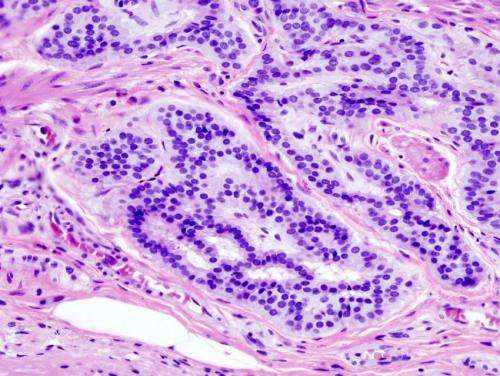
Cancer — Histopathologic image of colonic carcinoid. Credit: Wikipedia/CC BY-SA 3.0
_________________________________________________________________________________________
Screening is most commonly performed with endoscopy: visualization of the entire colon and rectum using a long flexible optical tube (colonoscopy), or of the lower part of the colon and rectum with a shorter flexible tube (sigmoidoscopy).
This week, the United States Preventive Services Task Force (USPSTF) lowered the recommended beginning age for screening from 50 to 45 for persons without a family history of colorectal cancer. However, its recommendation to continue periodically until age 75, after which the decision to undergo screening can be based on an individual's health and risk factors, remains unchanged.
Yet there has been very little hard evidence to support or contradict the recommendation to stop routine screening at age 75—until now. As researchers from Massachusetts General Hospital (MGH) report in JAMA Oncology, screening endoscopy for persons older than 75 in otherwise good health can reduce the risk of colorectal cancer incidence and cancer-related death by approximately 40%.
The researchers also found, however, that screening did not provide a significant survival benefit for individuals older than 75 with cardiovascular disease, diabetes or three or more other health conditions.
"Until now, there really weren't clear data to help us decide whether patients should be screened after age 75," says co-investigator Andrew T. Chan. MD, MPH, a gastroenterologist and chief of the Clinical and Translational Epidemiology Unit at MGH. "Current guidance was largely based on modeling and extrapolation of studies conducted in other age groups, and not on solid data to show whether screening was actually helpful in an older population."
To answer this important question, Chan and colleagues looked at data on the incidence of colorectal cancer and colorectal cancer-related deaths among participants in two large U.S. health studies: the Nurses' Health Study and the Health Professionals Follow-up Study. In both, participants fill out biannual questionnaires on demographics, lifestyle factors, screening, medical history and disease outcomes.
For the current study, the investigators examined data on participants who were followed from 1988 through 2016, focusing on the history of screening sigmoidoscopy or colonoscopy in 56,374 who reached 75 years of age during study follow-up.
The researchers identified 661 cases of colorectal cancer and 323 colorectal cancer-related deaths after age 75.
They found that screening after age 75 was associated with a 39% decrease in colorectal cancer incidence and a 40% decrease in risk of death related to colorectal cancer, regardless of whether participants had been screened before age 75.
Among participants who had undergone screening before 75 years of age, screening after age 75 was associated with a 33% reduction in colorectal cancer incidence and a 42% decrease in colorectal cancer-related death compared with those who were not screened after reaching 75.
Similarly, for participants who were screened for the first time only after age 75, the respective declines in incidence and death were 49% and 37% compared with those who were never screened.
In contrast, participants with cardiovascular disease or multiple co-morbidities did not benefit from screening after 75.
"These are the first empirical data that really demonstrate that there is value in continuing screening past age 75 for many individuals. But the key take-home message is that screening should be tailored according to individual risk factors," says Chan.
Explore further
Study finds disparities in colorectal cancer screenings
More information: JAMA Oncology (2021). DOI: 10.1001/jamaoncol.2021.1364
Journal information: JAMA Oncology
Provided by Massachusetts General Hospital
Endoscopy can also harm or kill you. Not directly, but because first you need to take a course of very strong spectrum antibiotics, like Cipro (Ciprofloxacin). The harm caused can take months to appear, for example with strokes; or it may cause severe harm in the short term with antibiotic resistant bacteria.
Severe side effects include an increased risk of tendon rupture, hallucinations, and nerve damage.
The Ass Doctor approves.
Had to go in for my first one. They screwed up and couldn’t finish. That will be the last one I ever get.
They screwed up? How? It’s a simple procedure.
I’ve had two colonoscopy procedures.................
I’m 66 and due for my 3rd on soon..............
I'm scheduled for a gastroscopy and colonoscopy on June 24th. I'm lucky that my doctor will do both at the same time, as he only gets paid for one procedure.
Uh, BREAKING!!!! The death rate world wide remains at 100% despite the UN and WHO’s best efforts. Everybody is gonna go sooner or later. :-}
My doctor usually does my gastroscopy and colonoscopy together. Never had any burning problem with the Propofol, but I have woken up a couple of times during the colonoscopy procedure. Last time I woke up, I said “He must be taking the scenic route.” The anesthesiologist leaned over and said: “Pardon me?” I repeated my earlier comment, and then fell back asleep.
I had a friend and c-worker that died of colon cancer at 39....................
75 has become the magical age for the death panels.
Some people have other issues like diverticulitis that need to be scoped. I followed my diet strictly for years, yet ended up in 2010 with a perforated bowel. Needed an emergency colostomy, that they reversed three months later. It wasn't a pleasant experience, and I wouldn't wish it on my worst enemy.
Well, okay...maybe I'd wish it on Nancy Pelosi.
It takes 10 yrs for polyp to become cancerous. I had 3 non cancerous removed.
On your butt?
A lot of false positives with that test.
My friend's husband has a twin sister. They have had a high rate of cancer in their family. They're both in their 70's like me. They both had the BRCA gene test done years ago. The sister was told by the doctor, that it wasn't a matter of if she got cancer, it was a matter of when. My friend's husband tested negative. The sister had a hysterectomy, and had her breasts removed. She's been cancer-free. Five years ago, my friend's husband was diagnosed with a rare cancer of the larynx and pharynx, and underwent radiation and chemo treatments. He's made it five years being cancer free.
The cancer he contracted is common in mostly southern China. The only foreign place he ever traveled to was Pakistan when he was in the Air Force in the 60's. Because of the radiation treatments he underwent to that part of his body, his salivary glands no longer produce spit. He has to be very careful when he eats anything.
Well, if a false positive you’d need the full colonoscopy anyway. What I see with healthy people who have no intestinal issues they start with the most invasive looking not just for cancers, polyps etc.
A cologuard test comes up no cancer there’s no need for further invasive issues. A colonoscopy is expensive sans the right insurance unless you can just for out a few grand to get a clean bill of health when cologuard runs a few hundred dollars.
Just got a colonoscopy this morning...my first one. The procedure is nothing (took less than a half hour) but the prep is a pain! Did the colonguard last year but the colonoscopy is still recommended as the colon guard is not designed to catch everything. Hoping they can come up with a better way to catch colon cancer early before my next one.
I wish I had a dollar for every colonoscopy, and gastroscopy I've had in my life. I'd be rich. I've been going to my Gastroenterologist for 24 years. The last time I was on the table, I told him he really needs to get some kind of Rewards Program for his long-time patients. Even a free-night in a hotel would suffice.
I get that. I’ll use me as an example. Never had an issue with intestines. I get the cheapo colguard and will get the full colonoscopy if the test finds a cancer.
For those as you state that have issues a colonoscopy is a very wise choice.
As for Pelosi she can go drink magnesium citrate and habaneros and have fun. That lady is one evil woman.
That's terrible. Way too young to die. My doctor said they've started screening younger people for colon cancer, because it's becoming more prevalent.
Disclaimer: Opinions posted on Free Republic are those of the individual posters and do not necessarily represent the opinion of Free Republic or its management. All materials posted herein are protected by copyright law and the exemption for fair use of copyrighted works.